
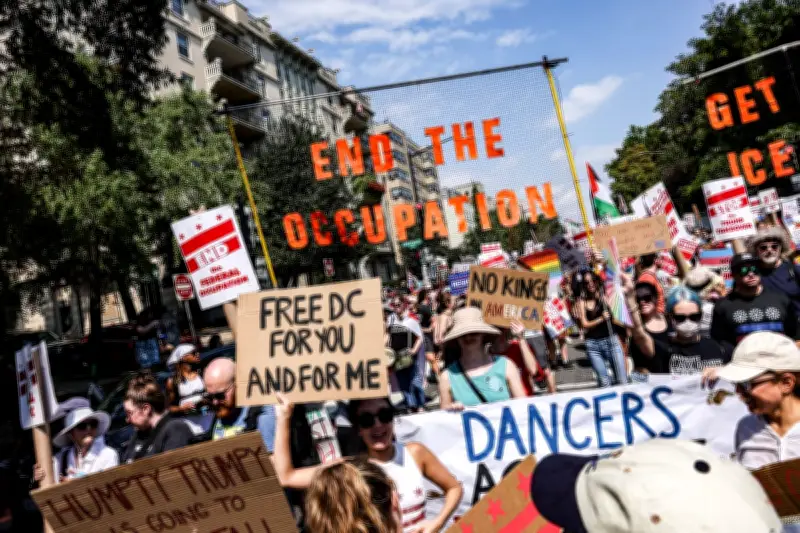
Every night as dusk settles in Lincoln Park, the sound of spoons and ladles banging metal pots and pans fills the air for five minutes straight, followed by the chant 'We'll be back.' This nightly ritual, known as a cacerolazo, dates back to the 1830s and has been a form of resistance in Washington DC for nearly a year, since President Donald Trump deployed thousands of national guard troops to the city.
Residents Protest Daily
'As long as they're going to be here, I'm going to be here,' said Chris Salm, a resident in the area. 'We need to show some resistance to what's happening to our city.' Their protests are some of the few in a city that has become uncomfortably accustomed to troops in camouflage fatigues and gun holsters patrolling neighborhoods as part of a presidential executive order declaring a crime emergency last August. That order was recently extended through January 2029.
Many DC residents believe the deployment hasn't helped the city and has made some situations more unsafe. New research supports their concerns. 'It's a city under siege,' said Mike Licht, a 40-year resident. 'Armed troops aimlessly walking our streets, they've got nothing to do, they're bored.'
Limited Local Control
Roughly 2,000-2,500 national guard troops have been patrolling metro stations, parks, city streets, and tourist attractions. In July, that number doubled to more than 5,000 troops from over a dozen states as part of the federal government's 'summer surge' for the nation's 250th birthday celebration. District officials push for withdrawal but have limited control because Washington DC is not a state; Mayor Muriel Bowser cannot call up the DC national guard, only request them, and has no control over troop deployments from other states.
'The national guard is not contributing to law enforcement,' said DC council chair Phil Mendelson. 'The presence of armed soldiers on our streets is unnecessary, hurts potential visitors, creates the wrong impression about safety, and that's not helpful.'
DC councilwoman Janeese Lewis George, the presumptive Democratic nominee for mayor, pledged to work with the federal government to improve conditions. 'Governors across the country have been bullied, bribed, and misled into misusing their national guard for armed patrols of DC neighborhoods that result in harm to the troops themselves and our community,' she said. 'It's been almost a year, and we must not normalize this.'
Impact on Crime
While national guard members do not make arrests, Trump administration officials argue their efforts reduce crime. The US Department of Justice reports that the broader DC Safe and Beautiful Task Force, comprising more than 30 federal agencies including ICE, has made over 13,900 arrests, removed more than 1,500 illegal firearms, and found 23 missing children since last August. The justice department said the taskforce will continue for three more years.
However, new analysis from the Niskanen Center, a non-partisan thinktank, shows the national guard deployment had very little effect on violent crime in DC, despite a daily cost of about $1.65 million for taxpayers nationwide. The report found a 24% drop in 'opportunistic' property crime within the first six months, but no effect on violent crime, which was already declining. Two national guard members were shot in an ambush-style attack last November at a DC Metro station; Spc Sarah Beckstrom was killed, and Sgt Andrew Wolfe was seriously injured.
Community Resistance
'There is an occupation of our community,' said Keya Chatterjee, executive director of Free DC, a grassroots movement resisting Trump's policies. 'One of the most dangerous things they've done is normalize the presence of the military on our streets.' During heightened federal immigration enforcement last summer, Free DC volunteers helped direct traffic away from national guard checkpoints and documented violent encounters between troops and residents. 'It is very surreal and isolating, because the rest of the country doesn't seem to understand that we are 10 months into a military occupation,' Chatterjee said.
Native Washingtonian Darius Baxter, chief engagement officer of GoodProjects DC, noted that the national guard doesn't patrol high-crime areas. 'It's not uncommon to see them congregating around the Safeway, dispersing people for loitering, versus positioning around public housing communities supporting young people often in the line of gunfire,' he said. Baxter believes addressing root causes—undersocialized, undereducated, and underinvested youth—is key to reducing crime.
Back in Northeast Washington, near a statue of Abraham Lincoln, the nightly pot-and-pan protests continue. 'It's five minutes of the first amendment,' said longtime resident Mike Licht, who will keep protesting until the national guard leaves.




