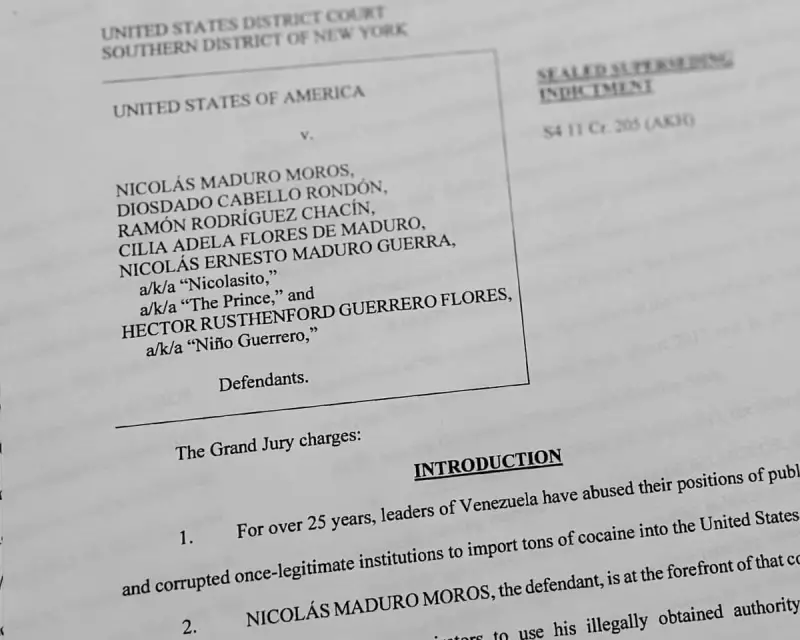
A superseding federal indictment unsealed against Venezuela's leader, Nicolás Maduro, on Saturday introduces a significant new element to the long-running legal case against him. The updated charges, filed in the Southern District of New York, attempt to formally link Maduro's regime to the notorious Venezuelan street gang, Tren de Aragua (TdA).
The New Allegations and a Key Co-Defendant
The indictment, revealed shortly after Maduro's capture by US forces, largely mirrors the 2020 narcoterrorism charges but now incorporates controversial claims previously championed by the Trump administration. One of Maduro's five co-defendants is the alleged founder of Tren de Aragua, Héctor Rusthenford Guerrero Flores, who was himself indicted just two weeks ago.
While the document does not allege a direct meeting between Maduro and Guerrero Flores, it accuses Maduro and others of having "partnered with narco-terrorists," including TdA. This legal move builds a courtroom framework for assertions that critics have labelled exaggerated and politically motivated.

The Trump Administration's Tren de Aragua Narrative
The focus on Tren de Aragua as a tool of the Venezuelan state became a cornerstone of Trump-era immigration policy. The interest intensified in 2024 after gang members were accused of taking over an apartment building in Aurora, Colorado. Despite initial law enforcement assessments viewing TdA as a vicious local group rather than a major international threat, the Trump administration took a hardline stance.
On his first day in office, President Trump signed an executive order designating certain drug cartels and groups, including Tren de Aragua, as "foreign terrorist organisations." This classification was later used to justify invoking the 200-year-old Alien Enemies Act. In March, Trump declared that TdA was perpetrating an "invasion or predatory incursion" against the US, sent by Maduro. This allowed for the immediate apprehension and deportation of alleged members without court hearings, a policy later blocked by US courts.
Intelligence and Investigative Counterpoints
However, US intelligence findings have directly contradicted the political narrative. A national intelligence memorandum from April stated that "the Maduro regime probably does not have a policy of coordinating with TDA and is not directing TDA movement to and operations in the United States."
This view is echoed by investigators on the ground. A local police detective who has probed TdA described it as exceptionally brutal but said, based on interrogations, members were not directed by the Venezuelan government to travel to the US. Similarly, a former Drug Enforcement Administration official noted he was unaware of any personal Maduro-TdA link, though evidence of Maduro profiting from the cocaine trade was solid.
Analysts suggest the updated indictment serves a political purpose. "TdA has been part of the Trump narrative since the beginning of the campaign," said Adam Isacson of the Washington Office on Latin America. "Really it’s more of a political change in this indictment. It updates or sharpens the narrative they need for the pretext for the capture."
The operation to capture Maduro, which involved explosions in Caracas, has drawn widespread international criticism and outrage from Democrats in Congress, setting the stage for a complex legal and diplomatic battle centred on these new allegations.