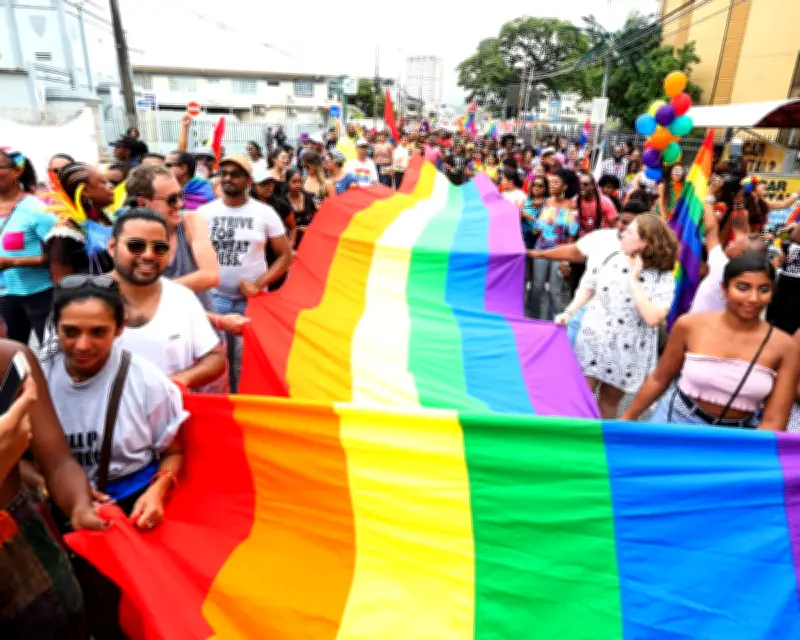
The UK's highest court for Commonwealth appeals is hearing arguments over whether Trinidad and Tobago's colonial-era law banning anal sex between consenting men should be struck down. The case, brought by LGBTQ+ activist Jason Jones, challenges a 2024 court of appeal decision that reinstated the law after a 2018 high court ruling had declared it unconstitutional.
Background of the 'buggery law'
The law, often referred to as the 'sodomy' or 'buggery' law, was enacted in 1925 during British colonial rule and later incorporated into Trinidad and Tobago's 1986 Sexual Offences Act. It criminalizes consensual same-sex intimacy between men, carrying a penalty of up to five years in prison. In 2017, Jones challenged the law, and in 2018, the high court ruled it violated his constitutional rights to privacy and equality. However, the court of appeal overturned that decision in 2024 after the attorney general intervened.
Privy council hearing
The London-based Judicial Committee of the Privy Council (JCPC), which shares judges with the UK Supreme Court, began hearing Jones's appeal on Tuesday. A decision is expected within three to six months. The case is being closely watched across the Caribbean, where similar laws remain in force in several former British colonies.

Regional context
The Bahamas decriminalized homosexuality in 1991, and the UK repealed such laws in its overseas territories in 2001. Recent court rulings have struck down similar laws in Barbados, Dominica, St Lucia, and Antigua and Barbuda. However, anal sex remains a crime in Guyana, Grenada, Jamaica, Trinidad and Tobago, and St Vincent and the Grenadines. According to former Irish Taoiseach Leo Varadkar, these are the only five countries in the Americas that still criminalize homosexuality, all of which are former British colonies.
Government opposition and savings clauses
The Trinidadian government is opposing Jones in the case. Prime Minister Kamla Persad-Bissessar argued that the ruling could affect 'savings clauses'—colonial-era provisions that preserve British laws after independence. 'This ruling is going to be a very profound decision, not just impacting on sodomy laws but that whole issue of the saving clause,' she said. Darrell Allahar, a minister and government lawyer, described the hearing as a 'very good exercise' to clarify the scope of these clauses, which were designed 'to save existing laws at independence so we don't have a wholesale gutting of those laws in light of the human rights provisions.'
Activist's perspective
Jones, 61, expressed frustration that the case reached the British court. 'At any time over the last decade of my legal challenge, the state and indeed parliament could have put a stop to this and just removed these heinous laws themselves,' he said. 'They have wasted millions of taxpayers' money fighting me.' He described the law as 'dehumanising' and said it 'makes us both a criminal and a victim at the same time.' Jones expressed confidence in his case, stating, 'The privy council will never uphold a 500-year-old homophobic piece of British law that goes against the rights of the individual. Not in 2026. I know I'm on the right side of history.'
International attention
Varadkar, now a global LGBTQI and human rights fellow at Harvard University, highlighted the irony that 'colonial-era laws that have long since been repealed in the United Kingdom itself' remain active in former colonies. In a recent paper, he noted that all five countries in the Americas that still criminalize homosexuality are 'anglophone and formerly part of the British empire. This is not a coincidence.' He added that the UK judges would preside knowing that human rights and privacy are enshrined in British law.