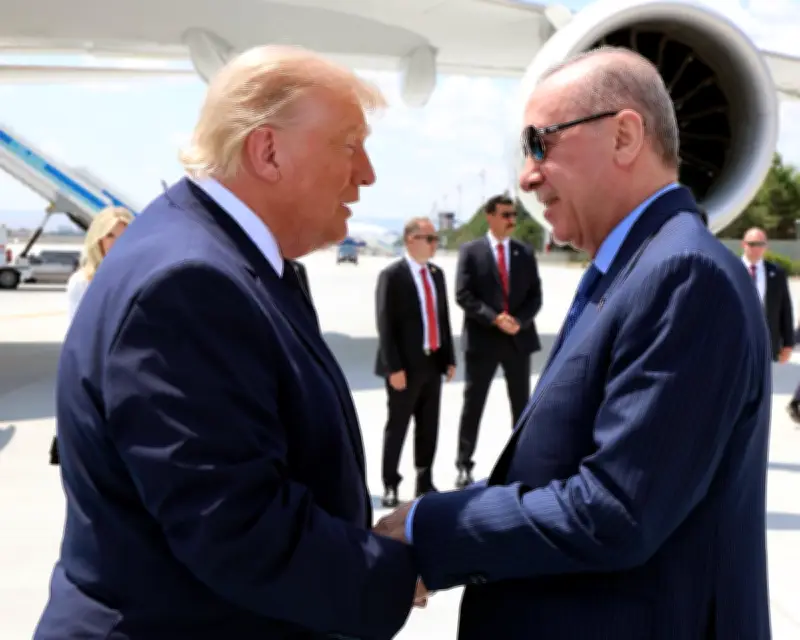
Donald Trump has revived his push for the United States to acquire Greenland and threatened to withdraw all American armed forces from Europe, citing frustration with allies' positions on defence spending, immigration, and energy. Arriving at the Nato summit in Ankara on Tuesday, the US president also suggested that the United Kingdom's stance on the Iran war contributed to the downfall of former Prime Minister Keir Starmer.
Trump's criticism of Nato allies
Trump told reporters that he was "very disappointed with Nato" and that the alliance had not treated the US well regarding its actions in Iran. "We don't need anybody's help, but before I asked they said they wouldn't be there," he said. Referring to the UK, he added: "The prime minister, I guess he's no longer there, maybe because of this, it was a very unpopular thing he did. He said: 'No, we'll help after the war is over.' I said: 'We don't need that kind of help.'"
Greenland dispute resurrected
Trump revived a previous row over Greenland, which is part of Denmark, a fellow Nato member. He argued that Denmark does not spend enough to help Greenland and that the territory is strategically important due to Chinese and Russian ships. "It should be controlled by the US, not by Denmark," he said. He claimed that the disagreement had "hurt" his relationship with the alliance and that the US could "remove all of our soldiers out of Europe" because Europe is "a very different place than it was 20 years ago." He warned: "They better be careful with immigration and energy. If they're not careful with those two things, you're not going to have a Europe any more."

UK response to Greenland remarks
In response, UK Chancellor Rachel Reeves told reporters: "The future of Greenland is up to the people of Greenland and of Denmark, and not up to the US president. I've been very clear about that ever since it was first suggested."
Defence spending tensions
Trump also renewed his criticism that Nato allies do not spend enough on defence and are too reliant on the US. "Why are we spending hundreds of billions of dollars and they're not there for us? We've always been there for them," he said. European members are attempting to address this by announcing multi-billion-pound defence collaborations. The UK has already pushed back on criticism that some allies are "lagging behind" on funding, with Trump expected to rebuke countries, including the UK, for not making enough progress on hitting the target of spending 3.5% of GDP by 2035.
Context of Nato summit
The summit comes after a bruising year for Nato, in which the Iran war exposed cracks in the alliance. Keir Starmer and European allies have been determined to avoid another public bust-up with Trump over defence spending. Nato's mutual defence clause has only ever been triggered after the September 11 attacks on New York, where allies joined US troops in Afghanistan.