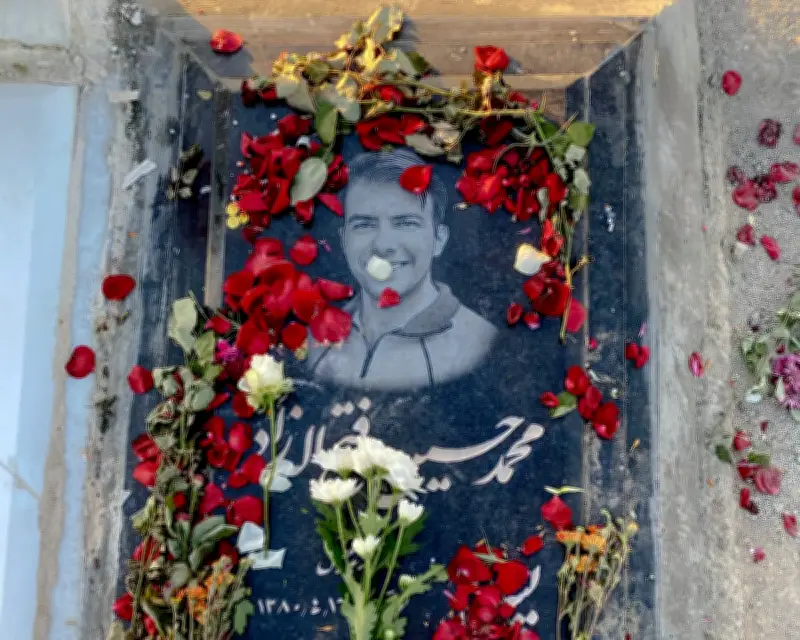
Six months after the bloody crackdown on anti-regime protesters in Iran, families continue to gather at Behesht-e Zahra cemetery in Tehran to mourn their loved ones. The gravestones tell stories of lives cut short, with many bearing inscriptions like "Sepehr-e Baba, where are you?" — a cry that became a symbol of the protests.
Sepehr: A Father's Grief and Defiance
Sepehr, 25, was shot and killed during January's mass street protests. His father became widely known after a video recorded in their home city of Kahrizak showed him repeatedly calling out, "Sepehr-e Baba, where are you?" Those same words are now etched on Sepehr's gravestone. At the grave, a crowd gathers, including the mother of a 16-year-old boy killed during the 2022 women's rights protests. Sepehr's father, speaking with courage born of grief, says he does not fear arrest. "I'm waiting for these people to fall," he declares. "Don't doubt it — they're already gone. This regime will not go back to what it was before." He encourages those around him to film and take pictures freely.
Mohammadreza: A Mother's Curse and a Sister's Hope
Mohammadreza, 38, was killed in Tehransar, western Tehran. At his grave, his sister and elderly mother recount his life. "My child had a hard life," his mother says. "I cursed Khamenei. I was very happy when they killed him. But my heart aches for these children of ours." She expresses longing for her son and hopes for the regime's end. His sister describes how Mohammadreza saved many people the night he was killed, bringing them into a parking garage. She wants to write "javidnam" — Farsi for "everlasting name" — on his gravestone but fears police retaliation, as they have broken some stones. "God willing, by next Nowruz [March 2027], these pieces of shit will be gone," she says.

Sara: A Symbol of Brutality
Sara, 45, was killed during the January protests. A CCTV video showed her being attacked by plainclothes security forces wielding machetes, her terrified gaze alone and empty-handed. Her large white gravestone bears the word "darya" (Farsi for "sea"), representing eternity. Nearby, another woman mourns her cousin and a friend killed on consecutive days. "I wish they had seen Khamenei's death," she says. "Let those bastards go to hell." She notes that while her cousin was shot, the other victim was killed with a knife.
Mohammad: A Boxer Who Defended Others
Mohammad, 28, was killed in Ariya Shahr, north-west Tehran, by members of the Basij paramilitary force. His father and young brother wash his gravestone. His brother recounts how Mohammad intervened to save two girls being dragged by Basijis: "He went to save the girls, and those bastards hit him instead. He was a boxer. Four or five Basijis surrounded two girls. My brother and his friends beat them and helped the girls escape. But then the Basijis surrounded them on motorbikes. They beat him until one shot him in the side. He fell and said, 'I'm burning.' Then one came over and shot him in the head and heart — three times in total."
Ali: A Footballer Without a Gravestone
Ali was killed by a bullet in Moshiriyeh, south Tehran, and still has no gravestone. His family, including his father — middle-aged, thin, with missing teeth — and his younger sister, gather at his grave. His father says, "My son was a footballer. He was 2 metres tall. A goalkeeper. We went to Kahrizak and identified him there." Money is short, and buying a gravestone is difficult. Ali's mother, in a long black manto, gives a soft smile but does not speak. A friend who was arrested and released says, "My friend is under the ground and I'm alive."
Danyal: A Father's Anguish
Danyal's father sits at his son's grave, recounting the search for his son, who was among the first killed in Fardis, west of Tehran. "These people — the Islamic Republic's units — have no religion, no faith, no mercy, no decency," he says. "They killed my son." He describes opening body bags one by one, losing hope, and finally finding Danyal. His aunt tells of a girl whose body bag was left open, leaving her naked. "I said: 'God damn you. You killed so many people over a few strands of hair, and now you've left her here like this?'" The family says the regime pressured them to declare Danyal a martyr of a terrorist attack, but they plan to change it later.