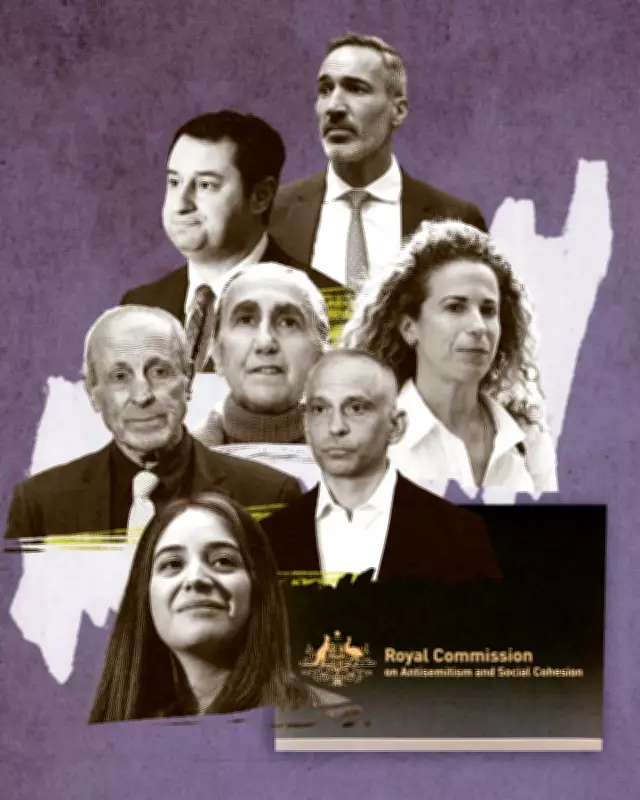
In a hushed room, personal testimonies reveal Australia’s troubling rise in antisemitism. This week, Jewish Australians have spoken about how displays of hostility, discrimination and the Bondi terror attack have changed their lives and their feelings about their place in the community.
A Reckoning with Ancient Bigotry
The narrow benches of the public gallery are filled. They have come from all over to offer their testimony, to support friends, to give and receive comfort. They come too, to listen. This, in this small, quiet room, is Australia’s attempt to reckon with the violent modern manifestation of an ancient bigotry.
“The sharp spike in antisemitism that we’ve witnessed in Australia has been mirrored in other western countries and seems clearly linked to events in the Middle East,” the commissioner, Virginia Bell, said on the first morning. “It’s important that people understand how quickly those events can prompt ugly displays of hostility towards Jewish Australians simply because they’re Jews: displays of hostility that are sometimes expressed in images and sentiments that can sometimes be traced back to the Middle Ages if not earlier.”

This royal commission into antisemitism and social cohesion was established in the wake of December’s Bondi massacre, in which two antisemitic gunmen opened fire on Jews attending a beachside Hanukah celebration, killing 15 people and injuring 40 others.
Voices of Fear and Resilience
Dina: “The reality is, they came to kill us. We just weren’t there. And it’s living with that truth that makes it very hard to feel safe as a Jew in Australia.” She added, “It’s impossible for children not to internalise that they are living through that reality. They hear antisemitism around them all the time … they see the stickers … they see the graffiti, they know about Bondi. It’s become part of their psyche.”
Joshua Kirsh: After running for the NSW Legislative Council, his campaign ads were “deluged with antisemitic comments of a nature that was particularly vitriolic.” He noted, “I’ve had a lot of conversations with people in the Jewish community who are incredibly bright and talented and would be perfect fits to be more involved in politics in this country. But their view is that they can’t bear the risk of receiving the kind of backlash I have received.”
Stephanie Cunio: “If they say ‘the Netanyahu government’, then I see it as a perpetrator of violence. But if they say ‘Israel’, I see it as a country I love, that is my ancestral homeland.” She explained the demonisation of the word “Israel” and the need for compassion toward directly affected communities.
Vic Alhadeff: He recounted a meeting with a faith leader who responded to concerns about antisemitism with, “But look what’s happening to the Palestinians in Gaza.” Alhadeff said, “You have to be made of stone not to care about what is happening to the Palestinians in Gaza. However, why are you holding me responsible?” He stressed that Jewish Australians have no agency in Israeli government actions.
Sheina Gutnick: “Bondi holds many complicated and conflicting feelings for me currently. It was somewhere where my parents had started their history together. … And now Bondi holds a really, really heavy weight in our community’s heart.”
Nir Golan: He described being physically attacked and called a “dirty Jew” on Oxford Street. Despite providing video evidence, police encouraged him to drop the case, saying CCTV lacked audio and the Nazi salute was not illegal at the time.
Anonymous: “Dead Jewish people don’t need love; alive Jewish people need people to listen to us when we tell them we feel like history is repeating itself.”
Alex Ryvchin: “The Jewish people have always carried with them an awareness that a golden age ends, and normally it doesn’t end calmly – it’s shattered.” He said families have asked him when to leave, but he remains committed to Australia.
Natalie Levy: Her daughter sees swastikas at school and hears “Heil Hitler” salutes. “I can’t believe that this, in 2026, in this beautiful country, that antisemitism has become so normalised.”

Anonymous parent: Both older children came home saying they didn’t want to be Jewish due to antisemitic comments on social media and from peers, including “We owe Hitler an apology” and “Jews are controlling the government.”
Outside the Commission
Beyond the sanctity and safety of the commission, the reality of antisemitism is all too apparent. A man was arrested for wearing an antisemitic T-shirt outside the commission, and a neo-Nazi was charged after a protest at the NSW parliament. The gallery remains full, with witnesses continuing to come in sadness, fear, defiance, and anger.