Legal Experts Outline Strategies to Force Release of Epstein Files After DoJ Misses Deadline
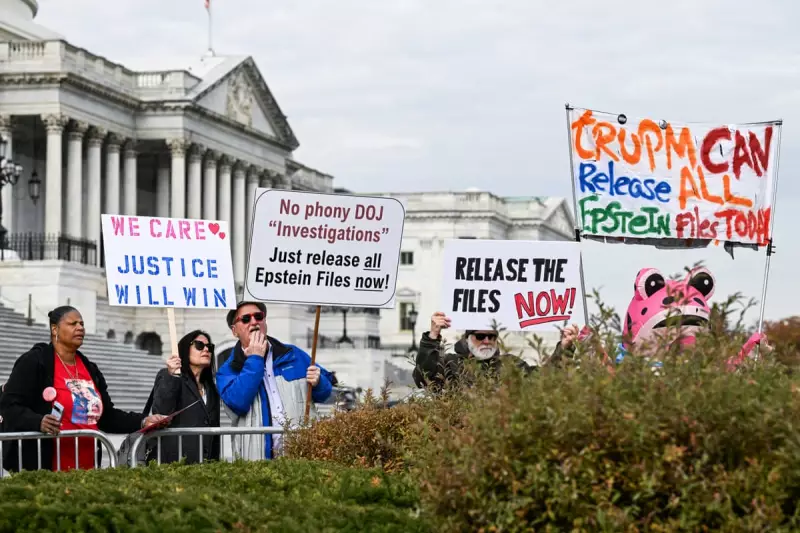
Protesters gathered in Washington DC on 18 November 2025, demanding the full disclosure of Jeffrey Epstein investigative files, as legal experts weigh potential strategies to compel the Department of Justice to comply with congressional mandates.
Missed Deadline Sparks Legal Debate
The deadline for Donald Trump's justice department to release the Epstein files under the Epstein Files Transparency Act (EFTA) has passed without full compliance, leaving victims and advocates frustrated. Despite Congress passing legislation mandating disclosure by 19 December 2025, which Trump signed into law, only a fraction of required documents have emerged.
For months, the Epstein case dominated news cycles, with public outrage growing over continued secrecy surrounding the disgraced financier's connections to high-profile individuals across the political spectrum. Federal lawmakers previously took matters into their own hands, issuing subpoenas and releasing document batches that renewed attention to Epstein's network.
Legal Avenues Remain Open
Mitchell Garabedian, an attorney with decades of experience representing sexual abuse victims, emphasized that legal options for forcing file disclosure remain far from exhausted. "The party moving for release should seek court relief if files haven't been released timely pursuant to a court order," Garabedian explained. "If non-compliance is shown, the burden shifts to the releasing party to demonstrate reasonable delay."
Garabedian highlighted how continued public pressure from Epstein victims could play a crucial role. "Victims have a public voice they should use to make the public aware of non-release, empower themselves and other victims, and make the world safer for children," he added, noting that transparency helps victims "gain at least a degree of healing, closure and validation."
Congressional and Judicial Pressure Required
Spencer Kuvin, an attorney representing dozens of Epstein victims, stressed that continued legal pressure and public accountability are essential. "If the special master route is off the table, then the only real tools left are court intervention, congressional oversight and sustained public scrutiny," Kuvin stated. "These files will not be released just because it's the right thing to do – history shows they only come out when someone forces the issue."
For survivors, Kuvin described the current impasse as "devastating," noting that being told there's "no path forward" is "retraumatizing." He emphasized that "transparency in cases like this has never been given freely – it has always had to be dragged out through the courts."
Legislative Enforcement Challenges
Democratic Congressman Ro Khanna, who co-sponsored the EFTA with Republican Thomas Massie, confirmed that multiple legal avenues remain under consideration. "We will continue to use every legal option to ensure the files are released and survivors see justice," Khanna stated, noting that a federal judge acknowledged "legitimate concerns" about DoJ compliance.
Massie echoed this determination, stating "we remain determined to force the DoJ to follow our law using other avenues available to us and the survivors."
Complicated Legal Landscape
Neama Rahmani, a former federal prosecutor, explained the unusual complications of this situation. "Typically, if there's contempt of Congress or obstruction, the DoJ would enforce it," Rahmani noted. "But obviously that's not going to happen here because the DoJ is the target. It's bizarro world where there's a law and the DoJ is not following the law."
Rahmani suggested Congress should sue for the records' release to obtain a judicial order, explaining that "if the judicial order is violated, the judge can start imposing sanctions." However, he acknowledged such proceedings could take weeks or longer.
Legislative Gaps Identified
Mark Zaid, a national security and transparency attorney, identified significant issues with the EFTA's enforcement mechanisms. "Congress failed to include any type of enforcement mechanism, especially judicial review, within the Epstein legislation," Zaid observed. "Despite mandatory provisions and aggressive disclosure requirements, this is a gaping hole that perhaps was unanticipated but is now openly evident."
Zaid suggested that "the likely best way forward is to amend the legislation and create explicit judicial oversight," noting that while viable legal mechanisms might exist, they remain "a long way from being viable or successful."
Neither the justice department nor the White House immediately responded to requests for comment regarding the missed deadline and ongoing non-compliance with congressional mandates.