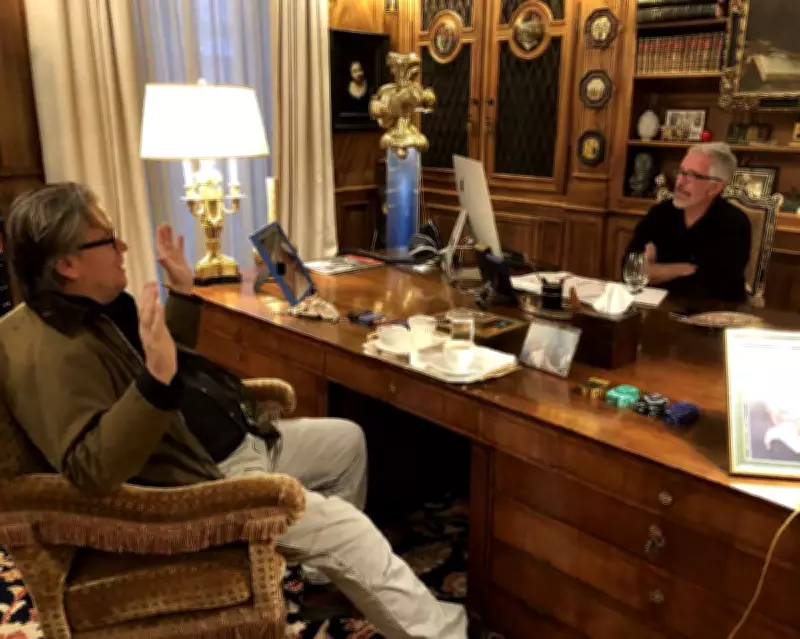
Epstein Documents Illuminate Bannon's European Political Ambitions
The latest release of documents from the Jeffrey Epstein case has shed significant light on the political activities of former Trump strategist Steve Bannon in Europe. Dozens of messages between Bannon and the convicted sex offender reveal concerted efforts to influence European politics through financial support for nationalist parties.
European Far-Right Funding Campaigns Exposed
The communications, predominantly from 2018 and 2019, detail Bannon's post-White House mission to build a unified far-right movement within the European Parliament. During this period, Bannon made regular visits to Europe, targeting ultra-rightwing and Eurosceptic forces across multiple nations including Italy, Germany, France, Hungary, Poland, Sweden and Austria.
In a particularly revealing message dated March 5, 2019, Bannon explicitly stated his focus was "raising money for Le Pen and Salvini so they can actually run full slates" ahead of the European parliamentary elections. This direct reference to funding Marine Le Pen's French National Rally and Matteo Salvini's Italian League has sparked political controversy across the continent.

Political Fallout Across European Capitals
The revelations have triggered immediate political reactions. In Italy, opposition parties have demanded clarity from Salvini regarding potential Epstein influence on the League's political ascent. Andrea Casu of the centre-left Democratic party emphasised the need for transparency, stating: "We must first understand if there is a link with those who today play a political game with these rightwing forces at the European level."
Riccardo Magi, president of the leftwing Più Europa party, went further, claiming the files "implicate Matteo Salvini in alleged funding that Bannon had promised to provide for his election campaign," raising concerns about external influence on Italian politics.
Bannon's European Network and Meetings
The documents chronicle Bannon's extensive European travels and political networking. They reference his March 2018 meeting with Salvini in Milan shortly after Italian general elections that brought the League into government with the Five Star Movement. Bannon met Salvini again that September when the League joined his anti-EU organisation, the Movement.
In Germany, exchanges show Bannon and Epstein promoting Alternative für Deutschland while criticising then-Chancellor Angela Merkel. Bannon reportedly boasted about his advisory role to new rightwing populists, seeing their European gains as opportunities for mutual benefit.
Political Denials and Damage Control
Salvini's League party has strongly denied any Epstein connection, dismissing speculation about funding as "unfounded" and "serious exaggerations." The party stated it has "never requested or received funding" and would defend itself against "insinuations or associations with disgusting figures."
Bannon has declined to comment to US media about the exchanges, while the documents contain no evidence of direct relations between Salvini and Epstein, nor any suggestion of involvement in Epstein's criminal network.
French Political Connections Revealed
The files extend beyond Italian politics, revealing French connections including former culture minister Jack Lang, who admitted knowing Epstein "at a time when nothing suggested Jeffrey Epstein was at the heart of a network of criminality." His daughter Caroline resigned from France's Union of Independent Producers after emails showed she founded an offshore company with Epstein in 2016.
Further communications involved Olivier Colom, former diplomatic adviser to Nicolas Sarkozy, with one email suggesting former finance minister Bruno Le Maire visited Epstein's New York residence. Le Maire's representative claimed he didn't know whose house he was visiting in 2013 and left immediately upon seeing Epstein.

Broader Implications for European Democracy
Andrea Casu highlighted the fundamental issue extends beyond the files themselves, noting: "These files are getting a lot of attention in the US, as is obvious. But in my opinion, they should be given just as much attention for what they represent for Europe today, and for the political situation in which we are in."
The revelations raise significant questions about foreign influence in European politics and the networks operating to reshape the continent's political landscape. As European far-right parties continue to gain electoral ground, these documents provide unprecedented insight into the financial and strategic support mechanisms behind their rise.
While no evidence has emerged of actual Epstein funding reaching European parties, the detailed communications between Bannon and Epstein reveal a clear blueprint for attempting to influence European politics through financial support for nationalist movements at a crucial political juncture.