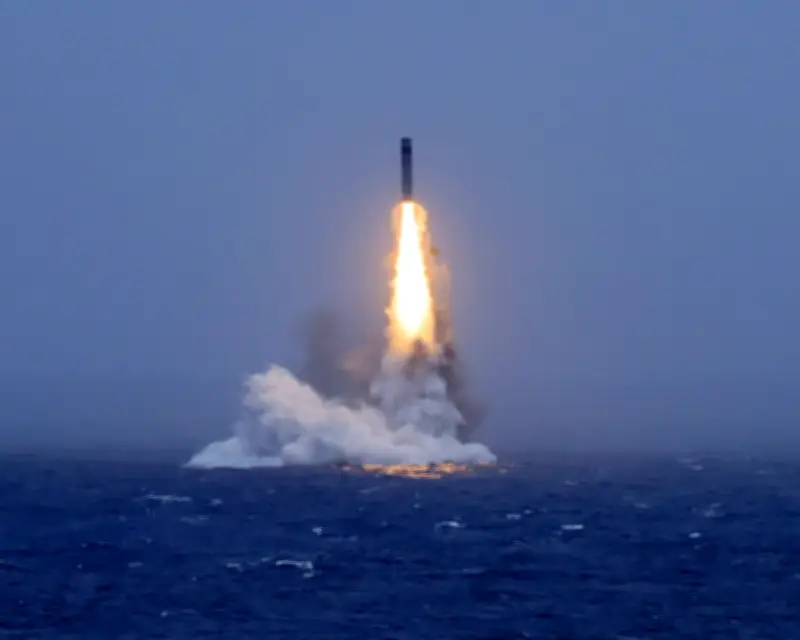
Australian Prime Minister Anthony Albanese has condemned China's intercontinental ballistic missile (ICBM) test in the Pacific, warning that the launch risks fuelling dangerous nuclear proliferation. Speaking during a visit to the Solomon Islands, Albanese said the missile, fired from a nuclear-powered submarine on Monday, could cause 'considerable damage' if weaponised.
International condemnation grows
China's state news agency Xinhua reported that a 'strategic missile carrying a dummy warhead' was launched from a 'strategic nuclear submarine of the navy' toward the Pacific. The test has drawn sharp criticism from Pacific leaders and allies, who say it undermines regional stability.
Solomon Islands Prime Minister Matthew Wale described the incident as 'further evidence for the need' of a new regional security pact. 'China is a good friend of Solomon Islands. But this is not something a friend does,' Wale said. 'We don't want to see any more countries – China, America, anybody – testing their ICBMs in the Pacific Islands region. That's the bottom line: be our friend but don't threaten us.'

Albanese: 'Provocative act'
Albanese stated that the test was 'a provocative act by China which does destabilise the region.' He expressed concern over the nature of the weapon, which has the capacity to reach long range and cause considerable damage. 'What we need is less nuclear weapons, certainly not more,' he added.
The Australian leader spoke after Independence Day celebrations in Honiara and ahead of hosting Pacific leaders in Brisbane. He said Australia would continue to express strong concerns to China over any move to destabilise the region or undermine peace.
China defends test as routine
China's foreign ministry spokesperson Mao Ning claimed the test was 'safe' and part of 'routine' military training, according to a translated statement. 'The test launch is a routine part of China's annual military training, in accordance with international law and practice, and is not directed against any specific country or target,' Mao said. 'Relevant countries were notified in advance, and it complies with international law and practice. The launch activity was conducted safely, systematically, and professionally throughout. We hope relevant countries will not over-interpret it.'
However, Australian Minister for Defence Industry and Pacific Island Affairs Pat Conroy rejected China's claims. 'No it's not, to be honest,' Conroy said in an ABC radio interview. 'This has been a destabilising event and certainly has drawn criticism from countries in the Pacific and Asia. Secondly, it's not consistent with The Hague convention on ballistic missile testing, which would require more notice and greater information provided to countries.'
US and Taiwan react
Joseph Wu, secretary-general of Taiwan's national security council, posted a map purportedly showing the missile's path travelling south-east of China, over the Philippines, and past Micronesia and Palau, landing south of Nauru. 'It's a provocation that destabilizes the IndoPacific. China just proved itself again to be a bully on the block,' Wu wrote.
Tommy Pigott, a US state department spokesperson, said the US wanted China to 'engage in meaningful arms control discussions' and commit to a 'regularized notification arrangement for all intercontinental-range ballistic missile and space launches.' Pigott added that 'Beijing's rapid and opaque nuclear weapons buildup is of great concern to the region and the world.'

Australia's concerns over insufficient notice
Conroy criticised China for providing 'insufficient notice' of the test, confirming that notice came only hours before the launch. Australian government ministers Penny Wong and Richard Marles gave public confirmation of the warnings from China only a short time before the launch occurred. Marles declined to specify the test's location but said it was 'not particularly close' to Australia. He raised concerns about China's capabilities, stating, 'This is China demonstrating a much greater range in terms of being able to deploy a nuclear weapon. Our fundamental issue in relation to China is that we have seen a very dramatic military buildup by China without that strategic reassurance. There really isn't an explanation as to why they are building the capabilities that they are, and that is fundamentally destabilising.'