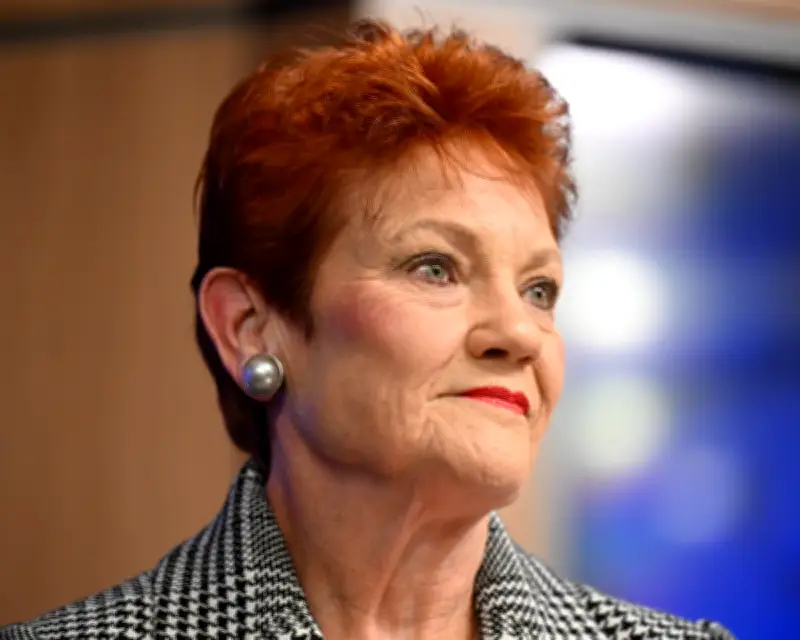
Pauline Hanson’s National Press Club address showed just how many Australians would be worse off under a One Nation government, Tom McIlroy writes.
One Nation Craves Mainstream Appeal, but Hanson’s Bleak Vision Shows She’s Firmly on the Fringes
Tom McIlroy
On the national stage, Hanson attacked multiculturalism and spoke of a ‘transgender insurgency’. It could be a reality check for voters.

There might not be a better symbol of the tectonic shifts happening in Australian politics than Pauline Hanson giving a landmark address to the National Press Club this week. Amid an exodus away from the major parties, the One Nation leader arrived on Wednesday armed with a speech she knew would make headlines for days. A huge crowd of journalists, lobbyists and diehard supporters illustrated perfectly the surge of interest in Hansonism, driven by swelling public support. But, rather than going mainstream as the party claims, it was quickly clear the firebrand Queensland senator remains stubbornly on the fringes of the policy debate, offering a bleak and at times strange policy prescription for modern Australia.
Openly discussing her plans for power, Hanson’s speech might prove a well-timed reality check on the hype around the party and just how many Australians would be losers from a One Nation government.
Consider just a few of the takeaways from the hour-long address and a fiery exchange with members of the Canberra press gallery. Prepared to tolerate a multiracial society, Hanson said she could not accept Australia being multicultural, insisting that the more than 51% of residents born overseas or who have at least one migrant parent were contributing to the country “losing its identity, along with its values”. Hanson is concerned too that about 23% of Australians say they speak a language other than English at home, mistakenly assuming everyone fluent in Mandarin or Arabic does not also speak English and therefore cannot contribute to social cohesion. She claimed decades of successful multiculturalism had failed in Australia, because “all cultures are allowed equivalence to ours”. Hanson did not explain what supposed “monoculture” she thinks should exist, instead only stating her views were not racist and simply represent “common sense”.
Punching down on young workers she says are lazy, unreliable and glued to their phones, the former small business owner defended bosses who want the right to sack their staff more easily. She suggested paid parental leave shouldn’t be a right for women, arguing business shouldn’t have to pay for workers taking time off after having a baby. Calling for cuts to funding for childcare services, Hanson said workers caring for children in early education and care settings did not need tertiary qualifications, saying “it has just gone out of proportion”. She also called for changes to family tax rules and significantly reduced abortion access. Hanson said terminations should be banned after 20 weeks of pregnancy, calling for a national debate on the rules, even as her trusted lieutenant Malcolm Roberts ramps up his push for a national abortion ban.
It is hard to think of less popular policy offerings for families, young people, professionals, women and multicultural voters, who combined represent a sizeable slice of the electorate. But Hanson’s strangest contribution of the day was the urgent national threat of a “transgender insurgency”. Referencing combative questioning in budget estimates hearings last month – which Hanson herself missed because she was campaigning ahead of the Victorian state election – she took aim at the Australian Human Rights Commission president, Hugh de Kretser, and the sex discrimination commissioner, Anna Cody. Without offering evidence, Hanson said almost every instrument of the government was dedicated to a transgender ideology seeking to redefine humanity. She believes trans propaganda is being imposed on schoolchildren and hit out at efforts to track diversity in workplaces. “This transgender movement is a militant force right throughout society and must be confronted,” Hanson warned, promising to sack De Kretser and Cody.

As the commission has pointed out, Australian Bureau of Statistics data shows that less than 1% of the Australian population are transgender or gender diverse. They face regular discrimination at work, in study, in online interactions and when trying to access essential services like housing or healthcare. The strange reactionary push against transgender rights by One Nation and elements of the Coalition, including the former attorney general Michaelia Cash, ignores the experiences of communities who are accepting and generous. Most people don’t want heated politics from dark corners of social media infecting everyday life. A poll conducted last year found 91% of Australians agreed that trans people should have the freedom and choice to live their lives like everyone else, while 81% said they should enjoy exactly the same legal rights and protections.
It is possible Hanson and the One Nation movement are overestimating their support in the community on niche political priorities such as abortion and transgender rights, in a political moment where swathes of voters are mad as hell at the major parties and political establishment. Wanting to register a protest vote by indicating support for a minor party like One Nation might not be the same thing as cheering on Hanson all the way to the Lodge.
One area where Hanson has clearly captured public sentiment however is immigration, having made her name warning against Australia being “swamped” by overseas arrivals. Voters appear to be rewarding One Nation for its hardline views on the contribution of migration to housing supply shortages and the infrastructure crunch happening in major cities. Both Labor and the Coalition are trying to cut migration to ease their political exposure ahead of the next election.
Expect large parts of Hanson’s speech to be used against One Nation as the major parties try to win back support. The Toowoomba-based Liberal-National MP Garth Hamilton on Friday said Hanson’s appeal to a monoculture had more in common with sharia law or North Korea than it did with western liberal democracies. Labor’s Murray Watt pointed out that Hanson had a 30-year record of sowing division. “You can’t run a country simply fuelled by who you hate,” he said.
Margo Kingston, the journalist who knows Hanson better than anyone, told Guardian Australia this week that the speech marks the unofficial start of the federal election campaign. For voters, that means a long couple of years.
Tom McIlroy is Guardian Australia’s political editor