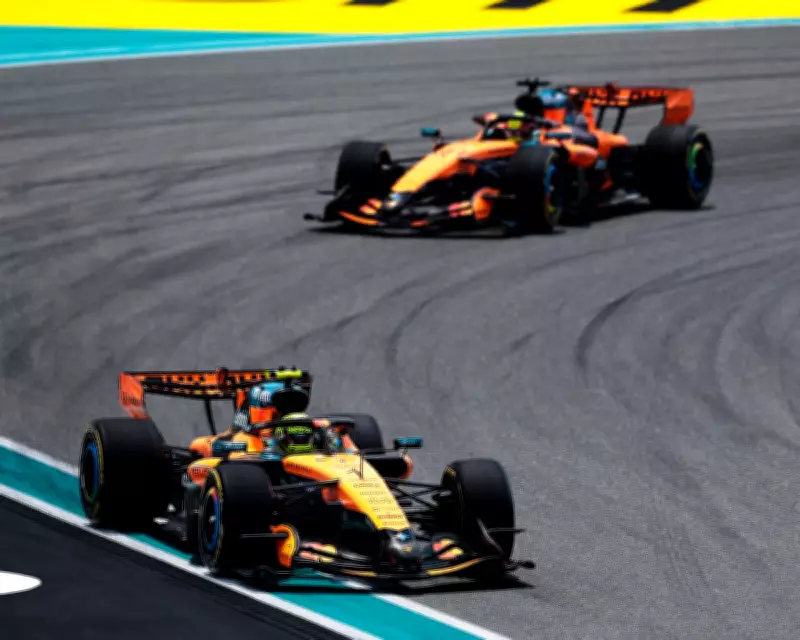
Formula One is under increasing pressure to consider immediate changes and the long-term future of its new engines, with world champion Lando Norris reiterating after the Miami Grand Prix that the only solution to address widespread dissatisfaction was to 'get rid of the battery'.
Miami Grand Prix Highlights
At the meeting in Florida, which was won by Mercedes' Kimi Antonelli, with Norris second, F1 and the FIA had introduced fresh regulations to address unhappiness and safety concerns prompted by the pivotal role energy management plays under the new 2026 formula.
There has been widespread criticism of the formula, which employs almost a 50-50 split between the internal combustion engine (ICE) and electrical energy. While adjustments to mitigate issues were considered successful, long-term distaste remains, as Norris noted.

'It's a small step in the right direction but it's not to the level that Formula One should still be at yet,' he said. 'If you go flat-out everywhere and try pushing like you were in previous years, you still just get penalised for it. You still can't be flat-out everywhere. You should never get penalised for that kind of thing and you still do.'
'Honestly, I don't really think you can fix that. You just have to get rid of the battery. So hopefully in a few years, that's the case.'
Piastri Echoes Concerns
Norris's opinions were echoed by his McLaren teammate, Oscar Piastri, who pointedly noted that, for all the tweaks to the rules, it was the fundamental way the engines were designed to operate that was the problem.
'The collaboration again from the FIA and F1 has been good, but there's only so many things you can change with the hardware we have,' he said. 'So some changes in the future are still needed for sure. How quickly we can do it is the big question.'
Piastri's position is understood to be popularly supported within the sport, where there is general agreement for reducing the role of electrical energy and increasing that of the combustion engine. However, even given what is considered a relatively straightforward hardware redesign that would increase fuel flow to the engine, there would have to be agreement from teams and engine manufacturers as soon as the Canadian Grand Prix in three weeks for it to be adopted for next season.
FIA President Hints at V8 Return
Over the weekend in Miami, FIA president Mohammed Ben Sulayem stated that he believed F1 would in future drop the current V6 hybrid engines and return to using V8s with 'minor electrification'. The V8s, most recently used between 2006 and 2013, were light, relatively simple, and very loud, and would run on fully sustainable fuel. 'V8 is coming,' he said.
Ben Sulayem quoted a timetable of introducing it by 2030 or 2031, but the immediate focus remains on whether a short-term change to engine regulations can be agreed. Mercedes, who have the best engine on the grid, considered the proposal worth considering, although team principal Toto Wolff intimated it would not be in time for next year.
'Can we tweak it and optimise it in the midterm? Absolutely,' he said. 'We will never be against making the show even better. We could extract a bit more performance out of the ICE, great. Give us enough lead time so we can actually do it.'
'From a Mercedes standpoint, we are open to new engine regulations. We love V8s. It has only great memories. It's a pure Mercedes engine, it revs high. How do we give it enough energy from the battery side to not lose connection to the real world? Because if we swing to 100% combustion, it might be looking a bit ridiculous in 2031 or 2030.'