
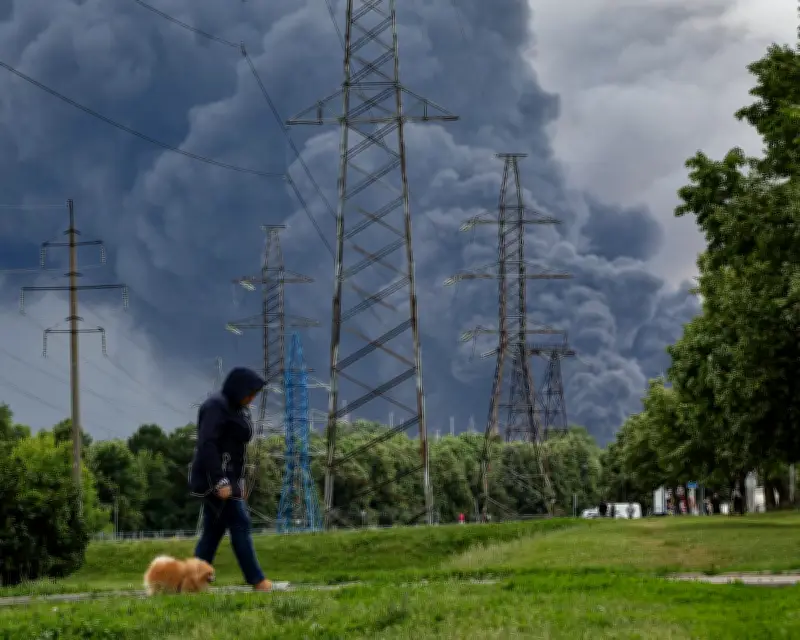
In response to a letter by Professor Christian Enemark arguing that Ukraine's drone strikes on Moscow are not justified, several readers have countered that the attacks are legitimate military actions targeting dual-use infrastructure that directly fuels Russia's war effort.
Strategic necessity, not morale bombing
Tim Dee-McCullough of Windsor writes that Enemark's argument rests on a bright-line distinction between combatants and civilians that becomes complicated when Russian civilians fund, staff, and politically sustain a war machine that has systematically targeted Ukrainian hospitals, schools, and energy infrastructure. He argues that strikes on oil refineries are not morale bombing but attacks on dual-use industrial infrastructure that international humanitarian law recognizes as potentially legitimate, provided proportionality is observed.
Dee-McCullough concludes that Ukraine is not retaliating for its own satisfaction but attempting to shorten a war in which its own civilians continue to suffer. Bringing the costs of war home to Russian society, he says, may accelerate its end.
Attacks save lives in Ukraine
Dr Natalie Kopytko, a lecturer at the University of Leeds, argues that Ukraine is targeting Russia's ability to fuel its continued attacks. She notes that injuries from the 18 June strike on the Moscow oil refinery probably arose from air defence debris, not deliberate targeting. She states that if Russia wants to protect its civilians, it should withdraw from Ukraine's territory entirely.
Kopytko further argues that these attacks force Russia to move air defence systems to Moscow, leaving gaps that Ukraine can exploit to liberate occupied territories. She writes, 'These attacks save thousands of lives for every ordinary Russian's shoulder injury.' She also criticizes Western allies for failing to close the skies over Ukraine or end fossil fuel imports from Russia.
Precision strikes, not indiscriminate attacks
Nathan Gabriel Wood, executive director of the International Society for Military Ethics in Europe, argues that Ukraine's largest-ever drone attack on Moscow was highly discriminate, with nearly all drones hitting the Moscow oil refinery. He rejects Enemark's claim of indiscriminate attacks, noting that many less defended targets could have been chosen if the aim was merely to increase insecurity.
Wood condemns what he calls a false moral equivalency between Russia and Ukraine, citing documented Russian war crimes including targeting civilians, torture, kidnapping children, and using rape as a method of war. He describes Ukraine's strikes as 'long-range sanctions' on the Russian war machine.




