
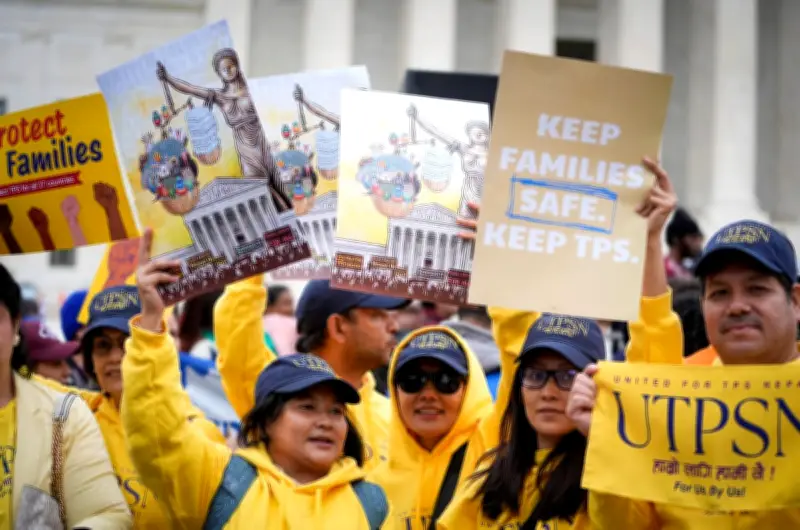
The US Supreme Court dealt a major blow to roughly 1.3 million immigrants in the US, many of whom have lived legally for decades under Temporary Protected Status (TPS). In a 6-3 decision, the conservative majority ruled that the homeland security secretary's TPS determinations are generally not subject to judicial review, except for constitutional claims. This makes it easier for the Trump administration to end TPS protections.
What Is Temporary Protected Status (TPS)?
TPS was enacted by Congress in 1990 to protect people already in the US when disaster strikes their home countries, making return unsafe. Designations can be based on natural disasters, epidemics, armed conflict, or other extraordinary conditions. TPS is initially granted for 6 to 18 months, during which recipients receive work permits and deportation protection. Those with serious criminal records are generally ineligible. Before a designation ends, the homeland security secretary decides whether to extend, re-designate, or terminate it. If no decision is made, TPS automatically extends for six months.
What Did the Supreme Court Rule?
The court ruled that TPS determinations and the processes behind them are generally not reviewable by courts. Justice Samuel Alito wrote that the sole constitutional claim—alleging racial animus by the Trump administration against Haitians—appeared unlikely to succeed. In dissent, Justice Elena Kagan warned that the ruling leaves the secretary free to act without consultation or evaluation of country conditions, with courts powerless to intervene. Kagan cited Trump's derogatory comments about immigrants of color and Haitians, including references to "filth, disease, and primitiveness," stating that these statements "fairly shout... that race entered into the President's resolve to remove Haitians."
Who Is Affected and How?
The specific case involved TPS for over 300,000 Haitians and several thousand Syrians. They are expected to lose TPS and work authorization once the ruling takes effect. Justice Kagan noted that the government could ensure they are "put on the next plane." The current homeland security secretary, Markwayne Mullin, indicated that TPS holders should seek permanent residence or leave, though there is no direct green card pathway via TPS. The decision also threatens all TPS nationalities by setting a precedent that limits judicial review, making it easier to end protections. It is expected to influence judges considering termination of TPS for other nationalities, five of which are blocked only by court orders.
State Department Warnings on Syria and Haiti
The US State Department lists both Syria and Haiti under the highest travel advisory: "Do Not Travel." For Syria, risks include terrorism, unrest, kidnapping, hostage taking, crime, and armed conflict. For Haiti, violent crime is rampant, with gang activity, robberies, carjackings, sexual assault, and kidnappings for ransom. Local law enforcement has extremely limited ability to respond.
Trump's Comments on Haiti
Trump has asked why the US accepts people from "shithole countries" like Haiti, called the nation "filthy, dirty, [and] disgusting," and likened Haitian migration to "a death wish for our country." He falsely claimed during the 2024 campaign that Haitians were "eating the pets of the people" in Ohio.
Countries With TPS Designation
Active TPS designations include Myanmar, El Salvador, Ethiopia, Haiti, Lebanon, Somalia, South Sudan, Sudan, Syria, Ukraine, Yemen, and a subset of Venezuelans. The Trump administration has terminated TPS for Afghanistan, Cameroon, Honduras, Nepal, Nicaragua, and hundreds of thousands of Venezuelans.
Logistics of Removing TPS Holders
Once TPS ends, if individuals lack other legal status, they risk arrest, detention, and deportation. Some may have existing removal orders, while others could face immigration court proceedings. If they do not qualify for other relief, deportation is likely, with a years-long bar on re-entry. They may also face prolonged detention before removal.
Recourse for TPS Holders
Some may qualify for asylum, but unlike TPS, asylum requires proving individual persecution—a high bar. The Trump administration has made asylum harder to win and suspended processing for many TPS countries, including Afghanistan, Myanmar, Haiti, Sudan, Yemen, South Sudan, and Syria.
Economic Implications
TPS holders pay $7.8 billion in taxes annually and have contributed $262 billion to the economy since 2001, according to Fwd.us. Hundreds of thousands work in essential industries like construction, hospitality, and healthcare. Among Haitian TPS holders, there are an estimated 13,000 nursing assistants caring for 65,000 patients daily, 3,000 school assistants working with 57,000 students, and 22,000 cooks and servers providing 880,000 meals daily. The elder care industry is especially affected, with TPS holders comprising up to 8% of caregivers in some areas.
Other Immigration Rulings This Term
On the same day, the court upheld the "metering" asylum policy at the US-Mexico border, potentially allowing its reimplementation. On June 30, the court upheld birthright citizenship for children born in the US to immigrant parents, rejecting Trump's executive order. However, four justices did not plainly state the executive order violates the Constitution, which Sirine Shebaya of the National Immigration Project noted deserves attention.




