
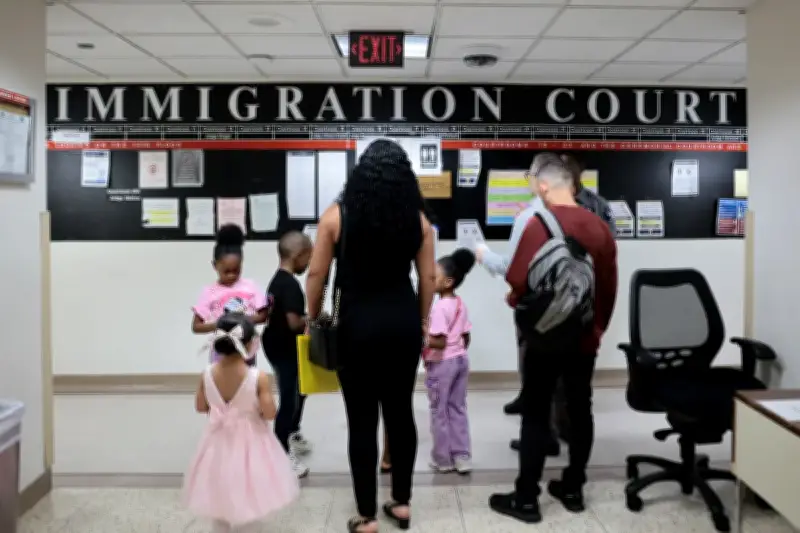
US immigration courts are issuing mass deportation orders through a new tactic called 'mega master' calendar hearings, where large groups of immigrants are scheduled for hearings on short notice, and those who fail to appear are ordered removed in absentia. In June, judges issued 53,808 in absentia removal orders, constituting a majority of overall case completions for that month, according to researchers at bklg.org.
Inside a 'mega master' hearing in San Antonio
On a morning in mid-July, inside the federal immigration court in San Antonio, Texas, Judge Brittany A Rodriquez, who had been on the bench for only about a month, presided over a docket that included a 49-year-old Cuban man whose hearing had been moved up by an entire year, a six-year-old Mexican girl and a three-year-old Cuban boy who may have been appearing in court alone, and a 22-year-old Venezuelan woman with her two-year-old son. Rodriquez, who had previously worked as a federal attorney arguing against immigrants for almost six years until May, quickly read through a list of 15 people who had missed their hearings, indicating they could be ordered removed 'in absentia'. She then discovered five more no-shows on the list, saying, 'I didn't even do that whole last page. I think these are all 'in absentias', too.'
This scene epitomizes the newest frontier in the second Trump administration's deportation push, where people are scheduled for mass hearings at the last minute, and those who don't make it receive removal orders almost by default. This sets them up for arrest and repatriation whenever they encounter immigration agents or local law enforcement cooperating with federal immigration enforcement, even during a traffic stop.
Policy changes erode due process
Critics allege that the Trump administration has upended the immigration courts, denying justice to many thousands of people. Adjudicators have taken on roles as so-called deportation judges, and the executive office for immigration review (EOIR) has become an integral part of the White House's mass deportation strategy. Paul Schmidt, a retired immigration judge, said, 'They abandon the real mission of the agency, which is to provide fair hearings and due process to as many people as possible, and instead sort of run it as an adjunct of DHS enforcement, with the only real objective to be being able to enter as many removal orders as you can, as fast as you can.'
EOIR's primary responsibility is, in its own words, 'to adjudicate immigration cases by fairly, expeditiously, and uniformly interpreting and administering the Nation's immigration laws'. However, it falls under the Department of Justice, not the judicial branch, raising concerns about its independence from executive policy priorities. The agency's nearly 3.2-million-case backlog has long caused headaches for both Democratic and Republican administrations.
An unnamed EOIR spokesperson said: 'The Executive Office for Immigration Review prioritizes the timely completion of all cases and makes scheduling adjustments as needed to ensure cases do not languish. Unnecessary delay hurts both aliens with meritorious claims and the American public who wish to see aliens with non-meritorious claims removed as quickly as possible. As it continues to add new immigration judges, EOIR will continue to make scheduling adjustments to ensure all cases are handled in a timely and lawful manner.'
Mega master hearings and their impact
Since March, master calendar hearings have been scheduled with little time to prepare, and by the end of May, hearings across the country were scheduled for unusually large numbers of people, with a single judge in a single session on a single day. Officials have set a threshold of 100-200 scheduled cases and 150 total people per session for these 'mega master' hearings, disproportionately singling out those without lawyers. Notice of hearings, if given at all, was short and sent out in English.
Brandon Marrow, who created bklg.org and is researching these hearings, said, 'These are kind of ways to skirt you getting a final hearing where you can actually present evidence for the relief you're seeking in immigration court.' The accelerated court dates make it harder for people to find lawyers, as their timeline shrinks from months or years to mere days. Legal clinics are overwhelmed, and private attorneys require fees that often amount to thousands of dollars.
Ironically, having a lawyer would allow for faster proceedings, Schmidt said: 'If somebody came in with a lawyer, I could probably do a fair master calendar in about two minutes. It actually took much longer to do hearings, masters, without lawyers if, you know, if you really wanted to give the person a fair opportunity to be heard.'
For mega masters, there are almost always more people scheduled than those who attend, leading to in absentia orders. The number of non-detained respondents appearing for master hearings in June rose 28.6% compared with June 2024, while in absentia removal orders soared 183.6%, according to researchers at bklg.org.
Reasons for non-attendance include lack of notice and fear. Schmidt recalled mistakes in address filing when he was a judge, saying, 'The clerical staff was spread pretty thin, and filing change of address forms wasn't one of their top priorities. There'd be stacks of them sitting on credenzas, waiting to be filed, which told you something about the reliability of the system.' In June, the median potential notice period for non-detained immigrants fell to just 42 days. In a New York hearing on 25 June, more than three-quarters of the 95 people on the docket, with a median lead time of just 24 days, received in absentia removal orders. In Kansas City, a docket with 93 people and a median lead time of at most 15 days resulted in 56 in absentia orders, while another with 96 people and a median lead time of 196 days ended with just nine.
Fear of arrest at courthouses also deters attendance. Since at least 1996, immigration judges and DHS have recognized that the presence of enforcement officers in courts can have a 'chilling effect', but EOIR officials dismissed this as 'contrary to logic' under the new administration. High-profile mass arrests followed, and a federal judge has since blocked that policy, but fear persists.
In June, judges issued 53,808 in absentia removal orders, with more than 13,000 coming from master calendar hearings with 100 or more people scheduled and a median lead time of 45 days or fewer. Joseph Gunther, a researcher with bklg.org, said, 'These absentia numbers are completely unlike anything that's been seen before in the immigration courts. Certainly, compared to before, a lot of things are happening that are completely unprecedented.'
Even those who attend may face rushed proceedings. Fleming witnessed a judge order a detained person deported because their application had not arrived, despite it being written punctually and misdirected in the mail. Once ordered deported, reversing course is difficult, as motions to reopen carry a $1,065 filing fee and are 'challenging applications', Fleming explained. 'It can be very hard to get an attorney to drop everything and represent someone on a complex motion to reopen. So it puts them in a very vulnerable legal position.'
More than 100 immigration judges have been fired, resigned, or retired since Trump's second inauguration, with replacements recruited through ads saying, 'Apply today to become a deportation judge' who will make decisions that will 'define America for generations'. In June, fewer than 2% of all completed cases ended with an immigrant winning relief. Schmidt said, 'When you send out ads recruiting deportation judges, I think you're probably not going to get people whose primary concern is understanding immigration law or making sure that people are fairly treated or, you know, resisting government overreach.'
In San Antonio, another judge, Rifian Newaz, appointed under the first Trump administration, paused for a long time reviewing no-shows' files, noting one person didn't get proper notice and another was a child, whom he moved to the unaccompanied kids' docket. Yet he still issued 26 new in absentia removal orders that day.




