Shocking Images of Detained Five-Year-Old Boy Expose Trump's Draconian ICE Crackdown
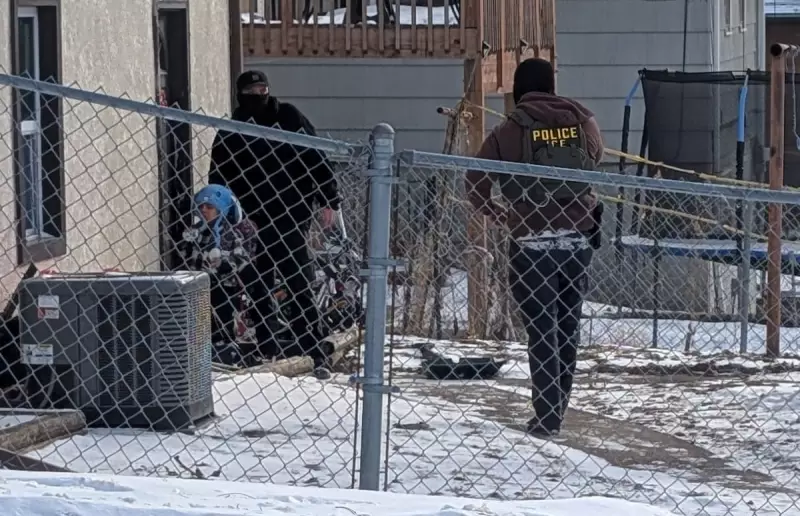
In a deeply disturbing development that has sent shockwaves through Minnesota and beyond, photographs have emerged showing five-year-old Liam Ramos being detained by Immigration and Customs Enforcement agents in Minneapolis. The images, which show the preschooler standing beside black vehicles with agents positioned behind him, have become powerful symbols of what critics describe as the indiscriminate and disproportionate nature of the Trump administration's militant anti-immigrant campaign.
The Disturbing Visual Evidence
One particularly haunting image captures Liam Ramos wearing a blue bobbled winter hat, standing next to a dark vehicle with an adult figure positioned behind him, their hand placed proprietorially on his backpack. A second photograph shows the same child at the door of a house, with what appears to be a masked ICE agent standing behind him. The exact circumstances surrounding these photographs remain somewhat unclear, but their impact is undeniable.
Officials from the Columbia Heights Public School District, which circulated both pictures, suggest the latter image reveals a particularly dark reality. They believe Liam may have been used as bait to lure adults in his family home to open the door, allowing ICE agents to make arrests. This interpretation, if accurate, represents a troubling escalation in enforcement tactics that directly involve young children.
Official Responses and Conflicting Narratives
The Department of Homeland Security has offered a different explanation, insisting that Liam was being held for protective purposes after his father absconded when agents attempted to detain him. Department spokesperson Tricia McLaughlin stated emphatically that "ICE did NOT target a child," describing the father as "an illegal alien" who had "fled on foot – abandoning his child."
However, the family's lawyer, Marc Prokosch, presents a contrasting account. He asserts that the family did not arrive in the United States illegally, entering instead at an officially designated crossing point. According to Prokosch, they were not subject to any deportation order and were following a recognized asylum process at the time of the incident.
A Wider Pattern of Child Detentions
Zena Stenvik, Superintendent of Columbia Heights Public Schools, suggests the pictures of Liam represent a broader and deeply concerning reality in Minneapolis. She reveals that Liam became the fourth child in the area to be taken by ICE agents within just three weeks. Other cases include a ten-year-old girl detained on her way to elementary school with her mother on January 6th, and a seventeen-year-old student taken by "armed and masked" agents without parental presence.
"Our children are traumatized," Stenvik told journalists. "The sense of safety in our community and around our schools is shaken. I can speak on behalf of all school staff when I say our hearts are shattered. After our fourth student was taken yesterday, I just thought someone has to hear the story. They're taking children."
Historical Parallels and Contemporary Concerns
The images of Liam Ramos inevitably evoke comparisons with other iconic photographs of children caught in extreme circumstances. They recall the haunting image of Alan Kurdi, the two-year-old Syrian boy whose body washed up on a Turkish beach in 2015, and the Pulitzer Prize-winning photograph of Elian Gonzalez, the six-year-old Cuban boy at the center of an international custody battle in 2000.
Some commentators have drawn even more disturbing parallels, noting similarities with historical images from darker periods, though such comparisons remain controversial. What remains undeniable is that these photographs have captured public attention in a way that statistics and policy debates often fail to achieve, putting a human face on complex immigration issues.
The Broader Context of ICE Operations
The incident involving Liam Ramos occurs against a backdrop of increasingly aggressive ICE operations in Minnesota. In the two weeks since the shocking killing of Renee Good by an armed agent, footage of violent arrests and assaults by ICE operatives has become grimly commonplace in the region. The Trump administration has deployed additional resources to Minnesota, claiming it seeks to restore "law and order" through intensified enforcement actions.
Yet the dystopian optics of a small child being caught up in what critics describe as Donald Trump's dragnet approach to mass deportations has the power to shock the conscience as much as footage of violent encounters. The images raise fundamental questions about proportionality, humanity, and the appropriate boundaries of immigration enforcement in a democratic society.
Community Impact and Ongoing Developments
The detention of Liam Ramos and other children has created profound anxiety within Minneapolis communities, particularly among immigrant populations. School officials report widespread trauma among students and staff, with the sense of safety around educational institutions fundamentally compromised. The psychological impact on children who witness or hear about such incidents represents a significant public health concern that extends far beyond immigration policy debates.
Liam has reportedly been taken to a Homeland Security detention center in San Antonio along with his father, later identified by officials as Adrian Alexander Conejo Arias, an asylum seeker from Ecuador. The case continues to develop, with legal proceedings underway and advocacy groups mobilizing around what they see as a fundamental violation of children's rights and human dignity.
As the controversy unfolds, these images of a five-year-old boy detained by federal agents serve as a powerful reminder of the human consequences of immigration policy decisions. They challenge observers to consider what values should guide enforcement actions and what protections should surround the most vulnerable members of society, regardless of their immigration status.