
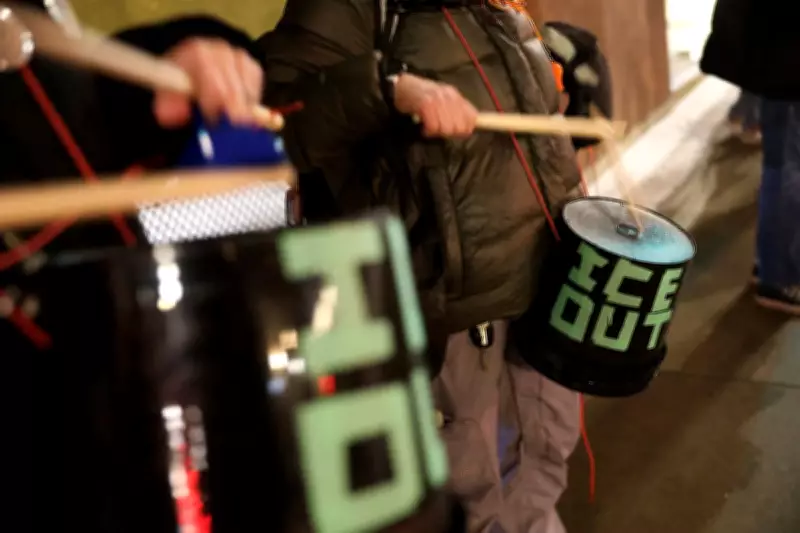
In a striking display of resistance, protesters in Saint Paul, Minnesota, beat buckets to generate noise outside a hotel where Immigration and Customs Enforcement (ICE) agents were reportedly staying on February 5, 2026. This act symbolizes the escalating conflict between US cities and federal immigration authorities, as municipalities develop unprecedented strategies to safeguard their communities.
Establishing ICE-Free Zones for Public Safety
Numerous cities, counties, and states are implementing "ICE-free zones" to restrict federal agents' access to government-owned and public areas. Officials assert that these measures enhance safety, allowing residents to visit hospitals, courthouses, parks, and other essential spaces without fear of immigration raids. While these restrictions cannot entirely prohibit ICE operations on public property, they facilitate potential lawsuits against agents who violate the rules.
This approach builds on the sanctuary city movement of the 1980s, which aimed to protect migrants and refugees by limiting cooperation with federal enforcement. During the first Trump administration, these cities were pivotal in opposing family separations and ICE raids. In October of last year, Chicago Mayor Brandon Johnson issued an executive order to create an ICE-free zone amid Operation Midway Blitz. Similar actions have since been taken in Oakland, San Jose, Richmond, Los Angeles County, Washtenaw County in Michigan, Providence, New York City, and New Jersey.
Enhancing Legal Accountability for ICE Agents
Following the fatal shooting of Minneapolis resident Renee Good by an ICE agent last month, claims of "absolute immunity" for federal agents have sparked debate. Legal experts dispute this notion, but accountability remains challenging, as seen in cases like that of Alex Pretti, another Minneapolis resident killed by federal agents.
To address this, cities such as Chicago and Philadelphia are proposing new methods to streamline lawsuits against ICE agents. In January, Chicago's mayor directed city police to document federal immigration agents, laying groundwork for prosecuting criminal misconduct. This evidence could prove crucial in incidents where residents are harmed or charged by agents.
The case of Marimar Martinez, a teacher shot five times by ICE agents in Chicago, illustrates the potential impact. While agents alleged she drove into them and the Department of Justice pressed charges, body camera footage contradicted the official narrative. The charges were dropped, and Martinez successfully sued to release additional evidence.
In Philadelphia, District Attorney Larry Krasner has formed the Project for the Fight Against Federal Overreach (Fafo), a coalition of prosecutors sharing strategies to hold federal agents accountable under state laws. Members include district attorneys from Minneapolis, Austin, Dallas, Arlington, and Pima County.
Blocking ICE's Warehouse Conversion Plans
As part of the Trump administration's mass deportation strategy, ICE has sought to purchase warehouses nationwide for conversion into detention centers, facing fierce opposition from communities and local officials.
In Ashland, Virginia, over 100 protesters braved freezing temperatures to successfully lobby against a Department of Homeland Security (DHS) warehouse purchase, leading the billionaire Canadian owner to reject the offer. In Oklahoma City, residents packed a city council meeting to protest DHS interest in a local warehouse, prompting Republican Mayor David Holt to negotiate with owners and announce the facility would not be sold.
Nearby in Durant, Oklahoma, the Choctaw Nation banned the sale of an empty distribution center near tribal lands to DHS. In Kansas City, Missouri, the port authority severed ties with a local company to discourage warehouse sales, and the city council imposed a moratorium on new detention centers.
Targeting ICE Contracts for Rental Cars and Parking
Organizers have focused on identifying and disrupting local contracts with ICE, pressuring elected officials and institutions to cut ties. Enterprise Rent-A-Car has been a frequent target due to its partnership with ICE. After agents swept into Los Angeles last summer, a local congregation of nuns canceled their 18-car rental reservations upon learning of the company's involvement.
City and state officials are also scrutinizing these relationships. In December, Illinois Secretary of State Alexi Giannoulias revoked an Enterprise license plate after reports of ICE agents illegally swapping plates to evade tracking.
Efforts extend to ICE's office spaces and parking facilities. In Lehigh County, Pennsylvania, County Executive Josh Siegel canceled a county-owned lease for an ICE office in Allentown, citing over $115,000 in unpaid rent and condemning DHS's "recklessness." In New York City, officials are urging a park trust to terminate a contract allowing ICE agents to park in a Manhattan garage, with the trust planning non-renewal this summer.
Philadelphia city councilors are advancing an "ICE Out" legislative package to prohibit city contracts with DHS and bar agents from city-owned spaces, mirroring ICE-free zone initiatives. Aniqa Raihan of the No ICE Philly coalition praised the bold approach, emphasizing the need for creativity in keeping ICE out of communities. In Minneapolis, the city council is withholding liquor license renewals from hotels housing ICE agents, intensifying the local resistance.




