
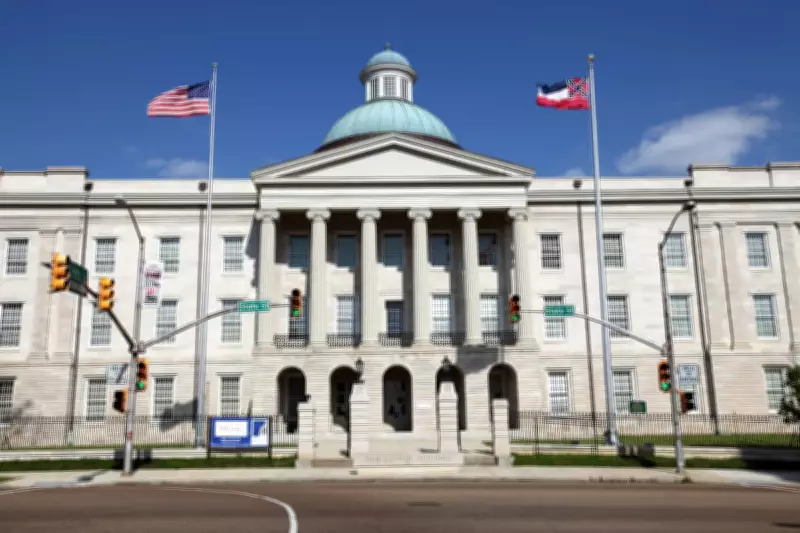
Mississippi’s Old Capitol building has witnessed some of the state’s most racist history, including the 1861 vote to secede from the Union to preserve slavery. Now, on May 20, members of the Mississippi House will convene there for a special session to redraw state supreme court districts, citing renovations in the current house chamber.
Controversial Venue
Republican House Speaker Jason White told WLBT that any special session between now and January 2027 will be held in the Old Capitol. The state senate will continue to use the new capitol. The last time lawmakers met at the Old Capitol was in 2009 for a ceremonial acknowledgment of post-Hurricane Katrina repairs. During the 1980s renovations, they met at the old Central High School.
For some, the choice of venue is deeply troubling. State Representative Kabir Karriem, leader of the legislative Black caucus, said: “I was a little taken aback with the location of the Old State Capitol. Even though they said that they were doing some remodeling, the optics of it are horrific for 1.2 million Black folks here in the state of Mississippi.”
Voting Rights Context
The special session follows the U.S. Supreme Court’s decision in Louisiana v. Callais, which weakened Section 2 of the Voting Rights Act. Governor Tate Reeves called lawmakers back to redraw three supreme court districts, and many predict the new maps will dilute Black voting strength. Additionally, Donald Trump has urged Mississippi to redraw congressional districts to target Representative Bennie Thompson, the state’s only congressional Democrat.
Safia Malin, policy director for One Voice Mississippi, said using the Old Capitol “feels like it’s almost a deliberate or intentionally cruel attempt, even if that’s not the way it’s being presented on its face.” She added, “It feels like a cool reminder of our past as it relates to regaining full citizenship in the state and the path that we’re moving towards.”
Historical Legacy
White supremacist lawmakers met at the Old Capitol to draft the 1890 constitution, which instituted Jim Crow laws and disenfranchised Black Mississippians for generations. Today, over 40,000 Black Mississippians remain disenfranchised due to those laws. State Representative Cheikh Taylor, chair of the Mississippi Democratic Party, said the session is about “power, and making sure Black Mississippians never have enough of it to threaten the people who currently hold it.” He added: “And now they plan to do it in the Old Capitol, the same building where Mississippi voted to secede from the Union over slavery, and where white supremacist delegates crafted the 1890 Constitution that stripped Black citizens of their voting rights and ushered in decades of poll taxes, literacy tests and racial terror. Rep Kabir Karriem is right. It is a slap in the face to the 1.2 million African Americans in this state. It is also a confession. They are returning to the scene of the crime to try and finish the job.”




