
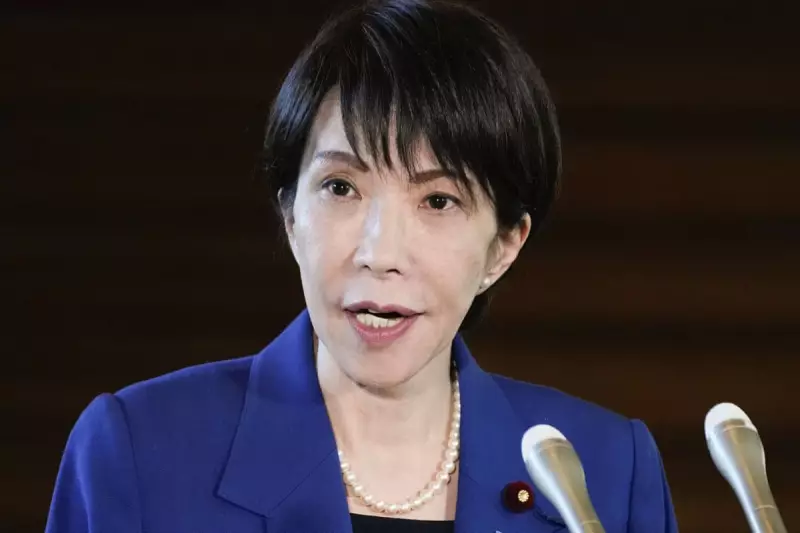
In a bold political gambit, Japan's Prime Minister Sanae Takaichi has announced a surprise snap election, seeking a public mandate to solidify her premiership and reverse her party's recent electoral decline.
High-Stakes Political Move
Prime Minister Takaichi confirmed on Monday that she will dissolve the powerful lower house of the Diet, Japan's parliament, on 23 January. The subsequent general election is scheduled for 8 February 2025, a full three years ahead of the originally planned date in October 2028.
Addressing the media, Takaichi framed the decision as a direct appeal to the electorate. "I am putting my future as prime minister on the line," she stated. "I want the people to decide directly whether they can entrust the management of the country to me." She described the choice to call an early poll as "very difficult" but necessary.
Capitalising on Popularity Amidst Challenges
Takaichi, who became Japan's first female prime minister three months ago, appears confident her personal popularity can stem a series of poor election results for the long-ruling Liberal Democratic Party (LDP). The party, alongside its former coalition partner Komeito, lost its majority in the lower house in October 2024 and in the upper house the previous July.
This forced Takaichi into a fragile governing alliance with the populist Japan Innovation Party upon taking office. Her approval ratings have remained robust, partly buoyed by a firm stance in a deepening dispute with China over Taiwan. She angered Beijing by suggesting Japan could intervene militarily in a Taiwan conflict if its own security were threatened, a remark she has refused to retract.
However, significant risks accompany her electoral gamble:
- Economic Fallout: The rift with China has led to travel advisories and cancelled events, potentially harming Japan's export-led economy. China has also banned exports of "dual-use" items to Japanese military firms.
- Domestic Concerns: Voters remain preoccupied with the cost of living. A recent NHK poll found 45% of respondents cited prices as their main worry, overshadowing diplomacy and national security at 16%.
- Party Scandals: The LDP continues to face scrutiny over a lingering political funding scandal involving slush funds.
Policy Pledges and Opposition Reshuffle
In response to economic anxieties, the ruling coalition is considering a two-year suspension of the 8% consumption tax on food items. Takaichi has also reportedly moved to ban political fundraisers by ministers to address public anger over financial misconduct.
An advocate of significant fiscal spending, Takaichi has instructed ministers to ensure the swift implementation of the current supplementary budget and parliamentary approval for next year's budget.
The political landscape has been further complicated by the formation of a new opposition force. The main opposition Constitutional Democratic Party of Japan (CDPJ) has merged with the LDP's former partner, Komeito, to create the Centrist Reform Alliance. Its leaders promise a shift from "divisive, confrontational politics to one of coexistence and inclusion," posing a fresh challenge to Takaichi's razor-thin majority.
The prime minister signalled her intent earlier this month, writing on social media platform X about her "fresh determination as a leader." She noted a visit to a memorial for her political mentor, the assassinated former Prime Minister Shinzo Abe, underscoring the personal and political stakes of her upcoming electoral test.




