
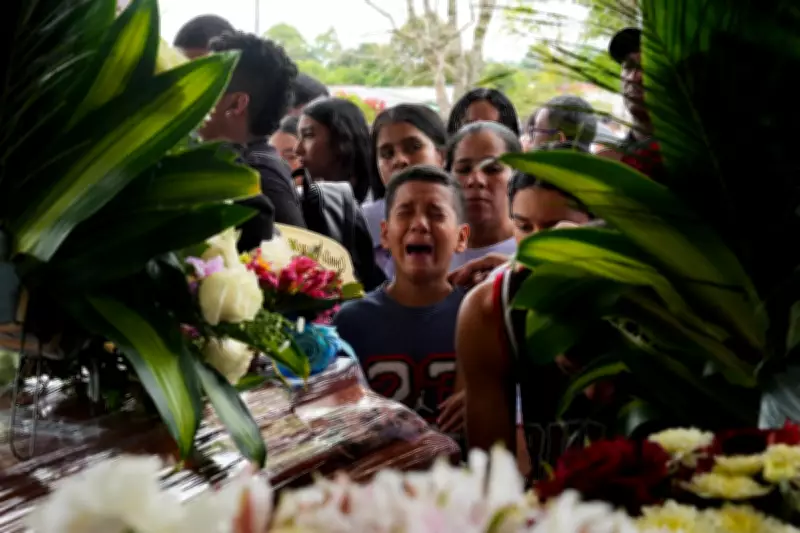
Mourners gathered at a funeral for victims of a bomb attack on Sunday in Cajibio, Colombia, as the country prepares to elect a new president amid a fierce debate on how to end the decades-long armed conflict. The landmark 2016 peace deal between the Colombian government and the Revolutionary Armed Forces of Colombia (Farc) succeeded in reducing violence, but it failed to end the conflict entirely. Subsequent administrations slow-walked implementation, and dissident factions rejected the settlement.
Petro's 'Total Peace' Promise
When Gustavo Petro, a former rebel, became president in 2022, he pledged to achieve 'total peace' by signing deals with all armed groups, including leftwing rebels and organized crime factions. However, four years later and weeks before the election of his successor, guerrilla attacks are surging. Homicides, kidnappings, and massacres have risen, making the internal armed conflict central to the vote once again.
Recent Attacks
Twenty-one people were killed in a bombing on a major road at the weekend, one of the deadliest attacks on civilians in Colombia's history. The attack was carried out by the Central Command (ECM), a powerful Farc dissident group. 'It was not an isolated incident,' said María Victoria Llorente, executive director of the Ideas for Peace Foundation. 'It has to be seen in the broader context of the evolution of organized violence in Colombia.'
Colombia risks a return to its violent past, warned the architect of the landmark peace deal. Petro's peace promise has become a key issue before the election's first round on 31 May. The constitution does not allow re-election, and Petro's chosen candidate, leftwing senator Iván Cepeda, supports maintaining 'total peace.' However, rightwing candidates Abelardo de la Espriella and Paloma Valencia promise to scrap the plan and return to all-out war.
Failure of Total Peace
Llorente stated, 'It is clear that total peace has failed. When this government began, there were six departments under dispute. Today there are between 13 and 14.' The policy offered armed groups benefits like reduced sentences and suspension of military operations in exchange for disarmament. But Petro announced ceasefires without established protocols, which had been vital to the original Farc peace deal.
Shortly after, the National Liberation Army (ELN) denied agreeing to any truce. Most negotiations are now frozen or abandoned. Armed factions have used temporary ceasefires to expand and clash for territorial control and illicit economies like drug trafficking. At the start of 2025, fighting between the ELN and Farc dissident group Frente 33 left more than 80 dead and 60,000 displaced.
Violence Escalates
Petro, initially a critic of lethal military action, authorized artillery assaults and airstrikes, some killing forcibly recruited youths. This year is the most violent since the 2016 peace agreement. The election race was marked by the first assassination of a prominent presidential hopeful in over three decades: rightwing senator Miguel Uribe Turbay was shot in June 2025 by Farc dissidents and died months later.
In February, leftwing senator Aida Quilcué was kidnapped while traveling through Cauca, the same department where the recent bomb exploded. She was released after four hours. Quilcué, now vice-presidential candidate on Cepeda's ticket, said the abduction marked a new level of danger.
Francisco Daza of the Colombian Peace and Reconciliation Foundation said, 'The elections have so far been marred by a context of insecurity and violence.' All main candidates have reported threats. Some illegal armed groups seek to interfere in the electoral cycle, using murder and kidnapping as warnings.
Looking Ahead
Llorente noted that while violence has risen, the current homicide rate of about 26 per 100,000 inhabitants is far below the peak of 80 per 100,000 in the early 1990s. She emphasized that Colombia has a track record of innovation in peace and security, but the state must use all tools more strategically. Catalina Beltrán of Colombia Risk Analysis said the next government faces an extremely difficult challenge due to the fragmentation of the conflict. 'Rather than a single solution, the situation needs to be approached calmly, avoiding overly ambitious decisions. Strengthening a mixed strategy of negotiations and offensive actions could be the most appropriate approach.'




