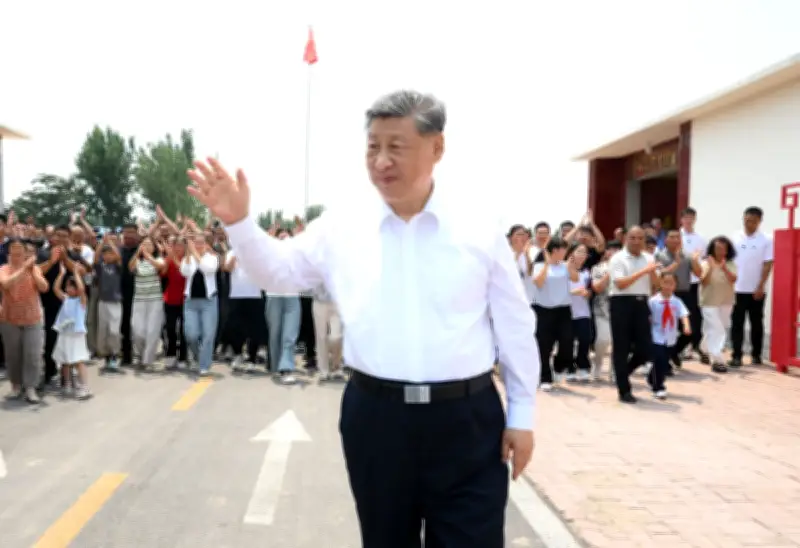
Chinese leader Xi Jinping met Bangladesh's new prime minister on Friday, the latest in a wave of world leaders to visit Beijing this year as the Chinese leader builds his influence and economic ties, and seeks to 'shift the balance of power' away from the west.
Xi's diplomatic blitz: more than a dozen leaders in 2025
Xi's meeting with Tarique Rahman came less than two weeks after the Chinese leader welcomed Myanmar's military chief-turned-president, Min Aung Hlaing, in Beijing. In May, Xi hosted leaders from the US, Russia, Brunei, Serbia, Tajikistan and Pakistan, while a host of foreign ministers also came to China for lower level meetings. More than a dozen world leaders—including presidents and prime ministers—have visited so far this year, including Russia's Vladimir Putin, the UK's Keir Starmer and US president Donald Trump. According to William Yang, a senior analyst for the International Crisis Group, 'The long list of world leaders travelling to Beijing to meet with Xi reflects the growing recognition of China's increasing global influence.'
Middle powers seek independent ties with Beijing
Many of the leaders to visit China this year, including Canada's prime minister Mark Carney, framed their trips as a chance for 'middle-power' countries to chart an independent relationship with Beijing against a backdrop of an increasingly capricious US. China can use such visits to 'promote the alternative multipolar world order that it has been championing while weakening these countries' trust and confidence in the US,' Yang said. China is presenting itself as a source of stability—and for many poorer countries, loans—at a time when from the perspective of many countries, the US is retreating from its leading position on the world stage.
Red carpet for authoritarian leaders
Despite Trump's pomp-filled state visit, Beijing has not been shy about courting leaders from authoritarian and Global South countries. Myanmar's military chief-turned-president Min Aung Hlaing got the red carpet treatment in Beijing. The Chinese leader signalled his 'firm support' for Min Aung Hlaing's regime, before reiterating his commitment to the 'principle of non-interference' in the war-torn country's 'internal affairs'. Min Aung Hlaing, accused by UN experts of overseeing war crimes and genocide in Myanmar, appeared a happy man. Only his second foreign trip since cementing power over the south-east Asian country in a widely condemned election six months ago, he has grown increasingly isolated since overthrowing Myanmar's democratically elected government in a 2021 coup. But this proved of little concern to Beijing, which signalled its 'acceptance of the legitimacy of the Myanmar military's rule in Myanmar' with this week's visit, according to Ja Ian Chong, a professor at the National University of Singapore and a non-resident scholar at Carnegie China.
Xi's strategy to shift power to the Global South
This approach can be viewed as part of Xi's wider project to influence international order so 'no country has a right to tell others how to manage their own domestic affairs', according to Steve Tsang, director of the China Institute at Soas University of London. 'Engagement with less glamorous leaders from less rich countries is very much what the strategy is about,' said Tsang. '[Xi is] fundamentally shifting the balance of power from the hands of the advanced democracies … to the Global South, with China as its leader.'
North Korea visit and nuclear issue sidestepped
Earlier this month, Xi adopted a similar playbook as he sidestepped another thorny issue when visiting Kim Jong-un in a rare overseas trip. Despite previously expressing strong opposition to North Korea's nuclear weapons programme, the issue was conspicuously absent from readouts. Stabilising ties took precedence, with Beijing's silence viewed as tacit acceptance of North Korea's nuclear-armed status.
China's limited influence in resolving crises
Chinese state media has been keen to present Beijing as the new hub of global diplomacy. In May, the Global Times ran a piece which said that the back-to-back visits of Trump and Putin 'underscores both the intensity of China's diplomatic calendar and its expanding influence on the world stage'. That is despite the fact that when it comes to actually solving international crises, Beijing's influence has been limited. Although credited with initially pushing Iran towards ceasefire talks with the US, Beijing has not been a peacemaker in that conflict. While Beijing helped to broker a detente between Saudi Arabia and Iran in 2023, China does not wield a decisive influence over Tehran. And when it comes to the war in Ukraine, China's 12-point plan for a political settlement, published in 2023, has long been forgotten and is overshadowed by Beijing's enduring support for Russia's invasion.