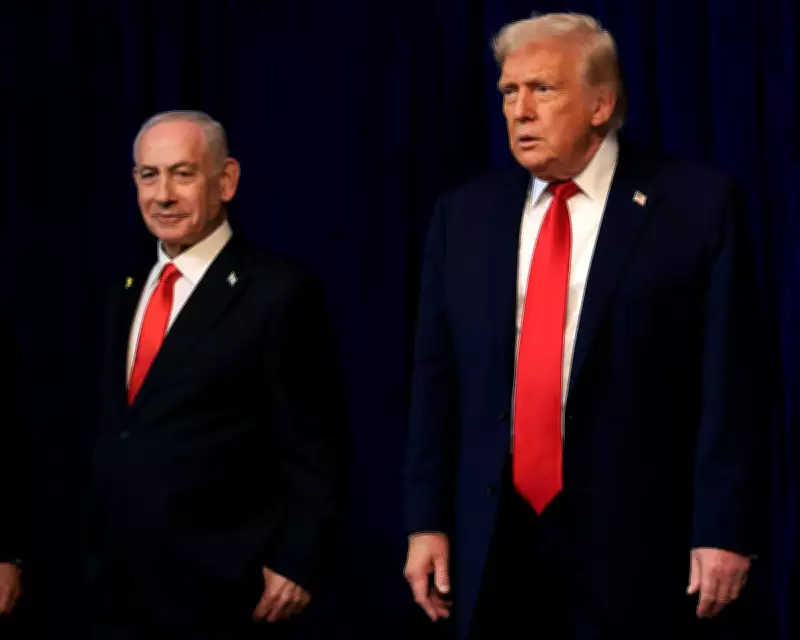
US-Israel Military Aid Consensus Frays as Public Opinion Shifts Dramatically
Bipartisan backing for the special relationship between the United States and Israel is showing significant signs of strain as ongoing Middle East conflicts drive a profound transformation in American public sentiment. For decades, military aid to Israel enjoyed widespread support across political lines, but that consensus is now unraveling under pressure from human rights concerns on the left and "America First" foreign policy sentiments on the right.
Democratic Party Shifts and Presidential Implications
The change has been particularly noticeable within the Democratic Party. When Senator Bernie Sanders first introduced a joint resolution to oppose arms sales to Israel last year, only 15 Democratic senators supported it. By July, that number had grown to 27. Most recently, a vote against supplying Caterpillar D9 bulldozers to Israel—which Sanders argued could be used to destroy homes in the West Bank, Gaza, and Lebanon—was defeated but garnered a record 40 Democratic supporters.
Foreign policy analyst Jon Hoffman from the Cato Institute noted that several Democratic senators who flipped to support these resolutions are considering presidential runs in 2028. "I think it's going to be very difficult for a 2028 Democratic primary candidate to win if they do not openly disavow US aid to Israel—possibly even the US-Israel special relationship," Hoffman stated. "I think we will have reached that point by 2028."
Public Opinion Data Reveals Growing Discontent
Recent polling underscores the dramatic shift in American attitudes. The Pew Research Center released data showing a record 60% of US adults now hold an unfavorable view of Israel, marking a 7% increase in just one year. The poll, conducted nearly a month into the joint US-Israeli intervention in Iran, also revealed a significant age gap: a majority of adults under 50 in both political parties view Israel and Prime Minister Benjamin Netanyahu negatively.
The number of Americans with a strongly or somewhat unfavorable view of Israel has risen by 20 percentage points since 2022. This period includes Hamas's raid from Gaza that killed over 1,200 people and Israel's subsequent war in Gaza, which has resulted in an estimated 72,000 Palestinian deaths. These events have served as an inflection point for the decades-long US-Israel relationship.
Moderate Democrats Cite Changing Circumstances
Moderate Democrats have been influenced by shifting public opinion and concerns over Israeli military conduct in Gaza, as well as frustration with Donald Trump's support for the Iran war. Senator Mark Kelly of Arizona, who voted for the joint resolution, explained, "We can all look at what is happening in the region right now and understand that this is not business as usual—and it is not making us safer. The United States and Israel are fighting a war against Iran without a clear strategy or goal."
Senator Ruben Gallego, who has become a vocal opponent of offensive weapons sales to Israel, told Punchbowl News that the vote "means Netanyahu really screwed up the politics of the Middle East, and he is destroying the bipartisan nature in terms of support for Israel."
Think Tanks and Advocacy Groups Reassess Positions
In a notable development this week, the liberal think tank J Street, which describes itself as "pro-Israel, pro-peace," announced it would change its stance for the first time to oppose direct US funding for arms sales to Israel, including defensive weapons like Iron Dome missiles. Jeremy Ben-Ami, founder of J Street, called for a "fundamental reassessment of the U.S.-Israel security relationship" and suggested the US should treat Israel like other wealthy allies, allowing it to purchase arms without subsidies.
"It's really important for Israel to stop this financial subsidy and take this out of the equation," Ben-Ami said. "It is really causing a whole additional level of anger that the things that this government of Israel is doing are being financed by American taxpayer dollars." He cited aggravating factors such as the war in Gaza, rising extremist Jewish terror in the West Bank, and the US-Israel war with Iran.
Impact on Future Elections and Policy Directions
While shifting public opinion may not immediately alter White House policy, observers predict it will strongly influence the 2028 presidential cycle. Democratic candidates are likely to face pressure to disavow US support for Israel in the Iran war, while the Republican field will be shaped by Trump's enduring influence in conservative politics.
Josh Paul, a former director at the US Bureau of Political-Military Affairs who resigned over lack of oversight on arms sales to Israel, noted the differing framings on each side: "The conversation on the Democratic side is often hinged to questions of human rights and the international rules-based order. On the Republican side, it's much more often framed either around taxpayer funding for Israel, or around is this America first or Israel first? And the war with Iran has only brought that into sharper focus."
As the 2028 elections approach, the erosion of bipartisan support for military aid to Israel signals a potential reconfiguration of US foreign policy in the Middle East, with lasting consequences for international relations and domestic politics.