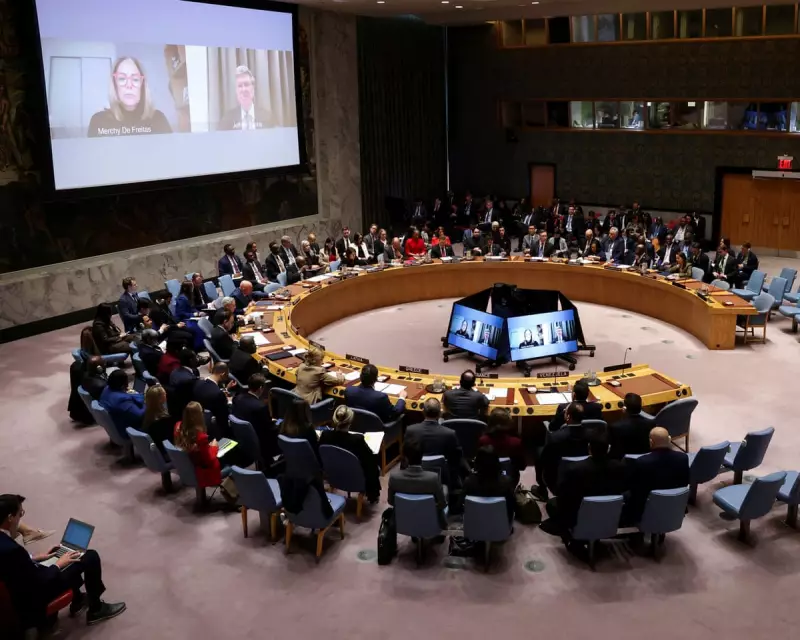
The United States faced a torrent of international criticism during an emergency session of the United Nations Security Council on Monday. Nations branded recent American military strikes against Venezuela and the capture of its president, Nicolás Maduro, and his wife as a "crime of aggression."
Global Condemnation at the UN
Ambassadors from a diverse coalition of countries united in their denunciation of the US actions. Sérgio França Danese, Brazil's ambassador to the UN, stated the operations crossed an unacceptable line, representing a grave affront to Venezuelan sovereignty and setting a perilous global precedent. The diplomatic rebuke was notably broad, with China, Russia, Spain, Mexico, South Africa, Colombia, Cuba, and Eritrea aligning with Brazil's position.
Meanwhile, in a Manhattan federal court, Nicolás Maduro entered a plea of not guilty to charges including drugs, weapons offences, and "narco-terrorism." His defence is being led by Barry Pollack, the prominent US attorney known for representing Julian Assange.
Domestic and Alliance Fallout
The dramatic foreign policy move has sparked intense debate within Washington. While Republican House Speaker Mike Johnson insisted the US was not at war with Venezuela, Democratic Senate Minority Leader Chuck Schumer warned the nation was teetering on the edge of a new, protracted conflict.
Simultaneously, a separate controversy is brewing over domestic resource allocation. In a letter to the White House, a group of 29 Democratic senators and one independent, led by Arizona's Ruben Gallego, alleged the Trump administration is hampering investigations into child exploitation and drug cartels. They claim this is due to the reassignment of over 28,000 federal law enforcement personnel to support Immigration and Customs Enforcement (ICE) operations.
NATO Under Threat Over Greenland
Further straining international relations, Danish Prime Minister Mette Frederiksen issued a stark warning regarding Donald Trump's renewed interest in acquiring Greenland. She stated that a US military attack on the Danish territory, a NATO ally, would mean the end of the alliance and the post-Second World War security architecture. Trump has cited Greenland's strategic location for missile defence and its significant mineral resources as reasons for the US needing it "very badly."
In other significant developments, the Trump administration has made a major shift in US health policy, now recommending only 11 out of 17 routine childhood vaccines. Public health experts have universally condemned the move under the guidance of vaccine critic Robert F. Kennedy Jr.
Venezuela's vast oil reserves, estimated at 303 billion barrels, remain a key strategic prize. However, analysts from Rystad Energy note that revitalising the country's oil industry would require massive foreign investment, contingent upon prolonged political stability.