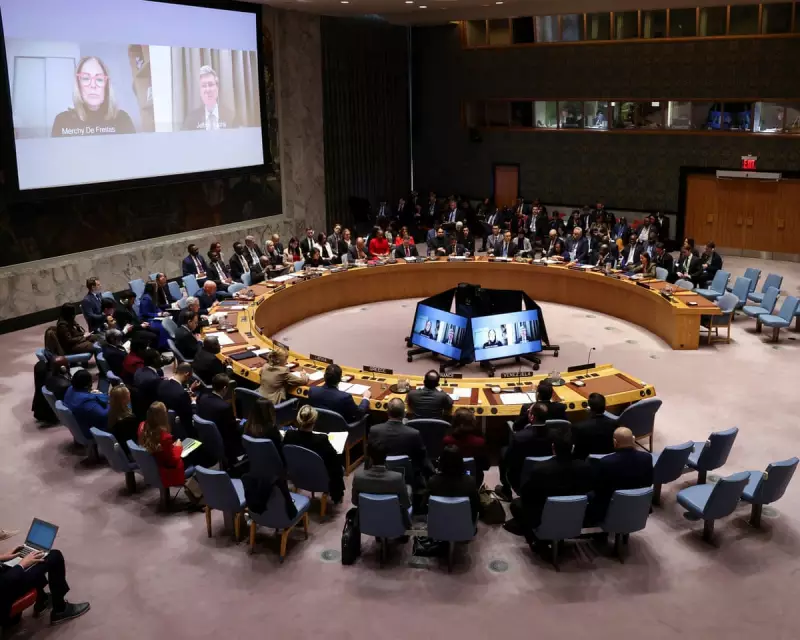
The United Nations Security Council convened for an emergency session on Monday, where the United States faced widespread international condemnation for its military strikes in Venezuela and the capture of the country's president, Nicolás Maduro, and his wife, Cilia Flores.
Global Outcry at Emergency Session
Ambassadors from a broad coalition of nations, including both US allies and adversaries, denounced the operation as a flagrant violation of international law. The Brazilian ambassador, Sérgio França Danese, told the council the actions crossed an unacceptable line, constituting a “very serious affront to the sovereignty of Venezuela” and setting a dangerous global precedent.
Other nations were equally forceful. Russia’s ambassador, Vasily Nebenzya, whose country is under US sanctions, described the intervention as a return to an era of lawlessness. China’s representative, Fu Cong, accused the US of trampling on sovereignty and acting as a self-appointed world police. Cuba’s envoy labelled it an “imperialist and fascist aggression.”
US Defends Action as Law Enforcement
In a robust defence, US Ambassador Mike Waltz argued the operation was not an act of war but a legitimate “law enforcement” action. He stated it was carried out to execute long-standing US criminal indictments against Maduro, whom he described as an “illegitimate so-called president.” Waltz invoked the 1989 capture of Panama’s Manuel Noriega as a precedent and cited Article 51 of the UN Charter concerning self-defence.
Venezuela’s ambassador, Samuel Moncada, countered by calling the attack illegitimate and a kidnapping. He asserted that “no state can set itself up as a judge, party and executor of the world order.”
Legal Precedent and Regional Stability in Question
The meeting revealed deep fractures within the international community. UN Secretary-General António Guterres, in a statement read by political chief Rosemary DiCarlo, expressed profound concern that the capture risked intensifying instability in Venezuela and the region, questioning its adherence to international law.
Legal experts have pointed out the operation lacked UN Security Council authorisation, Venezuelan consent, or a clear self-defence rationale. The principle of refraining from the use of force against a state's territorial integrity, a cornerstone of the UN Charter, was repeatedly invoked by critics.
Despite the strong rhetoric, the council remains paralysed. Any formal attempt to censure the United States is certain to be vetoed by Washington itself, highlighting the enduring power dynamics that stymie collective action at the world's top security body.