
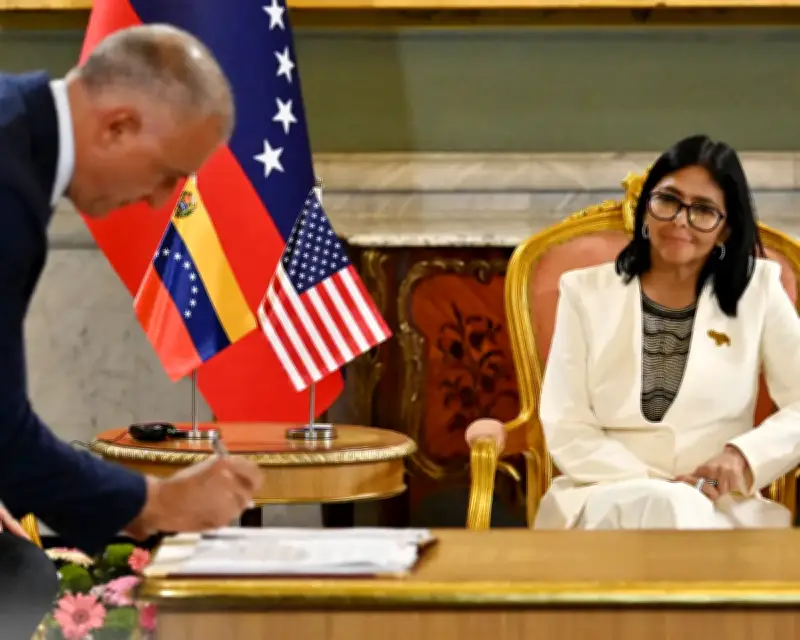
The United States, under President Donald Trump, has secured a deal granting it a fifth of Venezuela's proven oil reserves, signed by interim president Delcy Rodríguez in Caracas on 2 September 2026. This agreement, described by Trump as "the biggest oil deal in history," follows the capture of Nicolás Maduro and represents a modern form of gunboat diplomacy, according to a Guardian editorial.
Regime Change and Commercial Concession
The editorial argues that imperialism does not require a flag or a governor. It can be a powerful nation deciding who governs a smaller, weaker country and on what terms its resources are developed. Trump's actions—kidnapping Maduro, installing his deputy Rodríguez, and then having her sign over a fifth of the country's oil reserves—amount to regime change supplying America's commercial concession.
This approach, the editorial notes, aligns with 19th-century gunboat diplomacy. The US does not rule Venezuela directly but exercises power through Rodríguez, a lifelong socialist who is remaking Chavismo, the movement launched by Hugo Chávez, in her image, which has enraged some leftists.
Oversold Spoils and Unmet Promises
The editorial contends that Trump has oversold his neocolonial spoils. Additional production from Venezuela might bring down oil prices eventually, but not anytime soon. Crucially, the deal will not cause prices at the pump to fall before November's midterms, a key concern for American voters struggling with energy bills. The unrealized Orinoco Belt riches are unlikely to help Republican candidates.
Trump also promotes the idea that he is transforming the US industrial landscape through fossil fuels. However, while the Venezuela oil grab might be highly profitable for a few selected companies, the windfall is dwarfed by the size of the US economy. Trump is not getting cheap energy but a spectacle of American power, which may be enough for him.
Deal Details and Economic Impact
Before Maduro was captured, Trump had decided Venezuela's oil belonged to the US. Maduro was offered exile if he gave Washington what it wanted. When he dithered, a US armada assembled off Venezuela's coast. Trump did not replace Maduro with María Corina Machado from the democratic opposition but backed the authoritarian regime that could secure oilfields from ambitious army generals and spare occupation costs.
Rodríguez has granted North American Blue Energy Partners (Nabep) concessions to 17 oilfields in Venezuela for decades. Nabep's boss, Alejandro Betancourt, a controversial Venezuelan oil billionaire, appeared in Caracas for the visit by US energy secretary Chris Wright. Nabep has granted the Pentagon a 35% equity stake at no cost to the US taxpayer.
Rodríguez argues she is no puppet, saying cooperation with Trump will bring investment and could generate $200bn in oil revenues. The editorial questions what kind of economy and social order that revenue will produce, noting that oil cash is not the same as sovereign development. Unequal bargains have often benefited local rulers and intermediaries.
Ego and Legacy
The editorial characterizes Trump as a playground bully handed the world's most powerful military, mistaking coercion for greatness and sovereign nations for toys. He uses US power to feed his ego, recently claiming to be a bigger historical figure than Caesar, Genghis Khan, Napoleon, Stalin, and Mao. When he departs, others will have to rebuild what he has squandered: US authority, alliances, and reputation.




