Trump's Board of Peace Launches Amid European Boycott and Funding Questions
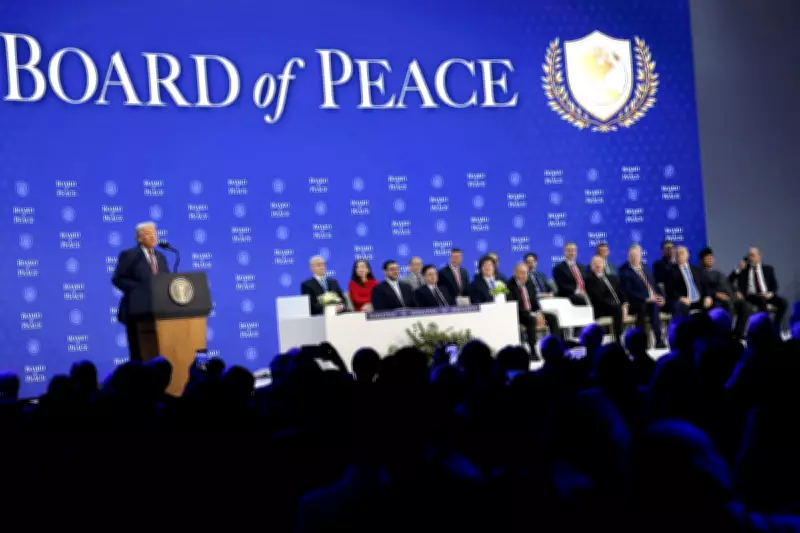
Donald Trump has announced the charter for his Board of Peace at the World Economic Forum in Davos, Switzerland, setting the stage for its inaugural meeting in Washington DC. However, the initiative faces significant skepticism as major European allies have declined to participate, raising concerns about the organization's opaque funding and political objectives.
European Allies Withdraw Support
The White House has indicated that Thursday's summit at the renamed Donald J Trump Institute of Peace will primarily function as a fundraising event. Trump claimed on social media that countries have pledged over $5 billion toward rebuilding Gaza, which remains devastated by the war with Israel and is in a severe humanitarian crisis. The US president also stated that member states committed "thousands of personnel to the International Stabilization Force and Local Police to maintain Security and Peace for Gazans."
Despite these announcements, key European leaders including Ursula von der Leyen of the European Commission, along with officials from the United Kingdom, Germany, and France, have refused to join the Board of Peace. Trump rescinded an invitation to Canada's Mark Carney following critical remarks by the Canadian prime minister at Davos last month. The Vatican also declined participation, with Cardinal Pietro Parolin emphasizing that international crises should be managed by the United Nations.
Skepticism Over Gaza Reconstruction Plans
The board was initially formed with Gaza reconstruction as its primary goal, though Trump has since expanded its mandate to address other global conflicts. Aaron David Miller, a senior fellow at the Carnegie Endowment for International Peace, noted that the board would struggle to resolve fundamental issues in the Israel-Gaza conflict, including governance, security, and Palestinian needs. "Pledges are one thing, delivering is another," Miller said, highlighting the gap between announcements and implementation.
Max Rodenbeck of the International Crisis Group added that there is "huge global scepticism about the shape and intentions of the Board of Peace," warning that credibility would quickly crumble without tangible improvements on the ground. The 100-day peace and recovery plan announced by Jared Kushner in Davos has stalled, with aid into Gaza remaining minimal.
Attendance and Political Dynamics
The Washington meeting will be attended by Middle Eastern delegations from Israel, the United Arab Emirates, Saudi Arabia, Turkey, Jordan, and Qatar, along with countries like Argentina, Paraguay, Hungary, and Kazakhstan. Many are seen as currying favor with the Trump administration, as the board offers a permanent seat for a $1 billion donation. However, Israeli Prime Minister Benjamin Netanyahu, who signed onto the idea during a recent Washington visit, will skip the event, sending Foreign Minister Gideon Saar instead.
Winning Israeli cooperation is expected to be challenging in an election year, as Netanyahu navigates political pressures and avoids associations with regional powers like Qatar and Turkey, which have ties to Hamas. On the ground, progress has been slow: the National Committee for the Administration of Gaza (NCAG), established under Trump's plan, remains in Cairo without clear tools or budgets. Nickolay Mladenov, the board's high representative for Gaza, has had little visibility, and the NCAG's social media posts express frustration over lacking administrative powers.
Humanitarian and Security Challenges
Aid into Gaza remains severely limited, with restrictive bans on "dual-use" items like metal tent poles hindering reconstruction. Sam Rose of UNRWA noted that Israel continues to encroach on Gaza territory, with ongoing demolitions and casualties. Diplomats in Jerusalem worry that the International Stabilization Force plan will fail without conditions for Hamas disarmament and IDF withdrawal. Indonesia has offered 8,000 troops, but preparations are incomplete, and an office marked "ISF" stands empty.
Gershon Baskin, an Israeli peace activist, summarized the situation: "Everything is going slower than expected, and everyone is very frustrated." As the Board of Peace convenes, it faces not only a boycott from traditional allies but also deep-seated doubts about its ability to deliver meaningful change in Gaza and beyond.