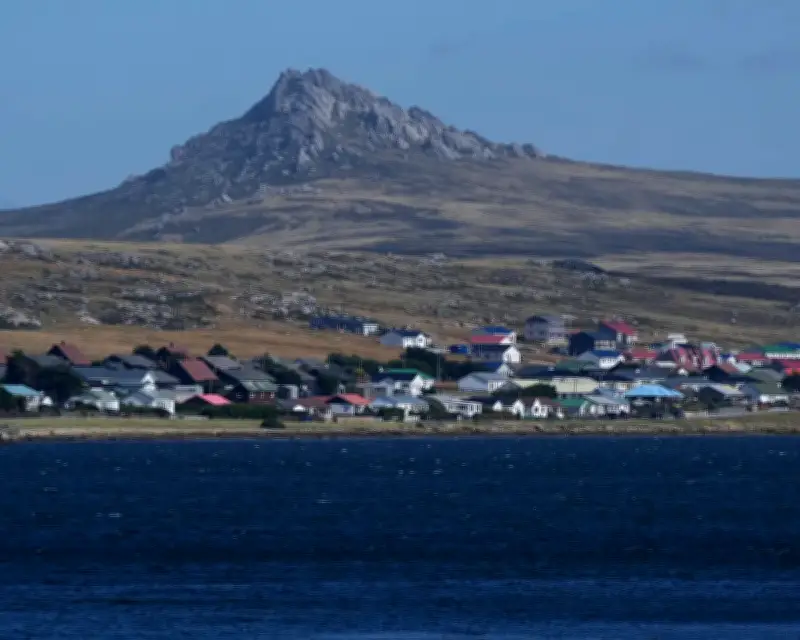
US President Donald Trump has suggested he is reconsidering Washington's longstanding support for British sovereignty over the Falkland Islands, a move that could favor Argentina's renewed claim to the territory and serve as retribution against the UK. The comment, made in a recent interview, has emboldened Argentinian President Javier Milei to formally reopen his country's claim to the islands, known as the Malvinas in Argentina.
Trump's Retribution and the Falklands
Trump's inclination towards vengeance, a theme he embraced publicly since his 2023 CPAC speech, now appears to extend to international relations. In a televised address on Thursday, Milei announced his intention to pursue Argentina's sovereignty claim over the islands, a dispute dormant since the 1982 Falklands War. Trump's suggestion that he is "reviewing" the US's neutral stance on the territory's sovereignty has been seized upon by Milei as an opportunity to press Argentina's case.
The roots of Trump's grievance lie in the UK's refusal, under former Prime Minister Keir Starmer, to support the US decision to go to war with Iran. Trump expressed his frustration in an interview with GB News, stating, "Your country was not there to help me. We didn't need help, but I did ask Nato, and I asked your former leader, 'Why don't you send a couple of ships?' He said, 'We don't have any.' It was pretty sad, the whole thing."
Milei's Opportunism and Geopolitical Ripples
Milei's move to capitalize on Trump's vengeance highlights the potential for ripple effects from the Iran conflict to reach beyond the Gulf. Trump's animosity towards allies who declined to support his war efforts is not limited to the UK. Annual joint military exercises with South Korea were scaled down and cut short by six days last month due to Seoul's refusal to join the fight against Iran. Trump has also threatened to bomb Oman if it impedes efforts to reopen the Strait of Hormuz, and the White House announced the withdrawal of 5,000 US troops from Germany after Chancellor Friedrich Merz rebuffed pressure to get involved in the conflict.
Milei, a self-styled "anarcho-capitalist" who attended Trump's 2025 inauguration, remains in the president's good graces. Last year, the US extended a $20bn loan guarantee to stabilize Argentina's economy, premised on Milei's party defeating the leftist opposition in congressional elections, which it did.
Historical Echoes and Political Calculations
In his address, Milei evoked the "winds of change," a phrase with historical connotations from a 1960 speech by British Prime Minister Harold Macmillan heralding independence for colonial possessions in Africa. Milei suggested Britain was on a "path of decline," citing migratory, demographic, and economic crises. He did not mention his own falling political popularity, a factor that may have influenced the 1982 junta's decision to seize the islands.
The current situation presents a challenge for Andy Burnham, Britain's newly installed Labour prime minister, who must navigate the "chill wind" from the Trump administration. Unlike Thatcher, who had the backing of Ronald Reagan during the Falklands conflict, Burnham faces a US president who views the UK with suspicion. Trump's comments could also be used as leverage to extract more defense spending from the UK, after Chancellor John Healey suggested it might not meet increased NATO targets.