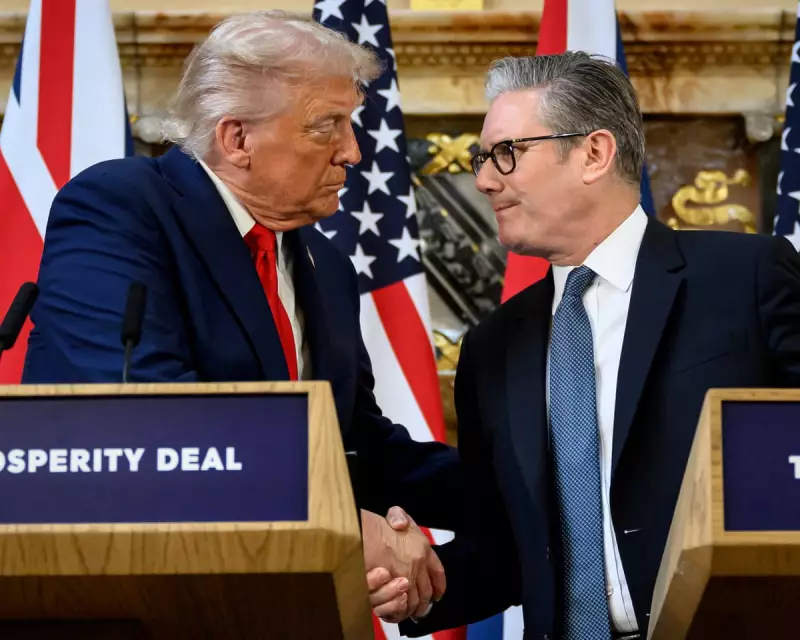
The historic setting of Chequers provided the backdrop for a pivotal moment in modern diplomacy on 18 September 2025. Prime Minister Keir Starmer and former US President Donald Trump shook hands for the cameras, a visual symbol of a complex and fraught relationship. The image, captured by Reuters photographer Leon Neal, belied the profound tension beneath the surface, centred on Trump's recent, unilateral seizure of Venezuelan President Nicolás Maduro from Caracas.
The Art of Diplomatic Evasion
For an observer of Trump's career, his actions are rarely shrouded in mystery. His stated intent—whether it involves regime change in Venezuela or territorial ambitions—is typically a reliable blueprint. This brazen, freewheeling approach stands in stark contrast to Prime Minister Starmer's public caution. The Labour leader's measured, often reticent public statements are not merely a stylistic difference but a diplomatic posture forced upon allies navigating Trump's volatile return to global power.
It took Downing Street 16 hours to issue a comment on the extraordinary event in Venezuela. The eventual statement was a masterclass in saying very little, carefully straddling Britain's nominal commitment to international law and its pragmatic need to avoid alienating Washington. For a former human rights lawyer like Starmer, the principle of state sovereignty and the illegality of abducting foreign leaders would seem clear-cut. Yet, the national interest, particularly security dependence on the US, complicates the moral calculus.
Weighing the Cost of Condemnation
The Prime Minister's hesitation is rooted in real-world consequences. With crucial negotiations on future security guarantees for Ukraine scheduled in Paris—attended by Trump's team—any harsh criticism from London could prove costly. Would the US demand a humiliating retraction? Would it weaken European solidarity at a critical juncture for Kyiv? The dilemma is acute: should Starmer uphold principle to satisfy his backbenchers and maintain moral consistency against Putin, or should he prioritise back-channel diplomacy to shield Ukraine from a potential Trump-brokered deal with the Kremlin?
The defence of Starmer's approach points to a working relationship with Trump that is better than many predicted. On Ukraine, the PM has played a leading role in a NATO charm offensive, successfully persuading Trump that Europe is now bearing the financial burden of the war, which has tempered his earlier enthusiasm for abandoning Kyiv. If the goal is to buy time—to postpone a catastrophic US withdrawal from NATO or a radical shift in policy until a new administration takes office—then this cautious diplomacy has merit.
A Strategic Vacuum at a Critical Juncture
However, the most alarming aspect of Starmer's caginess is not the silence on Venezuela, but what it reveals about a potential strategic void. There is a tactical logic to not criticising Washington now, but it must serve a broader strategy that acknowledges a fundamental truth: Britain's future security and prosperity are inextricably linked to Europe.
Yet, Starmer's vision remains opaque. He speaks in vague terms about closer EU ties but consistently caveats that nothing should compromise the US relationship. His repeated insistence that he will "never choose between the US and Europe" is becoming a mantra of indecision. In a world where Trump actively burns bridges and globalisation fragments into competing blocs, refusing to choose is itself a choice—a choice to let others determine Britain's fate.
The quiet inertia is more dangerous than the refusal to moralise over Latin American adventures. A realpolitik argument for tolerating Trump's "military gangsterism" is also an argument for urgently reducing dependency on the White House. The problem is that Starmer's reticence, in the context of his broader ambiguous statements, looks less like shrewd pragmatism and more like paralysis. The public can forgive a leader who sometimes holds his tongue, but only if they believe he has a serious, unspoken plan for navigating the storm. As of now, that conviction is in short supply.