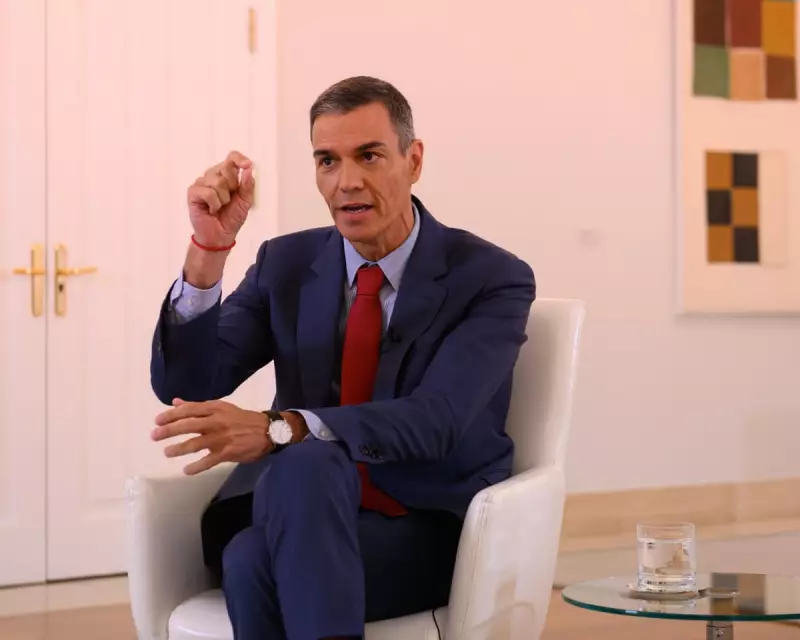
In a striking departure from European diplomatic convention, Spain's Prime Minister Pedro Sánchez has publicly and forcefully condemned the United States' recent military action in Venezuela. While other EU leaders have remained largely silent, Sánchez has broken ranks, delivering some of the most direct criticism of President Donald Trump's foreign policy from any European capital.
A Swift and Unilateral Condemnation
The rupture came this week following what Sánchez termed the US's "illegal military intervention" aimed at capturing Venezuelan President Nicolás Maduro. Unlike his counterparts, Sánchez did not wait for a coordinated European Union statement. Instead, he swiftly aligned Spain with Latin American nations in denouncing the operation.
Speaking in Paris on Tuesday after a meeting on Ukraine, the Spanish leader escalated his rhetoric. He warned that the Caracas operation set "a terrible precedent and a very dangerous one" that evoked past aggressions and pushed the world toward uncertainty. He explicitly linked it to a history of invasions "driven by the thirst for oil."
The Domestic Consensus Behind the Bold Stance
Sánchez's unusually outspoken position, which surpasses even that of other progressive European leaders, is rooted in a unique Spanish context. Analysts point to the influence of the far-left Sumar party, the junior partner in his coalition government. However, his stance also taps into a broad social and political consensus within Spain on several international issues.
Public confidence in President Trump is among the lowest in the world in Spain, and there is widespread support for Palestinian and Ukrainian rights. The Venezuela crisis is particularly resonant domestically. Approximately 600,000 Venezuelans live in Spain, with over 200,000 in Madrid alone, making conversations about Caracas commonplace.
This has created a rare point of agreement across the political spectrum. Even the leadership of the conservative Popular Party (PP) has questioned the legitimacy of the US actions, with the PP-founded thinktank FAES criticising American "colonialism" in the region. The notable exception is the PP's regional Madrid president, Isabel Díaz Ayuso, who remains less critical of Trump and often uses accusations of links to "Chavismo" to attack Sánchez's government.
Calculated Risk or Domestic Distraction?
The critical question is whether Sánchez's condemnation will damage Spain's crucial relationship with the United States—a fear that has kept other European leaders quiet. Thus far, the White House reaction has been muted, though Trump has previously suggested expelling Spain from NATO over defence spending disputes and hinted at punitive tariffs.
Some observers suggest the government's strong words on Venezuela, like its positions on Gaza and Ukraine, are not always matched by decisive action. Madrid has offered to mediate in the crisis, a move seen as partly protecting the interests of major Spanish companies like Repsol and Telefónica operating there. The recent release of five Spanish prisoners in Caracas was hailed by Sánchez as an "act of justice."
For Sánchez, facing a difficult year with looming regional elections and domestic scandals eroding his popularity, focusing on global issues may provide a useful respite. His smooth, outspoken manner on the world stage plays well not just in the global south but also at home, where most Spaniards agree with his fundamental stance on Trump, Ukraine, and Gaza.
Ultimately, Pedro Sánchez's criticism of Donald Trump may be less politically risky than it first appears, given the domestic consensus. Yet, his boldness in articulating what many other European leaders think but dare not say marks a significant moment in European foreign policy independence.