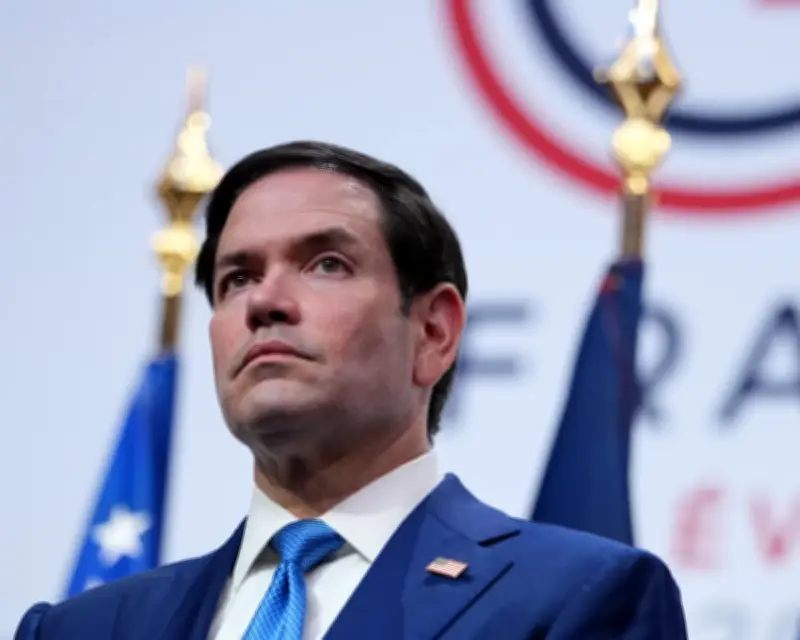
US Secretary of State Marco Rubio is scheduled to visit the United Arab Emirates, Kuwait and Bahrain on Tuesday and Wednesday in an effort to reassure Gulf allies that the United States remains committed to their security following the 60-day ceasefire agreement with Iran reached last week, the State Department announced.
The visit comes amid deep divisions within the Gulf over the ceasefire deal. While Qatar played a central mediating role, countries such as the UAE, Kuwait and Bahrain fear the agreement could hand Iran substantial sums that might be used to bolster its military capabilities.
Trump defends ceasefire terms
President Donald Trump stated on Truth Social on Tuesday that unfrozen Iranian assets would remain under US control and be used exclusively to purchase food and medical supplies from the United States. He also claimed Iran had agreed to allow nuclear inspections far into the future, a statement contradicted by Iranian officials who deny any such commitment.
This marks Rubio's first trip to the region since the US and Israel launched military operations against Iran on 28 February. The State Department confirmed that Rubio will also likely meet with officials from the Gulf Cooperation Council.
Military bases under threat
All three host countries house major US military bases and have been targeted by Iranian missiles, though the US has declined to disclose the extent of the damage. Severe penalties have been imposed on individuals using social media to reveal details of the impacts.
Trump previously disclosed that the UAE actively participated in counterattacks against Iran. Iranian foreign ministry spokesperson Esmail Baghaei stated that Iran believes the UAE, Kuwait and Jordan assisted US attacks on Iran. “We will definitely not abandon this issue. We will both document and demand,” Baghaei said. “The US military presence in the region has shown what consequences and harm it has brought to the region and its countries.”
Iran seeks regional realignment
Iran's long-term objective is to persuade Gulf states to expel US forces from the region. Some Iranian voices advocate rapprochement, potentially through an alliance with Turkey, Saudi Arabia, Pakistan and Egypt. Iranian President Masoud Pezeshkian traveled to Pakistan on Tuesday, his first overseas visit since the war ended.
The UAE, which has the closest economic ties with Iran among Gulf states, has also shown signs of seeking to de-escalate tensions with Tehran.
Financial implications of the deal
In the short term, Iran expects approximately $6 billion of its assets frozen in Qatar under US sanctions to be unfrozen, with an additional $6 billion provided by Doha as a repayable loan. Over the next two months, Iran could receive at least $8 billion in income following the US Treasury's decision on Monday to issue a sanctions waiver on Iranian oil exports. The waiver document specifies that payments can be made in dollars.
Internal Iranian estimates suggest that unhindered oil sales, primarily to China, could generate more than $30 billion annually. Iran has long evaded sanctions by covertly trading with China at heavily discounted prices.
Strait of Hormuz and nuclear inspections
Shipping monitor Kepler reported that 36 ships passed through the Strait of Hormuz on Monday, the highest traffic since 1 March. Iran's chief negotiator, Mohammad Bagher Ghalibaf, stated he is working with Oman on a long-term agreement to manage the strait. Ghalibaf met the Sultan of Oman in Muscat on Monday.
Tehran and Washington clashed on Monday over whether unfrozen Iranian assets could only be used to purchase US agricultural products like soybeans. Iran's central bank governor, Abdolnaser Hemmati, said the memorandum of understanding does not obligate Iran to spend on US goods, and purchase decisions will be based on quality and price.
Iran also disputed claims that Rafael Grossi, director general of the UN nuclear inspectorate, had been given a green light to inspect damaged nuclear sites. Baghaei stated: “We have neither met with Grossi nor do we have any plans for the agency to inspect the damaged nuclear facilities resulting from the aggression of the United States and the Zionist regime. There is no protocol in this regard.”
Lebanon ceasefire complications
Iran indicated that further work is needed on a mechanism to monitor the proposed Lebanon ceasefire. The MOU states that the US, Iran and “their allies in the current war” declare the “immediate and permanent termination of military operations on all fronts, including in Lebanon,” a formulation that appears to bind Israel to end operations against Hezbollah. This could complicate the US-backed Israel-Lebanon ceasefire reached in early June, which required direct agreement between Israel and Lebanon.