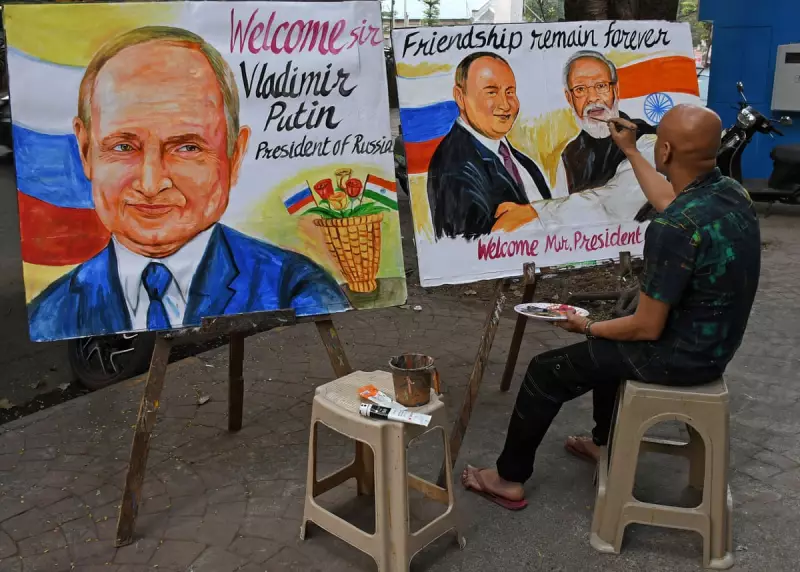
Russian President Vladimir Putin has arrived in India for a critical summit with Prime Minister Narendra Modi, a meeting set against a dramatically altered global landscape since his last visit four years ago. The talks come at a politically perilous moment for both nations, as they navigate the fallout from Russia's war in Ukraine, a newly assertive America under Donald Trump, and the rising power of China.
A Summit of Strategic Necessity
When Putin last travelled to Delhi in December 2021, the encounter was curtailed to just five hours by the pandemic. Three months later, Russia's full-scale invasion of Ukraine transformed the Russian leader into a global pariah, severely restricting his international travel. This week's visit, therefore, carries profound symbolic weight, signalling Moscow's attempt to break its isolation. Petr Topychkanov of the Stockholm International Peace Research Institute noted the primary importance lies in the visit happening at all, marking a tentative return to normal international relations for Russia.
For India, the stakes are arguably higher. Analysts describe Delhi as facing its most challenging geopolitical climate in years, caught between a semi-isolationist United States, a militarily weakened Russia, and an increasingly powerful and assertive China. The delicate balancing act was underscored just before Putin's arrival, when the French, German, and UK envoys to India co-authored a newspaper piece criticising Russia's approach to peace in Ukraine. India's foreign ministry issued a sharp rebuke, calling public advice on its foreign relations "unacceptable."
The Realpolitik Foundations of an Enduring Partnership
The Russia-India relationship, rooted in the Cold War, has long been anchored by defence. For decades, Russia supplied around 70% of India's military hardware. While that figure has dropped below 40% in recent years, discussions on arms deals, including the S-400 air defence system and Sukhoi Su-57 fighter aircraft, are expected to feature prominently in the Modi-Putin talks. Aparna Pande of the Hudson Institute argues the alliance is based on "pure realpolitik." For India, a key driver is geography and the need for a continental counterbalance to China, a role historically played by Russia.
However, the deepening "no-limits partnership" between Moscow and Beijing has caused anxiety in Delhi. India's strategy now involves a careful hedge: purchasing enough Russian weaponry to maintain the strategic alliance, but reducing dependency to avoid being vulnerable if Russia ever cut supplies under Chinese pressure. This complex dance occurs alongside a significant deterioration in US-India relations. President Trump's accusations that India is bankrolling Russia's war, followed by punitive tariffs, have sparked outrage in Delhi and represent the worst dip in bilateral ties in recent memory.
Oil, Economics, and the Limits of Influence
Economic cooperation will also be high on the agenda. Putin recently emphasised plans to take cooperation with India "to a qualitatively new level," defying Western sanctions. The trade in Russian oil remains a central, yet complicated, pillar. While Modi insists India will continue buying Russian crude, new US and EU sanctions threatening secondary parties have slowed purchases from Indian private firms. In a move interpreted as an attempt to placate Washington, India has agreed to increase imports of US oil and gas.
Kremlin spokesperson Dmitry Peskov acknowledged "obstacles" in energy cooperation but predicted only brief, insignificant drops in exports, claiming Moscow possesses the technology to circumvent sanctions long-term. On the war in Ukraine, analysts expect Modi to reiterate calls for peace but possess little leverage to alter the conflict's trajectory. India can speak to both sides, but lacks the power to fundamentally shift the positions of either Moscow or Kyiv.
Ultimately, the Modi-Putin summit is a testament to an enduring, if increasingly pragmatic, partnership. Both leaders seek to demonstrate resilience against external pressure—be it from Washington, Brussels, or Beijing. In a world where alliances are being violently remade, this meeting underscores how national interest, historical ties, and immediate geopolitical necessity continue to bind these two major powers together.