Miami's Cuban Exiles Baffled by Speedboat Shootout Near Cuba Coast
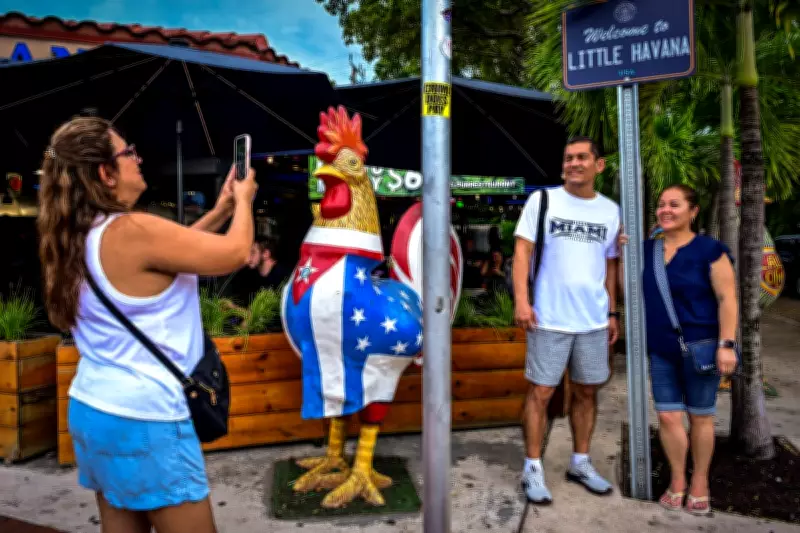
Foot traffic was notably slow outside the Bay of Pigs Museum on Calle Ocho in Miami's Little Havana neighborhood this week. A few tourists in casual attire bypassed the gallery dedicated to one of the most pivotal days in Cuba's history, opting instead to photograph Cuban exiles playing dominoes at nearby Máximo Gómez Park.
This iconic street serves as the vibrant heart of the Cuban expatriate community, home to over one million people. It is where tens of thousands celebrated exuberantly through the night in November 2016 upon news of Fidel Castro's death. It is also where they gathered in solemn sorrow almost exactly thirty years prior to mourn four Cuban-Americans shot down by Cuba's air force while conducting a mission for the humanitarian exile group Brothers to the Rescue.
An Incident of Bewildering Proportions
This week, however, the atmosphere shifted to one of profound curiosity and bewilderment. The catalyst was news of a violent shootout on Wednesday at Cayo Falcones, located barely a mile off Cuba's north coast. The confrontation involved the Cuban coastguard and ten heavily armed men aboard a speedboat that had been stolen in Florida.
Cuba's government reported that its border agents returned fire after individuals on the speedboat initiated shooting. The exchange resulted in four fatalities and six injuries. Officials described the men as dressed in camouflage and equipped with assault rifles, handguns, homemade explosives, ballistic vests, and telescopic sights. They were also in possession of numerous containers bearing symbols associated with counter-revolutionary organizations.
"Didn't we stop doing that years ago?" remarked Javi González, a second-generation Cuban-American office worker on his coffee break. He was referring to the ill-fated, CIA-backed 1961 Bay of Pigs invasion by Cuban paramilitary exiles aiming to overthrow the Castro regime, an event for which the museum is named.
Deepening Mystery and Community Response
The mystery intensified as family, friends, and acquaintances began confirming the identities of those involved. A list provided by Cuban officials on Wednesday night, labeling the individuals as "terrorists and mercenaries," mistakenly included at least one person who was confirmed to have been in south Florida at the time of the incident. A vigil was held in Miami late on Thursday.
Tributes at the vigil were heartfelt, praising "patriots committed to the cause of freedom." José Daniel Ferrer, a prominent Cuban dissident leader freed last year, expressed his "respect and admiration for those who died assassinated by the Castro-communist tyranny north of Villa Clara" via social media.
Yet, significant questions remain unanswered. How did these ten individuals, confirmed by the U.S. State Department on Thursday night to include at least two U.S. citizens—one deceased—along with several permanent residents and visa holders, converge from various locations across Florida? What motivated them to embark on such a perilous misadventure? What were their ultimate objectives?
Profiles and Parallels to a Bygone Era
One of the four killed was identified as Michel Ortega Casanova, a member of the Casa Cuba de Tampa expatriate group and the Tampa chapter of the Cuban Republican party. A truck driver by profession, Casanova had been drawn into what his brother Misael described to the Associated Press as an "obsessive and diabolical" quest for Cuba's liberation.
"They became so obsessed that they didn't think about the consequences, nor their own lives," Misael stated.
The source of funding for their operation remains unknown. U.S. Secretary of State Marco Rubio, himself a son of Cuban immigrants, has emphatically stated that the U.S. government was neither involved nor had prior knowledge of the event. He announced that an independent inquiry would be conducted "to figure out exactly what happened" rather than relying on information provided by Cuban authorities.
Guillermo Grenier, a Havana-born professor of sociology and faculty member at Florida International University's Cuban-American Institute, offered analysis. "Some people are suggesting the CIA are involved, but the CIA doesn't do this. If they want to be in there they land on an airplane, they're not sneaking in," he noted.
Grenier drew parallels between the Cayo Falcones incident and the immediate post-Cuban revolution period of the 1960s. During that era, thousands of exiles formed commando-style groups like Alpha 66, conducting military training in the Florida Everglades in preparation to reclaim their homeland.
A Shift in Community Sentiment and Policy
The incident also evokes memories of more recent, unrealistic "made in Miami" coup plots. These include a fanciful 2019 scheme to abduct Venezuela's leader and a 2021 plan to assassinate Haiti's leader using Colombian mercenaries.
However, Grenier emphasized that the post-revolution mindset is largely obsolete. Two decades of polling by Florida International University reveal that newer generations of Cuban-Americans increasingly favor engagement with Cuba. Meanwhile, older, hardline exile groups that traditionally advocated for the forcible overthrow of the Castro regime have struggled to maintain membership and relevance.
"This kind of approach is anachronistic and not serious, to tell you the truth," Grenier asserted. "Once upon a time there was an ethos in the community that armed rebellions would get you where you wanted to go. But I think that there's a sense that any kind of adventurism like this has had its day, and this is not a serious anything."
U.S. policy toward Cuba has oscillated through successive administrations, with the current strategy focusing on economic pressure to instigate change. Reports emerged on Thursday of U.S. officials engaging in discussions with the grandson of former Cuban President Raúl Castro on the sidelines of the Caricom meeting in St. Kitts and Nevis.
Official Reactions and Historical Context
In Havana, Cuba's vice-minister of foreign affairs, Carlos Fernández de Cossío, the point person on U.S. relations, informed reporters that communication channels with the U.S. government remain open. He stated that the U.S. had "shown a willingness" to cooperate in clarifying these "regrettable" events.
Grenier speculated on the official stance: "They just want this story to go away, ultimately. If it doesn't get any more complicated, it's not going to hamper any negotiations, and their chill response shows me that they are really aware of that. They're hoping it was like 10 crazy folks from Hialeah who decided to go over there and start a little revolution from the inside."
In his official statement, de Cossío also reiterated a long-held position: "Cuba has been the victim of aggression and countless terrorist acts for over 60 years, mostly organised, financed and carried out from the territory of the U.S."
This perspective resonates with many in Havana. "It's the same story," commented Hugo Hernandez, an accountant walking past the Tribuna Antiimperialista José Martí, the square in front of the U.S. embassy often used for protests. "It's been happening since the beginning. When I was young in Santa Clara I had to guard those cays. The coastguards were always worried someone might turn up in a boat and attack them."
The incident at Cayo Falcones serves as a stark reminder of enduring tensions, while simultaneously highlighting a significant generational and strategic shift within the Cuban exile community in Miami, where such "adventurism" is increasingly viewed as a relic of a distant past.