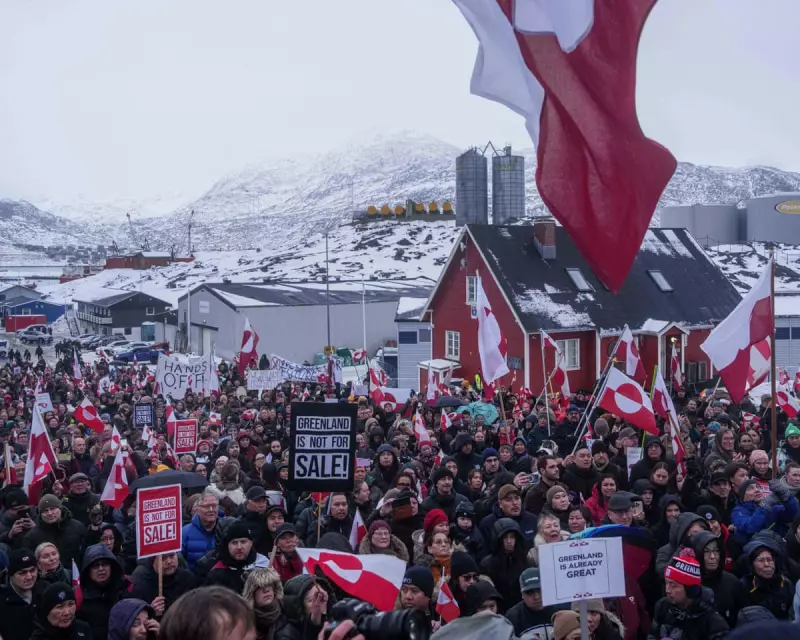
Protests have erupted in Greenland's capital, with demonstrators waving the national flag outside the US consulate in Nuuk. The rally is a direct response to former President Donald Trump's renewed claims over the vast Arctic territory, a move that has escalated into a severe transatlantic crisis threatening the very foundation of the NATO alliance.
A Line in the Ice: Europe's Unified Stance
The immediate flashpoint is Trump's threat to impose 10% tariffs on eight NATO member states. This punitive measure targets countries that recently sent troops to support Greenland's sovereignty, a gesture of solidarity led by Denmark. European leaders have reacted with unprecedented unity and resolve. The chair of the Danish parliament's defence committee, Rasmus Jarlov, stated unequivocally: "Every insult, threat, tariff and lie that we receive strengthens our resolve. The answer from Denmark and Greenland is final: We will never hand over Greenland."
This sentiment was echoed across the continent. Leaders, including Italy's Giorgia Meloni, traditionally seen as close to Trump, labelled his decision a mistake. The eight targeted nations issued a joint statement warning of a dangerous downward spiral, with a trade war now seeming inevitable. French President Emmanuel Macron is reportedly exploring activating the EU's anti-coercion instrument, a powerful tool designed to counter economic intimidation.
The UK's Precarious Position
For the United Kingdom, the crisis presents a profound dilemma, exacerbating the perennial tension between its "special relationship" with the US and its ties to Europe. Prime Minister Keir Starmer's position is increasingly precarious. The benefits of Brexit are evaporating as the planned UK-US trade deal, agreed last autumn, remains unsigned and is now indefinitely postponed.
This leaves the UK facing the prospect of blanket 10% tariffs on its exports to the US, undermining Starmer's argument against rejoining elements of the EU customs union. The crisis has amplified voices within his own party, such as Health Secretary Wes Streeting, who advocate for closer European trade links. As Bronwen Maddox, Director of Chatham House, declared last week, the Western alliance as we know it may be over—a view believed to be gaining traction in the Foreign Office.
From Fantasy to Military Threat
For months, European leaders hoped Trump's interest in Greenland was mere rhetoric. Denmark's political leadership even travelled to the White House last week with a compromise offer, suggesting enhanced US military access under existing agreements like the 1951 Greenland Defence Agreement. Trump, however, rejected this, appearing intent on outright ownership, not sovereign bases.
This shift has made the previously unthinkable a tangible risk. Danish Prime Minister Mette Frederiksen stated on 5 January that a US military attack on another NATO country would mean the end of the alliance and post-war security architecture. Former UK Permanent Secretary Simon McDonald agreed, telling the BBC that such an action would be a point of no return, ultimately benefiting adversaries like Vladimir Putin and Xi Jinping.
The potential closure of US access to NATO bases in Europe would be a catastrophic endpoint. Ironically, as the US pursuit of Greenland is ostensibly about monitoring Russian and Chinese activity in the Arctic, losing cooperation from Scandinavia, Iceland, and the UK would severely damage American strategic interests.
While some, like McDonald, have pointed to historical precedents like the 1917 purchase of the Danish West Indies, such voices are isolated. For Europe, acceding to a doctrine where territory and influence are merely commodities for sale would represent a fundamental surrender of its values. The protest in Nuuk, though small in scale, symbolises a much larger battle for the future of international order.