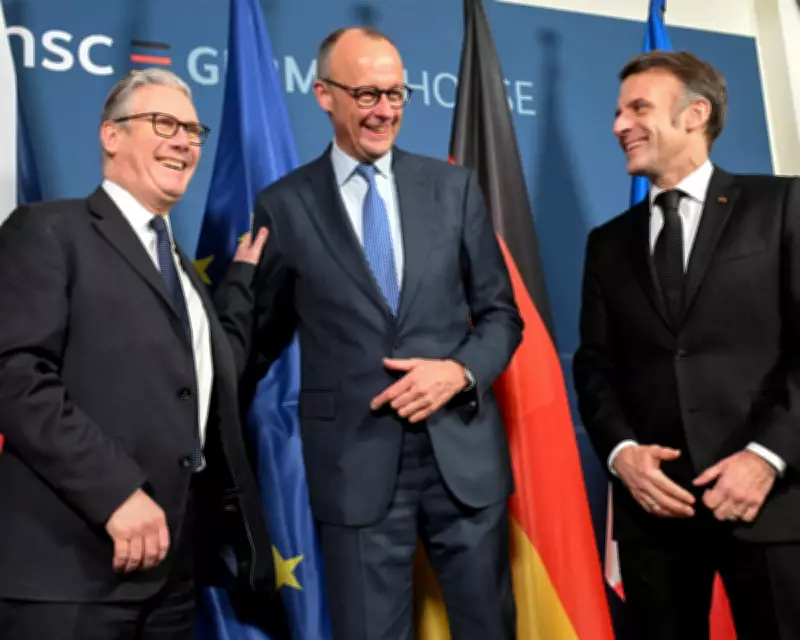
European Powers Issue Unprecedented Joint Appeal to Iran
In a significant diplomatic development, the leaders of France, Germany, and the United Kingdom have issued a rare joint statement urging Iran to pursue a "negotiated solution" following recent military escalations in the Middle East. The statement emerged from discussions at the Munich Security Conference earlier this month, where French President Emmanuel Macron, German Chancellor Friedrich Merz, and British Prime Minister Keir Starmer coordinated their response to the unfolding crisis.
Clarification on Military Involvement
The European leaders made explicitly clear that their nations did not participate in the recent US-Israeli strikes against Iranian targets. "We did not participate in these strikes, but are in close contact with our international partners, including the United States, Israel and partners in the region," the joint declaration stated. This clarification comes amid growing concerns about broader regional conflict and the potential for further escalation.
Comprehensive Demands on Iranian Behavior
The tripartite statement outlined multiple demands on the Iranian government, including:
- Ending Iran's nuclear program development
- Curbing ballistic missile activities
- Ceasing destabilizing actions throughout the region
- Halting violence and repression against Iranian citizens
The leaders emphasized that "the Iranian people must be allowed to determine their future" while condemning Tehran's retaliatory attacks on US military installations in the region. They described Iranian military actions as "indiscriminate strikes" that threaten regional stability and civilian safety.
European Union's Parallel Diplomatic Efforts
European Commission President Ursula von der Leyen separately described the situation as "greatly concerning" and confirmed the EU is exploring "diplomatic paths" with Arab nations. The EU has called for "maximum restraint" from all parties to protect civilian lives and uphold international law.
Von der Leyen highlighted the EU's commitment to regional security, nuclear safety, and preventing actions that could undermine global non-proliferation efforts. She also reassured European citizens in the region of the EU's "full support" and noted the Aspides naval mission remains on high alert in the Red Sea, ready to maintain maritime corridor access.
International Reactions and Calls for De-escalation
President Macron has called for an urgent United Nations Security Council meeting, warning that the conflict has "serious consequences" for international peace and security. "The current escalation is dangerous for everyone. It must stop," Macron declared on social media platform X.
In the United Kingdom, Prime Minister Starmer convened the government's Cobra emergency committee to discuss Britain's response. A government spokesperson stated the UK stands ready to protect its interests with enhanced defensive capabilities in the region but emphasized the desire to avoid wider conflict escalation.
Regional and Global Responses
The United Arab Emirates, Bahrain, Qatar, Jordan, and Kuwait all condemned Iranian ballistic missile attacks as violations of national sovereignty and international law. These nations affirmed their right to respond to protect their sovereignty while calling for de-escalation.
Australian Prime Minister Anthony Albanese expressed support for US actions to prevent Iranian nuclear weapon development, while Russia demanded an immediate halt to US-Israeli strikes and called for a return to political and diplomatic solutions based on international law and mutual respect.
The coordinated European response represents a significant diplomatic effort to contain the conflict through multilateral engagement rather than military escalation, emphasizing negotiation and international cooperation as the preferred path forward.