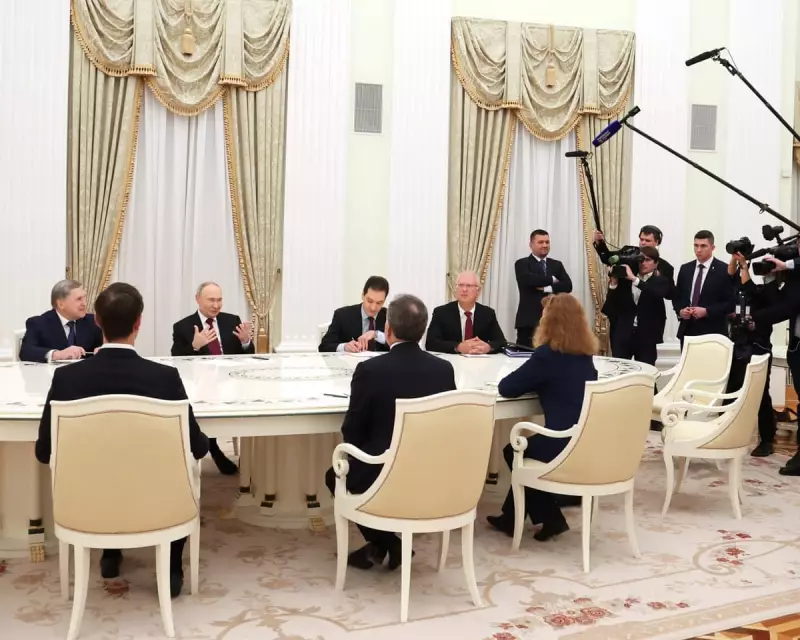
The latest attempt by the United States and Russia to broker an end to the war in Ukraine has ended in a familiar stalemate. A meeting in Moscow on 2 December 2025 between Russian President Vladimir Putin and US special envoy Steve Witkoff, accompanied by Donald Trump's son-in-law Jared Kushner, failed to yield a breakthrough. This impasse underscores a persistent geopolitical pattern that has defined the conflict since Trump's return to the White House.
The Repeating Cycle of Failed Diplomacy
The dynamic is now well-established. The Trump administration, having cut military aid to Kyiv, pursues a bilateral deal with Moscow aimed at halting hostilities, a move that would likely come at a significant territorial cost to Ukraine. Russia continues its military campaign on the ground, while Ukraine and its European allies mobilise diplomatically to challenge any emerging settlement seen as overly favourable to the Kremlin.
This week's talks, which followed a pattern set since Trump's first direct conversation with Putin about Ukraine on 12 February 2025, resulted in another deadlock. President Putin rejected the proposed terms, and the war grinds on. However, analysts suggest the lack of progress will only spur further attempts, with the underlying goal remaining a US-backed ceasefire on terms that broadly benefit Russia.
Europe: The Unlikely Bulwark Against a Pro-Russian Deal
In this high-stakes game, Europe has emerged as a critical, if fragile, obstacle. Putin himself pointed to this dynamic ahead of the Witkoff meeting, stating, "Europe is preventing the US administration from achieving peace on Ukraine." He accused European nations of being "on the side of war," a charge that masks a key strategic insight: the NATO alliance, minus the United States, has so far managed to frustrate Trump's efforts to strike a swift deal with Moscow.
This European coalition, involving most nations on the continent plus Canada, has worked intensively and often behind the scenes since the controversial Oval Office meeting between Trump, Vice President JD Vance, and Ukrainian leader Volodymyr Zelenskyy on 28 February 2025. Their strategy has involved reaffirming support for Ukraine, offering alternative security guarantees, and reportedly advising President Zelenskyy closely at every turn. This concerted effort forced a last-minute tweak to the Witkoff plan before it was presented in Moscow this week.
The Unsustainable Imbalance of Power
Despite these tactical successes, the fundamental problem for both Ukraine and Europe is a stark 21st-century imbalance of power. Collectively, Europe lacks the military might, economic leverage, and political weight to force Russia and the United States to accept an alternative peace settlement that safeguards Ukrainian sovereignty and European security interests.
The postwar concept of a unified West is, in the words of the analysis, "in intensive care." European leaders are fighting to keep it alive, but the reality is that President Trump could unilaterally "pull the plug" on this transatlantic solidarity at any moment, opting for a direct understanding with Putin.
A Fork in the Road for the West
If the US-Russia diplomatic process is ultimately abandoned, the war would likely intensify. Alternatively, if a deal is forced through by bypassing European objections, it would represent a historic rupture in transatlantic relations. The world is edging closer to a moment where Washington may feel compelled to choose between its traditional allies in Europe and Ukraine on one hand, and a new understanding with Russia on the other—a juncture not seen since 1945.
The looming tragedy, as framed by observers, is that Europe has been thrust into a role of defending Ukrainian and continental interests that it ultimately lacks the capacity to fulfil alone. The strategic self-correction required of Europe in the absence of a fully committed US partner would be arduous and come with a political and financial price tag that few European electorates are currently prepared to pay.