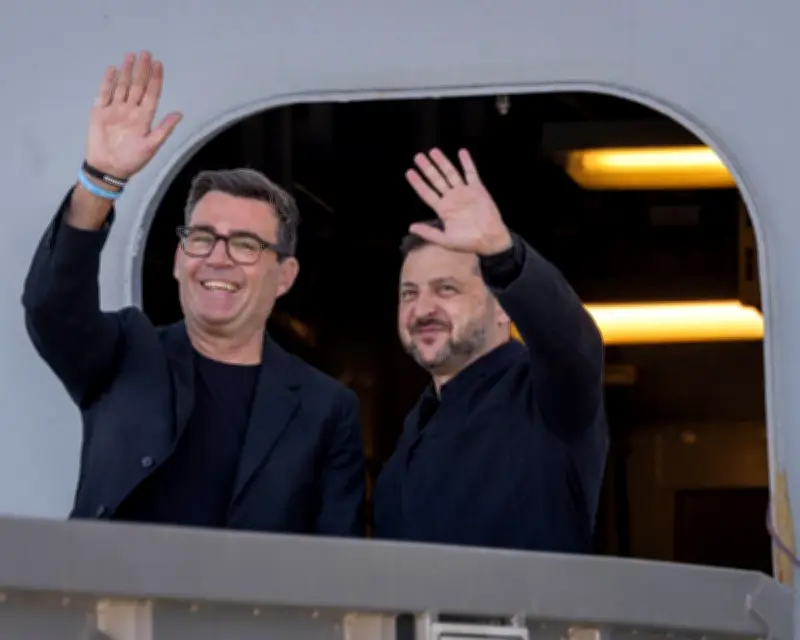
In a symbolic move during his first week in office, Prime Minister Andy Burnham welcomed Ukrainian President Volodymyr Zelenskyy to a naval base in Portsmouth on Monday, marking his first international visitor since entering Number 10. Burnham told Zelenskyy: “It is intended to send a very clear message. We are with Ukraine 100%, I am personally with you 100%, and I will honour every commitment this country has made to Ukraine in full.”
Continuity in UK support for Ukraine
The meeting underscored that the UK’s backing for Kyiv would persist despite the change in leadership. For Burnham’s predecessor, Keir Starmer, the relationship with Zelenskyy became a defining feature of his premiership. Starmer visited Ukraine four times over his two years in office and invited the Ukrainian president to the UK on four occasions, with regular meetings at international summits. In a symbolic gesture during his final week in office, Starmer travelled to Ukraine to receive the Order of Freedom medal for his role in leading the coalition of the willing and persuading Donald Trump to re-engage on Ukraine after the US president had considered siding with Vladimir Putin.
Balancing domestic and foreign priorities
Throughout his premiership, Starmer faced criticism for spending excessive time on international issues at the expense of domestic concerns. Critics dubbed him “never here Keir,” and even his Downing Street team complained that he “needs to get off a plane.” Burnham, by contrast, has consistently emphasised his intention to prioritise domestic affairs, reflecting his political instincts and wariness of repeating his predecessor’s mistakes. This approach has sparked concern among some Labour figures that Burnham may be unprepared for the global stage.
“It’s a frustrating characterisation because not many incoming prime ministers, including Keir, have any experience of international affairs,” one of Burnham’s inner circle said. “Andy has said that his priority will be domestic, but of course there will be moments where he’ll need to be more outward facing.”
Delegation and team reliance
Burnham’s allies have indicated that he will rely heavily on delegation, entrusting responsibilities to his team, including Foreign Secretary Ed Miliband and senior diplomatic adviser Jonathan Powell, whom Burnham persuaded to remain in Number 10 from the Starmer administration. Labour MPs note that Yvette Cooper, Miliband’s predecessor, often struggled for influence due to the presence of other senior figures who saw themselves as de facto foreign secretaries, such as Deputy Prime Minister David Lammy, Powell, and Starmer himself.
One senior MP commented: “I suspect that Ed may be in a fortunate position where he is actually given more freedom than other foreign secretaries in the past. As long as Ed is known to have the authority of the PM and to be trusted to speak for him, then this may be his moment.”
Potential challenges ahead
Other Labour figures suggested that strong prime ministers should be able to delegate and rely on their teams. One said: “I don’t think Andy is particularly interested in foreign affairs. He’ll need to front some things up, but as long as he’s well briefed and charming, he doesn’t need to make the day-to-day decisions like Keir did.” However, they warned that complex international issues would inevitably “crash land” on UK domestic policy, as Starmer found when dealing with Trump, forcing Burnham to intervene.
Burnham has already signalled a willingness to stand up to the US president. “Obviously, the relationship is important to the UK, but not to the point where we just go along with anything that they say,” he told the Guardian last month.
Starmer’s advice and Burnham’s window
Some government figures with foreign affairs experience believe Starmer has already laid the groundwork on key issues like Ukraine, the European Union, and the US, allowing Burnham to maintain the same course. In his final interview in office, Starmer advised his successor not to reduce focus on international affairs to prioritise domestic matters. “It’s not sensible to think you can just separate these two things out,” he said. “If you’re PM and you care what bills are going to be like in any household around the country, you have to care about finding a lasting solution to the situation in Ukraine, you have to care about what happens in the Strait of Hormuz.”
Burnham’s team believes he can better balance these demands, at least for now. They are closely monitoring events in Iran, mindful that further action by Trump could cause global economic upheaval. “Andy has a bit of space now to prioritise policy at home – but it could all be blown off course by Iran,” one Foreign Office insider said. “He has to seize this moment to talk about the domestic, because this window might not come again.”