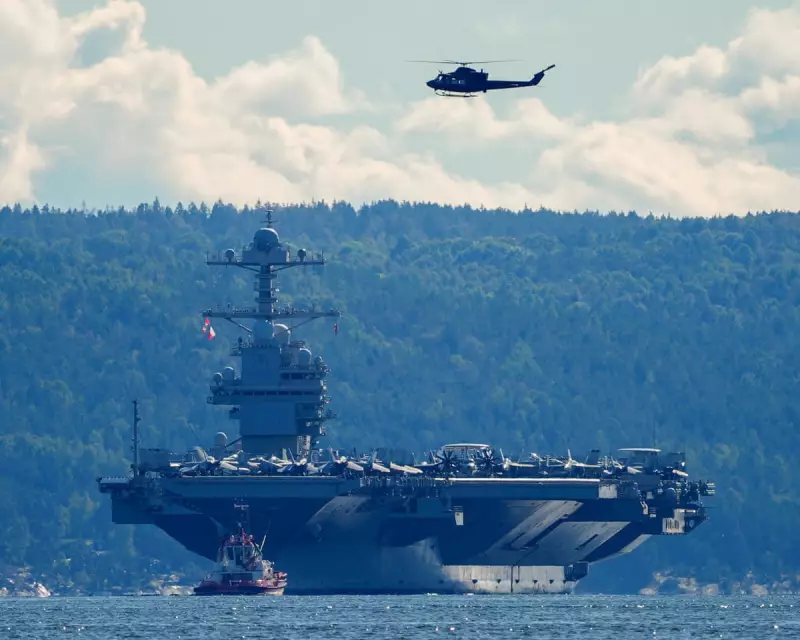
The United States has deployed the world's largest warship, the USS Gerald R Ford, to Caribbean and Latin American waters in a significant escalation of military presence that has heightened tensions with Venezuela.
Military Buildup Reaches New Heights
This formidable aircraft carrier has joined other warships and a nuclear-powered submarine in what analysts describe as the largest US military deployment in the region since the 1989 invasion of Panama. The vessel carries 4,000 sailors and can transport up to 90 aircraft, representing a substantial show of force currently positioned in the western Atlantic and expected to reach the Caribbean shortly.
Meanwhile, Venezuelan dictator Nicolás Maduro has responded with what he terms a "massive deployment" of land, sea, air, river and missile forces, alongside civilian militia. Defence minister Vladimir Padrino announced that 200,000 troops are participating in exercises designed to counter the US naval presence.

The Real Motives Behind the Deployment
US President Donald Trump has justified the military buildup and recent airstrikes—which have killed at least 76 people since September—as necessary to combat drug trafficking from Venezuela. However, many experts question this explanation.
Christopher Sabatini, senior research fellow for Latin America at Chatham House, suggests this represents an attempt at "regime change on the cheap" rather than a genuine anti-drug operation. "This is clearly an attempt to scare Maduro, perhaps into seeking exile, and to push the Venezuelan military to overthrow him," Sabatini explained, while noting the enormous cost of maintaining the carrier at $8 million per day.
Maduro has accused the US of "fabricating a new war" and described the naval deployment as "the greatest threat our continent has faced in the past 100 years". Venezuela has reportedly received Russian military equipment to strengthen its defences, with Moscow reaffirming its support for Venezuelan sovereignty.
Questioning the Anti-Drug Narrative
Evidence supporting Trump's drug interdiction claims appears limited. The United Nations has described the killings during airstrikes as extrajudicial executions, and the US has released no evidence about the vessels targeted or their cargo.
According to a 2020 US Drug Enforcement Administration report, only 8% of documented cocaine movements from South America travelled toward Caribbean islands in 2019, with 74% reaching the US via the Pacific route instead.
Andrés Antillano, criminology professor at the Central University of Venezuela, questioned Trump's claim that targeted boats carried fentanyl, noting this substance is neither produced nor significantly consumed in South America. "It's nothing more than a bad alibi—a narrative meant to justify other agendas," Antillano stated.
Venezuela's role in cocaine trafficking primarily involves transit of drugs from neighbouring Colombia, the world's largest producer. UN data shows Venezuelan cocaine seizures accounted for just 2.3% of the global total in 2020, falling to 1.9% by 2023.
José Luis Pérez Guadalupe, a criminology professor at Peru's Universidad del Pacífico, noted there's "no evidence that shipments go directly to the US" from Venezuela, instead typically passing through intermediate Caribbean points before reaching final destinations.
The situation remains volatile, with experts warning that any US intervention could backfire by strengthening Maduro's position and making it difficult for any successor government to gain legitimacy if perceived as installed by foreign powers.