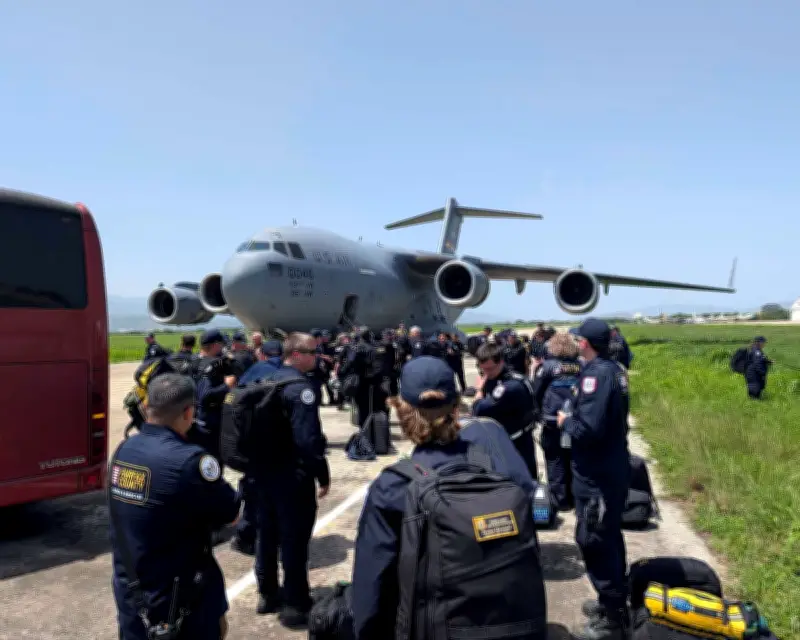
The United States has deployed over 250 search and rescue personnel and pledged $150 million in assistance to Venezuela following dual earthquakes that left at least 920 dead, marking a high-stakes test of the Trump administration's new Western Hemisphere policy. Secretary of State Marco Rubio called the response “big, fast, effective” and “whole-of-government,” as the State Department sent three specialized urban search and rescue teams to the disaster zone.
Massive Response Amid Policy Shift
The disaster assistance response team (DART) deployed to Venezuela includes more than 250 people, the State Department said in a statement. The $150 million assistance fund, announced within 24 hours of the quakes, is the largest such commitment former USAID officials said they had seen for a sudden-onset disaster. This response comes after the Trump administration gutted the US Agency for International Development (USAID) and placed disaster assistance under the State Department, laying off thousands of aid workers.
“This is their first real test, because of the magnitude of the disaster,” said Susan Reichle, a former counselor for USAID who worked on disaster response including after the 2010 Haiti earthquake. “It’s obviously within our hemisphere and it’s critical to our foreign policy under President Trump.”
Political Context: From Adversary to Ally
The mission is complicated by the recent US special forces raid in January that deposed former strongman Nicolás Maduro, who now faces narco-terrorism charges in the US. His successor, acting president Delcy Rodríguez, has been far more amenable to Washington. President Trump noted the changed relationship, saying on Friday: “We have a great relationship with Venezuela since capturing Maduro. Outside of what happened last night … it’s a happy country again, people are dancing in the streets.”
The scale of the disaster far exceeds any previous test for the administration. While the US has responded to events like Hurricane Melissa in Jamaica, the Venezuela quakes have killed at least 920 and caused widespread destruction in Caracas.
Operational Challenges and Capacity
Under the Trump administration, US foreign aid has been recast as a mutually beneficial pact rather than charity. Bilateral deals have been reduced, and the infrastructure of US humanitarian aid overseas has been cut, especially through USAID reductions. Reichle noted that the US foreign assistance unit in Colombia had 144 staff before the cuts, but now only 14 remain, with many ties to local NGOs and contractors severed.
“On a positive side, they immediately did declare a disaster and called for the activation of the DART, as well as the search and rescue,” she said, adding that the first 72 hours after an earthquake are crucial for reaching survivors. Rodríguez said on Saturday that dozens of people had been rescued alive, which “brings us joy that they can embrace their families and loved ones.”
Comparison to Past Responses
Sam Vigersky, an international affairs fellow at the Council on Foreign Relations who previously led US disaster assistance teams in Africa, compiled key indicators showing the State Department is keeping pace with past US responses to earthquakes in Turkey (2023) and Haiti (2021). The $150 million commitment was the largest he had seen “within the first 24 hours of a sudden onset.”
“There’s obviously the political element to Venezuela,” Vigersky said. “They have this relationship with the interim government, it’s in their interest to see them succeed and be stable.”
Empathy and Scrutiny
The Trump administration has faced an empathy crisis in past disasters, such as when Trump threw paper towels to hurricane survivors in Puerto Rico. This time, the response appears calculated to pre-empt scrutiny. “They feel the pressure, and they’re throwing all the resources at this emergency in a way that hopefully delivers for people who desperately need help,” Vigersky said.
The US's anti-internationalist approach to public health has already caused missed opportunities. Health experts said the US withdrawal from the World Health Organization delayed notification about an Ebola outbreak in the Democratic Republic of the Congo by up to 10 days, significantly affecting the response.