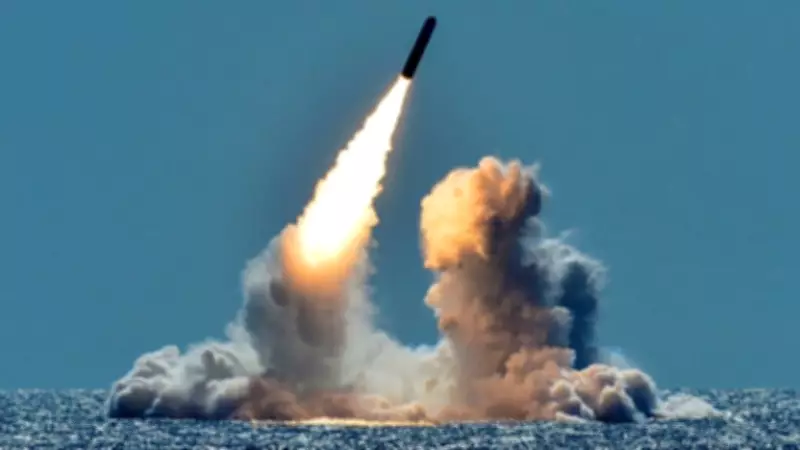
The world stands at a precarious nuclear crossroads as the final remaining treaty limiting American and Russian strategic arsenals expires, marking the first time in more than half a century that there are no legal constraints on the missiles and warheads of these two superpowers. Experts warn this development creates a "real danger" of triggering a fresh and unpredictable arms race, with profound implications for global security.
A World Without Nuclear Arms Control
The New START treaty, which capped deployed strategic warheads at 1,550 per side and limited delivery vehicles to 700, officially lapsed on Thursday. This agreement, originally signed in 2010 by President Barack Obama and Russian President Dmitry Medvedev and extended in 2021, represented the last vestige of decades-long arms control cooperation between Washington and Moscow. Its expiration signals the end of an era that began with the 1972 Anti-Ballistic Missile Treaty between President Richard Nixon and Soviet leader Leonid Brezhnev.
Vasily Kashin, a research fellow at Moscow's Higher School of Economics, told Sky News: "It's a serious situation. Probably now we can witness a lot of developments, especially in US nuclear policy, and the situation will be quite unpredictable. There is a real danger of a nuclear arms race in the coming years."
Historical Context and Breakdown
The framework for nuclear arms control has gradually eroded over recent decades. The original START treaty, signed in 1991 by President George H.W. Bush and Soviet leader Mikhail Gorbachev, established crucial verification mechanisms and required actual reductions in arsenals. However, the current diplomatic collapse can be traced directly to Russia's 2022 invasion of Ukraine, which shattered US-Russia relations to the extent that negotiations for a successor treaty were never even scheduled.
The terms of New START allowed for only one formal extension. While Russian President Vladimir Putin proposed an informal 12-month rollover, former US President Donald Trump has not agreed to this arrangement. This impasse leaves both nations free to expand their nuclear capabilities without any agreed limitations or inspection protocols for the first time since the Cold War's darkest days.
Diverging Perspectives on the Future
The expiration has sparked intense debate among security analysts. Some experts believe America is making a grave mistake by not extending the treaty, fearing the United States would be disadvantaged in an unrestricted arms competition. Others argue that abandoning the constraints allows America to better respond to nuclear developments from other nations, particularly China.
Trump has expressed interest in a new trilateral agreement that would include Beijing, but experienced negotiators consider this approach unrealistic. Nikolai Sokov, a former Soviet and Russian arms control negotiator, explained: "We never tried trilateral [talks] actually. Who says it's going to be trilateral? The official Russian position and the official Chinese position is that negotiations can be bilateral between the United States and Russia, or they can be five-party, including the United Kingdom and France."
Implications for Global Security
While strategic stability won't collapse overnight, the absence of any agreement demonstrates how profoundly US-Russia relations have deteriorated. The world now enters uncharted territory where the two largest nuclear powers face no mutual constraints on their most destructive weapons. This development comes as the Doomsday Clock, maintained by the Bulletin of the Atomic Scientists, stands closer to midnight than ever before in its history.
The expiration removes not just numerical limits but also the transparency and verification mechanisms that have helped prevent misunderstandings and miscalculations for generations. As both nations potentially embark on new nuclear modernization programs without oversight, the risk of escalation and accident increases significantly.
Barring any last-minute diplomatic breakthrough, the international community must now navigate a nuclear landscape without the guardrails that have been in place since the Nixon administration. This new reality could make the world a substantially more dangerous place, with implications extending far beyond the bilateral relationship between Washington and Moscow.