
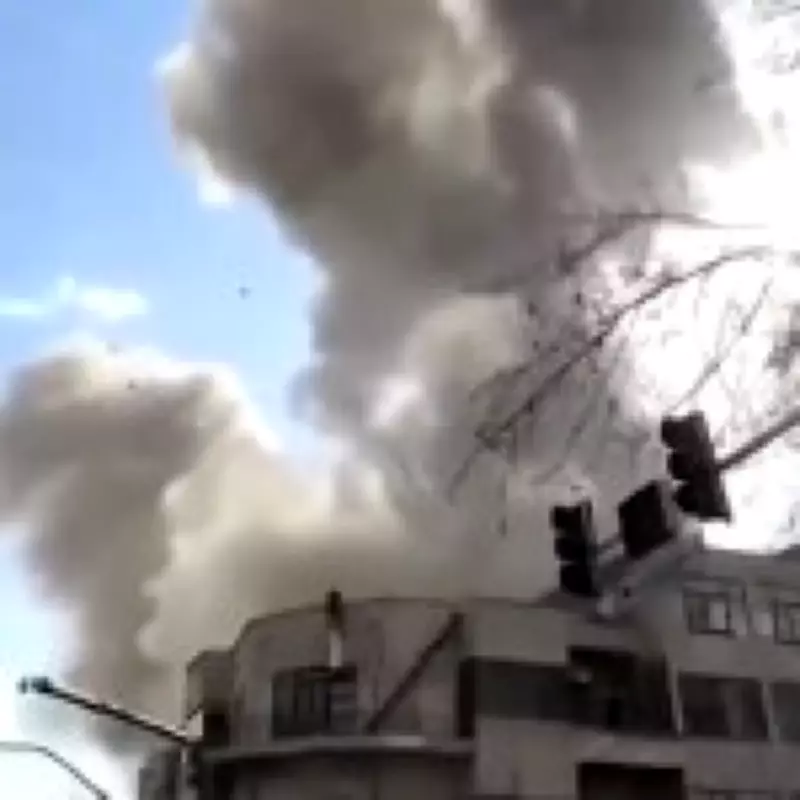
US and Israel Launch Coordinated Military Strikes on Iran
In a dramatic escalation of tensions, the United States and Israel have initiated coordinated airstrikes on Tehran, Iran's capital city. President Donald Trump announced the commencement of a "massive and ongoing operation" aimed at crippling Iran's missile industry and preventing the regime from threatening American national security interests.
Timeline of Events Leading to the Strikes
The military intervention follows a series of diplomatic failures and heightened geopolitical friction. Talks between the US and Iran concluded in Geneva on Thursday without a breakthrough, despite reports of "significant progress." By Friday night, Trump indicated he had not made a final decision on military action but expressed dissatisfaction with Tehran's stance.
Early Saturday morning, Israeli forces executed "pre-emptive" strikes on Tehran, resulting in visible columns of smoke rising from buildings in the city, which is home to approximately 9.7 million people. Concurrently, the US urged its citizens in Iran to evacuate immediately, while non-emergency embassy staff in Israel were advised to depart while commercial flights remained available.
Trump's Demands and Strategic Objectives
In an eight-minute speech broadcast on his Truth Social platform, Trump outlined key objectives for the operation. He demanded an end to uranium enrichment in Iran, a process that had reportedly halted since US bombings of three sites in June of the previous year. However, the UN's nuclear watchdog has raised concerns about restricted access to these uranium facilities.
Trump asserted that the US military would "destroy their missiles and raze their missile industry to the ground," emphasizing a commitment to ensure Iran does not obtain nuclear weapons. He also warned Iran's Revolutionary Guards to stand down or "face certain death," and called on the Iranian people to "take over your government."
Expert Analysis on Trump's Motivations
Dr. Dafydd Townley, a senior teaching fellow in International Security at the University of Portsmouth, noted that Trump views Iran as a major destabilizing force in the Middle East. This perception may explain his shift towards direct military involvement, despite previous reluctance to engage in international conflicts.
Trump's decision appears emboldened by recent events in Venezuela, where US forces successfully removed Nicolas Maduro in a swift operation. However, resistance exists within his administration, with figures like Vice President JD Vance reportedly opposing military intervention in the Middle East.
Implications for Iran's Regime and Regional Stability
The strikes have disrupted communication in Iran, with mobile phone services reported down and internet outages becoming routine since protests erupted in December. Ayatollah Ali Khamenei, Iran's supreme leader, was not in Tehran during the attacks and had been relocated to a secure location.
Experts caution that even if the strikes weaken Khamenei's regime, the resulting power vacuum could lead to chaos and fragmentation. Dr. Andreas Krieg, an associate professor in Defence Studies at King's College London, highlighted risks such as score-settling among armed actors and a scramble for strategic assets.
International and Domestic Reactions
Many Iranians fear a repeat of the 1953 Western-backed coup, which could undermine their autonomy. The international community remains wary of potential fallout, drawing parallels to the chaos following US interventions in Libya and Iraq. Domestically, Trump faces pressure from some factions of the MAGA movement to prioritize domestic issues over foreign engagements.
As the situation unfolds, the world watches closely, with the stakes high for regional stability and global security. The operation marks a significant moment in US-Iran relations, with long-term consequences yet to be determined.




