
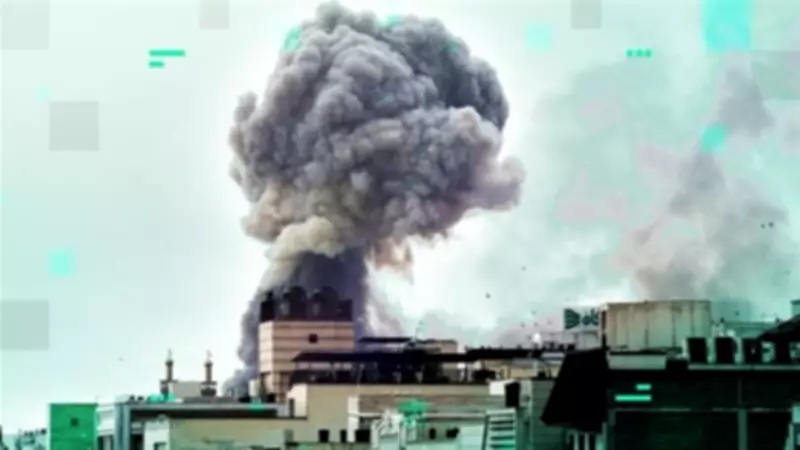
Intensive Bombing Campaign Targets Iranian Infrastructure
In a dramatic escalation of hostilities, the United States and Israel have conducted a massive bombing campaign against Iran, dropping more than 7,000 bombs across the country in just one week. Sky News' Data and Forensics Unit, in collaboration with the Institute for the Study of War (ISW), has meticulously mapped and verified over 360 individual strikes. These attacks have not been limited to military installations; they have also targeted critical civilian infrastructure, including hospitals, energy facilities, and even a girls' school, raising significant humanitarian concerns.
Political Rhetoric and Strategic Objectives
On the inaugural day of the conflict, Israeli Prime Minister Benjamin Netanyahu issued a direct appeal to the Iranian populace, urging them to overthrow their government. He called upon all ethnic groups within Iran—Persians, Kurds, Azeris, Balochis, and Ahwazis—to "rid themselves of the yoke of tyranny" and establish a "free and peace-seeking Iran." U.S. President Donald Trump initially echoed these sentiments, but the White House has since clarified its official war aims, stating they are focused on neutralizing threats from Iran's navy, missiles, nuclear program, and allied militias, rather than pursuing explicit regime change.
More recently, President Trump has suggested a potential compromise, indicating he would accept leadership from within the existing Iranian regime if their policies align with U.S. interests. He maintains that his primary objective is to eliminate the threat Iran poses to the United States, a point he has reiterated multiple times.
Police Stations Emerge as Primary Targets
Professor Yossi Mekelberg, a senior consulting fellow at Chatham House, asserts that the deliberate targeting of police stations in Tehran and Kurdish-majority areas, as identified by Sky News, reveals a continued U.S. and Israeli hope for internal regime overthrow. "It's about regime change," Professor Mekelberg states. "We don't think the US and Israel have any intention to put boots on the ground, so there is the expectation [that they will need to] create the conditions for the Iranian people to go back to the streets."
Tehran, historically the epicenter of liberal and nationalist opposition, was the origin of anti-government protests late last year, which were met with a lethal crackdown by state forces, including the police. "Tehran is the centre of power of the Iranian regime - if it collapses, if they can't control the capital, the assumption is the rest will follow suit," explains Prof. Mekelberg.
In Kurdish-majority cities like Sanandaj, where residents have long sought greater autonomy, the conflict hit home on March 2nd. Initial strikes targeted the regional headquarters of the Special Units Command—a police branch notorious for suppressing protests—and the city's regular police command. Subsequent attacks demolished smaller police stations, with verified footage showing one central station reduced to ruins. Sky News has confirmed strikes on 12 police stations in Kurdish cities and 17 in Tehran, with ISW verifying additional attacks on three in Tehran and four in Kurdish regions.
Kurdish Militias Mobilize Amidst Uncertainty
As the bombing intensifies, six Kurdish militias based in Iraq are preparing for a potential invasion to support the U.S.-Israeli war effort. These groups announced that Iranian strikes on their Iraqi bases resulted in one fighter killed and several injured. During a visit by Sky's Stuart Ramsay, militia bases had evacuated families, leaving fighters to prepare for battle. President Trump expressed support for their mobilization, stating, "I think it's wonderful that they want to do that, I'd be all for it," but refused to confirm whether the U.S. would provide air cover.
Senior militia figures provided ambiguous responses regarding U.S. military support. Kako Aliyar of Komala's leadership committee declined to comment, while Rebaz Sharifi, a senior commander in the Kurdistan National Army, noted that "nothing has been officially announced to us yet." He cited obstacles such as the presence of Iranian, Iraqi, and Kurdistan Regional Government troops, suggesting an incursion is currently impossible but may become feasible if Iran depletes its arsenal.
In Sanandaj, located less than 50 miles from Iraq, strikes included a local border guard station among five police compounds hit on March 2nd. The Islamic Revolutionary Guard Corps (IRGC) sent text messages urging residents to report "terrorist group" movements, framing the strikes as a prelude to "terrorist acts and street riots." By Thursday, Sanandaj's police court was destroyed—the sixth police compound in the city—and a police station in Evyan, another Kurdish-majority city, was also bombed.
Risks of Instability and Regional Fallout
Professor Mekelberg warns that while attacking police stations aims to embolden Iranians to rebel without fear of reprisal, rapid regime collapse could lead to chaos. "But the risk is that if the regime falls, and falls very quickly without an alternative to it, it might descend into chaos," he cautions. "We saw it in Iraq... you could see different groups trying to take position - even looting, killing. That's the biggest fear."
The Data and Forensics team at Sky News emphasizes its commitment to transparent journalism, utilizing data analysis, satellite imagery, social media verification, and traditional reporting to provide comprehensive coverage of this complex conflict.




