US Expands Ebola Travel Restrictions to Green-Card Holders
The United States has temporarily banned lawful permanent residents, commonly known as green-card holders, from entering the country if they have traveled to the Democratic Republic of the Congo (DRC), Uganda, or South Sudan within the past 21 days. The order, issued on Friday, is part of an escalating effort to prevent the spread of Ebola to US soil.
Previously, travel restrictions only applied to individuals without US passports who had visited these African nations, with exemptions for US citizens and green-card holders. The new directive now includes green-card holders, a shift justified by the Department of Health and Human Services (HHS) and the Centers for Disease Control and Prevention (CDC) as necessary for public health. The order states that green-card holders may have stronger ties to families and communities outside the US, making their exclusion less burdensome compared to citizens.
Enhanced Screening and Entry Points
US citizens returning from the DRC, Uganda, or South Sudan now have a second designated entry point: Hartsfield-Jackson Atlanta International Airport, in addition to Washington Dulles International Airport. The CDC announced this expansion on Saturday, citing resource constraints for containing quarantinable diseases. Currently, 18 individuals are in a dedicated quarantine unit at the University of Nebraska after being released from the hantavirus-affected cruise ship MV Hondius.
The CDC emphasized that containing such diseases is highly resource-intensive, requiring specialized and isolated facilities with limited capacity. The entry ban on green-card holders is initially set for 30 days, balancing public health protection with emergency response management.
WHO and Africa CDC Raise Alarms
The World Health Organization (WHO) has raised the risk of the rare Bundibugyo strain of Ebola escalating into a national outbreak in the DRC to "very high." WHO declared the outbreak in the DRC and Uganda an emergency of international concern. So far, 82 confirmed cases and seven confirmed deaths have been reported in the DRC, along with 177 suspected deaths and nearly 750 suspected cases linked to this strain.
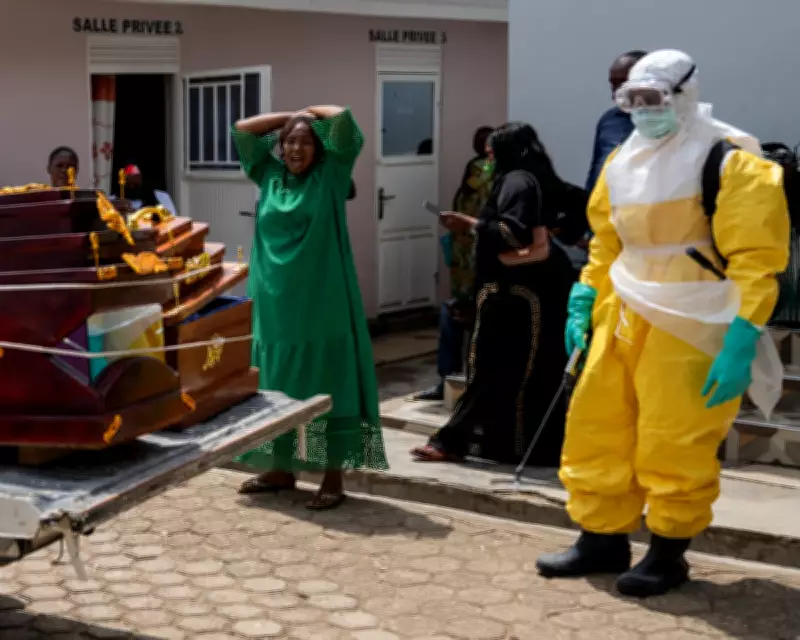
On Saturday, the Africa Centres for Disease Control and Prevention (Africa CDC) identified 10 African countries at risk from the Ebola virus: Angola, Burundi, the Central African Republic, the Republic of the Congo, Ethiopia, Kenya, Rwanda, South Sudan, Tanzania, and Zambia. This warning came as reports emerged of attacks on health centers in eastern DRC. In one incident, residents of a town at the outbreak's epicenter burned part of a treatment facility, leading 18 suspected patients to flee. Another treatment center in Rwampara was destroyed after family members were denied retrieval of a local man's body.
Ebola victims' bodies remain highly contagious, and traditional burial practices can accelerate spread. Authorities in northeastern DRC have banned funeral wakes and gatherings of more than 50 people to curb transmission.
US Secretary of State Marco Rubio stated last week, "Our No. 1 objective on Ebola … has to be we can't have it affect the United States. We can't have Ebola cases coming here." The entry ban reflects this priority, aiming to prevent any introduction of the virus into the country.