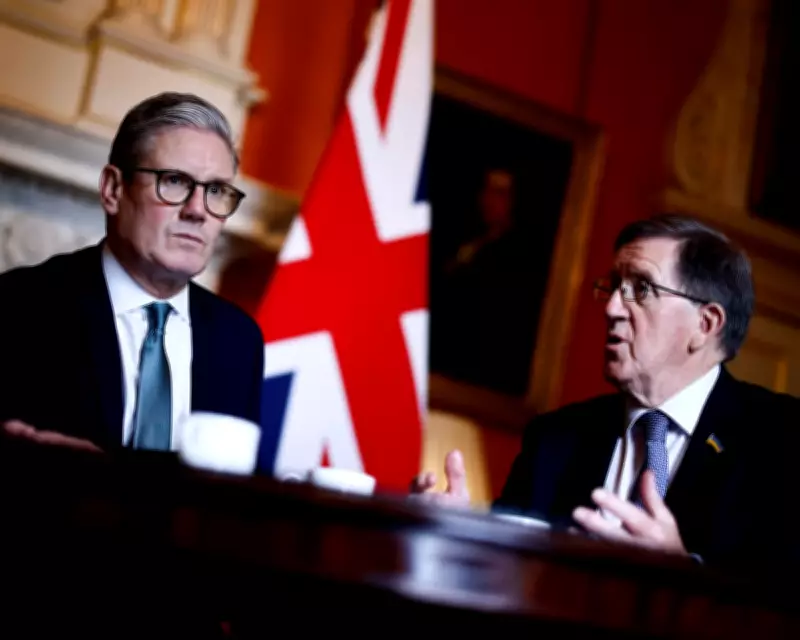
Former NATO Chief Declares UK's Military Dependence on US 'No Longer Tenable'
Britain's high military dependence on the United States is "no longer tenable," and the UK must rapidly become more independent from its special relationship with Washington, according to George Robertson, a former NATO secretary general. Speaking at a seminar hosted by the Chatham House thinktank, Robertson emphasized that the diplomatic tone from the White House has reached a "historic low point" under President Donald Trump, with the two traditional allies likely to continue diverging even after Trump's presidency ends.
Diverging Values and Unilateral Actions
Lord Robertson, who previously served as a Labour defence minister and NATO secretary general, highlighted several actions by Trump that illustrate a growing rift between Westminster and Washington. These include unprovoked attacks on Iran, the imposition of tariffs on allies, and the controversial threat to acquire Greenland from Denmark. Robertson stated that these moves signal the potential end of the postwar era where the US acted as a steward of global rules and institutions.
He noted that Trump's repeated public criticisms of the UK, such as comparing Keir Starmer to Neville Chamberlain and dismissing the Royal Navy's aircraft carriers as "toys," have exacerbated tensions. While Robertson acknowledged that Trump does not represent all American opinion, he argued that the UK must recognize longer-term shifts in US foreign policy and adapt accordingly.
Call for Military Autonomy and Increased Spending
Robertson asserted that the UK's naive belief in unwavering US support has led to a diminishment of its own military capabilities. He called for a rapid pivot towards becoming a more autonomous military actor, focusing on closer collaboration with European allies, particularly in countering Russia. Additionally, he stressed the importance of lifting defence spending to 3.5% of GDP by 2035, in line with NATO targets, to demonstrate commitment to the alliance.
The relationship with the United States will increasingly depend on what the UK contributes, Robertson warned, noting forecasts that Germany could spend twice as much on defence as the UK by 2029 if current plans are maintained. This intervention marks the second time in a week that Robertson has addressed military spending, aiming to bolster the Ministry of Defence's position in ongoing disputes with the Treasury over an £18 billion funding gap in a 10-year defence investment plan.
Committee Report and Broader Implications
On the same day, the cross-party Lords international relations and defence committee, chaired by Robertson, published a report stating that the UK-US special relationship is under greater strain today than at any point since World War II. The report did not comment on specific political appointments, such as Keir Starmer's controversial choice of Peter Mandelson as ambassador to the US, but former ambassador Kim Darroch noted that such appointments are inevitable as politicians seek trusted representatives.
In response, US ambassador Warren Stephens reaffirmed the White House's commitment to supporting allies in Europe, describing the UK as "our closest ally" and emphasizing collaborative efforts to ensure safety and prosperity. However, Robertson's stark warning underscores a pressing need for the UK to reassess its defence strategy and reduce reliance on the US in an increasingly uncertain geopolitical landscape.