Ukraine's Robot Army: Unmanned Ground Vehicles Transform War with Russia
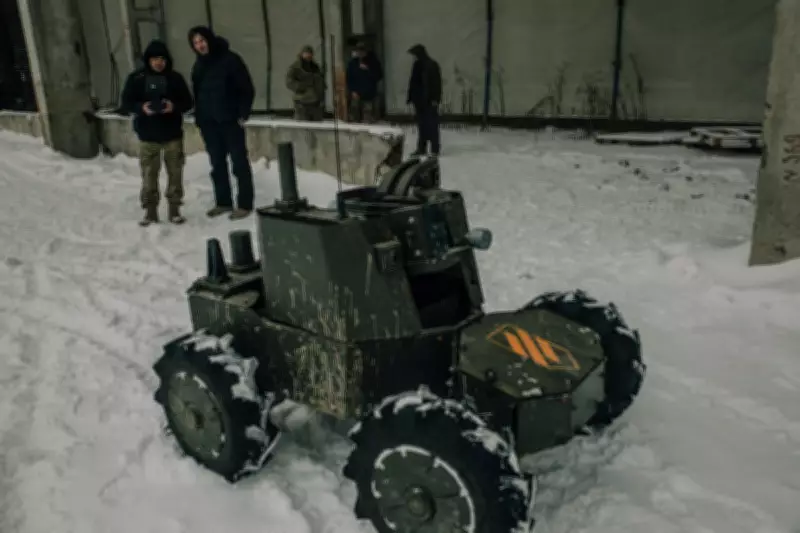
In a school run by Ukraine's third army corps, trainee operators test out an unmanned ground robot, showcasing the nation's shift toward robotic warfare. Photographs reveal a battery-powered land robot, part of a diverse fleet that includes caterpillar-tracked models resembling roofless milk floats, wheeled versions with antennas, and units carrying anti-tank mines. Since spring 2024, the deployment of these unmanned ground vehicles (UGVs) has grown exponentially, marking a pivotal change in the conflict.
Lieutenant Victor Pavlov of Ukraine's 3rd army corps emphasized the significance of this development, stating, "This is what modern warfare looks like. Armies everywhere will have to robotise." Now in its fifth year, Russia's full-scale invasion of Ukraine has evolved into Europe's largest conflict since 1945, characterized by a rapid transformation of battlefield weapons and tactics. The war has become a technological contest, where cheap, expendable drones deliver bombs with deadly accuracy, replacing expensive traditional tanks.
Technological Advancements and Global Impact
Ukraine's expertise in drone technology is now highly sought after globally. Last week, President Volodymyr Zelenskyy signed 10-year defence agreements with several Gulf states, including Saudi Arabia and Qatar, to provide low-cost Ukrainian interceptors. These interceptors are designed to shoot down long-range kamikaze Shahed drones, used by Iran in attacks on its neighbours and by Moscow in the war. The Kremlin's aggression has transformed Kyiv into a hub for modern unmanned weapons development, fostering a unique ecosystem where engineers innovate based on instant feedback from frontline soldiers.
Manufacturers in Ukraine are scaling up supplies, producing ground vehicles, anti-Shahed interceptors, and pioneering sea drones. Land robots now account for 90% of Ukrainian army logistics, as Pavlov explained: "It's very difficult to move around because of enemy first-person-view drones. So we use robotic systems." In January, Ukraine's armed forces conducted a record 7,000 operations using UGVs, highlighting their critical role.
Combat and Logistics Applications
Robots are increasingly taking on key combat roles, replacing human infantry in dangerous scenarios. They have been equipped with remote-controlled machine guns and grenade launchers. For instance, a DevDroid TW 12.7 system defended a position for 45 days, while last summer, a kamikaze robot carrying 200kg of explosives traveled 12 miles to destroy a school building used by Russian troops. Drone operator Bambi from the 25th airborne brigade described the frontline as "more like Terminator," noting that robots do not feel pain and can continue firing even when shot.
Beyond combat, land drones deliver essential supplies such as food, ammunition, and materials like logs for constructing underground shelters. They can evacuate up to three wounded soldiers from the frontline, operating for up to eight hours. Their smaller size makes them less visible than armoured vehicles, reducing the risk of detection by Russian spy drones. Since December 2025, robots have provided provisions to Ukrainian soldiers around the ruined eastern city of Pokrovsk, with Bambi recalling the surreal experience: "One rolled up to the entrance of our dugout. I felt like a caveman gazing at alien technology."
Engineering and Training Initiatives
UGVs also perform vital engineering tasks, including mining and de-mining, laying barbed wire, and towing damaged vehicles. Pavlov reported that his company loses about three robots daily to Russian aerial attacks, an attrition rate of 25%, but he considers this "a small price to pay when you consider that we are saving the lives of our infantry." Ukraine's defence minister, Mykhailo Fedorov, praised the rapid expansion of remote operations, noting that robots now routinely enter high-risk areas for logistics and evacuations.
In a historic moment last summer, Russian soldiers surrendered to an armed ground robot after their position came under sustained Ukrainian fire. The 3rd army corps, based in north-eastern Ukraine, has pioneered UGV development through its KillHouse academy, which trains UGV pilots. Instructors like Oleksandr, with the call sign "Barman," highlight that former gamers adapt quickly to this technology, making them more effective than ordinary servicemen.
Strategic Implications and Future Outlook
Russia also employs ground systems, such as the "Courier" electric vehicle for cargo transport and electronic warfare, but Pavlov asserts that Ukraine currently holds the upper hand in ground robot technology, with more systems in use. Despite Russia occupying about 20% of Ukraine, including Crimea, it has failed to make significant progress since 2022, with 1.2 million soldiers killed or wounded. On the fourth anniversary of the invasion, Zelenskyy declared, "Putin has not won this war," pointing to reclaimed territory in Zaporizhzhia oblast.
Andriy Biletsky, commander of the 3rd Corps, predicted that ground-based robotic systems will "radically change the battlefield and replace a significant share of soldiers," both in logistics and combat. This revolution, alongside advancements in aerial drones, positions Ukraine at the forefront of modern warfare, offering hope in a protracted conflict defined by technological innovation.