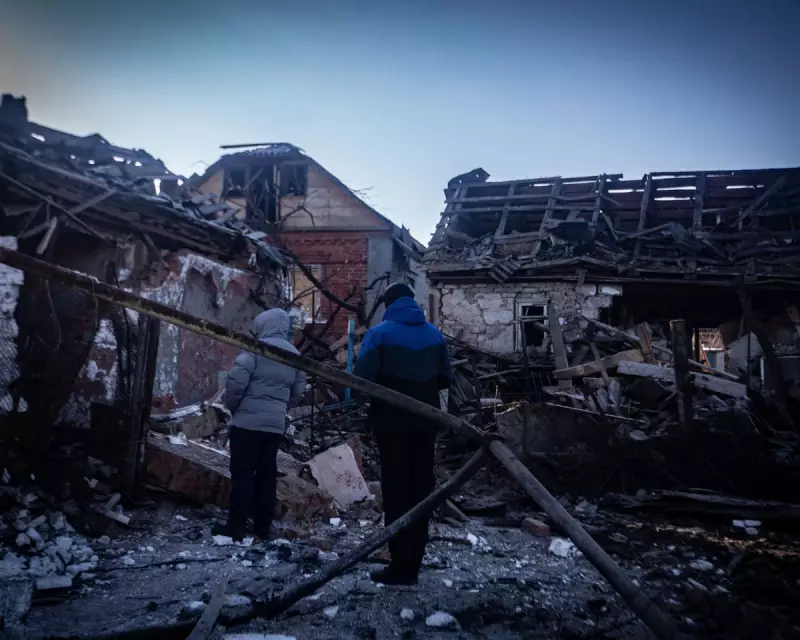
Russian forces have intensified their assault on Ukraine's civilian energy infrastructure, killing at least two people in a series of overnight attacks. The strikes, which involved more than 200 drones, targeted regions across the country, exacerbating the humanitarian crisis on day 1,426 of the conflict.
Widespread Attacks on Civilian Areas
Ukrainian officials reported that Moscow maintained its relentless hammering of the nation's power grid from Saturday into Sunday. The aerial bombardment struck multiple regions, including Sumy, Kharkiv, Dnipro, Zaporizhzhia, Khmelnytskyi, and Odesa.
One person was killed in Kharkiv, Ukraine's second-largest city, according to Mayor Ihor Terekhov. The emergency services confirmed that at least six more people were wounded in the Dnipropetrovsk region alone. A fire broke out at energy infrastructure in Odesa but was promptly extinguished by responders.
The Ukrainian military stated it had recorded 30 separate strikes across 15 different locations. President Volodymyr Zelenskyy addressed the situation on Telegram, acknowledging the severe challenge of repairing the energy system but vowing that everything possible was being done to restore power swiftly.
Ukrainian Retaliation and Nuclear Plant Concerns
In a retaliatory move, Ukrainian drone strikes damaged energy networks in Russian-occupied parts of southern Ukraine. Kremlin-installed authorities reported that this left hundreds of thousands of residents without electricity.
Yevgeny Balitsky, the Russian-appointed governor in Zaporizhzhia, stated that over 200,000 households in the occupied part of the region were without power on Sunday. He claimed that nearly 400 settlements had their supply cut due to the Ukrainian attacks.
The precarious situation at the Zaporizhzhia Nuclear Power Plant, Europe's largest, remains a central concern. The International Atomic Energy Agency (IAEA) reported on Sunday that Ukrainian crews had begun repair work on a backup power line to the plant. This critical work is proceeding under a ceasefire brokered by the Vienna-based UN watchdog.
Diplomatic Moves and Global Reactions
As the fighting continues, diplomatic efforts persist. Ukraine's top negotiator, Rustem Umerov, announced that talks with US officials on ending the war would continue at the World Economic Forum in Davos this week. Preliminary discussions in Florida focused on security guarantees and a postwar recovery plan for Ukraine.
In a separate development, Spanish Prime Minister Pedro Sánchez issued a stark warning in an interview with La Vanguardia newspaper. He suggested that any US military action against Greenland, a territory of Denmark, would severely damage NATO and, paradoxically, legitimise Russia's invasion of Ukraine in the eyes of the world. "If the United States were to use force, it would be the death knell for NATO," Sánchez stated, adding that such an act would make Russian President Vladimir Putin "the happiest man in the world."
The war's toll on Ukraine's infrastructure and civilian population continues to mount, with energy systems becoming a primary battlefield. The international community watches closely, particularly regarding the safety of nuclear facilities, as both sides engage in a devastating war of attrition.