Four Years of War in Ukraine: A Visual Chronicle of Conflict and Resilience
On the fourth anniversary of Russia's invasion of Ukraine, we reflect on the profound impact of the conflict through a series of powerful photojournalistic images. These photographs capture the raw emotions, destruction, and resilience that have defined the war since its onset on 24 February 2022.
Early Days: Evacuation and Initial Attacks
In the early weeks of the invasion, scenes of mass displacement unfolded across Ukraine. Passengers waited anxiously for trains to Przemyśl in Poland on 13 March 2022, as the UN reported at least 1 million people had fled to neighboring countries. Meanwhile, members of the National Guard of Ukraine took defensive positions in central Kyiv on 25 February 2022, highlighting the immediate military response.
Civilians faced dire circumstances, with Ukrainians crowding under a destroyed bridge to flee across the Irpin River on the outskirts of Kyiv on 5 March 2022. Smoke rose from airstrikes as people evacuated along roads in Irpin on 6 March 2022, underscoring the chaos and danger.
Humanitarian Tragedies and War Crimes
The conflict has been marked by severe humanitarian crises. On 9 March 2022, Iryna Kalinina, a pregnant woman injured in a Russian airstrike on a maternity hospital in Mariupol, was carried on a stretcher. Her baby, Miron, was stillborn, and Kalinina died shortly after. This haunting image by Evgeniy Maloletka later won the World Press Photo of the Year award.
In Bucha, outside Kyiv, the bodies of hundreds of civilians were found after Russian forces retreated, many showing signs of torture. Vladyslava Liubarets and her family walked past destroyed Russian military machinery on 6 April 2022 before reuniting with her sister. President Volodymyr Zelenskyy visited Bucha on 4 April 2022, speaking to the media about the atrocities.
Rescue efforts continued in Kremenchuk on 27 June 2022, where teams worked for over 20 hours to recover bodies. In Izyum, east Ukraine, rescue workers exhumed bodies from a mass grave on 16 September 2022, revealing the scale of loss.
Ongoing Destruction and Environmental Impact
The war has left landscapes scarred. The remains of a residential block in Trostyanets, damaged when Ukrainian forces retook the town, were photographed on 2 April 2022. In Posad-Pokrovske, outside Kherson, destroyed houses stood as ruins on 15 November 2022.
Environmental consequences emerged, such as the breach of a large hydroelectric dam in Kherson on 7 June 2023, causing extensive flooding. Ukraine accused Russia of blowing up the dam, which provided water to Crimea and the Zaporizhzhia nuclear plant. Volunteers rescued people and pets from the floodwaters.
Trenches in the Sumy region on 1 November 2024 illustrated the widespread construction of fortifications, a direct impact of military actions on the environment.
Civilian Life and Resilience
Amid the turmoil, Ukrainians demonstrated remarkable resilience. Young children attended classes in a metro station in Kharkiv on 22 September 2023, adapting to disrupted education. In Kyiv, two women fixed Ukrainian flags and pictures at a memorial in Independence Square after heavy snow on 17 December 2023.
The birth rate collapsed, with two babies born from surrogacy mothers in a Kyiv maternity hospital on 23 June 2023. Vira Chernukha stood in what was once her home in Dementiivka, Kharkiv region, on 29 June 2023, as the sole remaining resident of a village razed by Russian forces.
Military Actions and International Relations
Military engagements persisted throughout the years. The Black Tulip volunteer group searched for missing Ukrainian soldiers in Krasnopillia on 12 March 2023. A church destroyed by Russian forces in Dolina was captured on the same day.
In Kyiv, smoke rose after a deadly airstrike on 24 June 2023, with Ukrainian air defense shooting down over 20 missiles. Members of the Azov Brigade attended a ceremony on 28 July 2024 to remember victims of the Olenivka camp explosion, where about 50 Ukrainian prisoners of war were killed in July 2022.
International tensions flared, with Donald Trump arguing with Volodymyr Zelenskyy during a meeting in Washington DC on 28 February 2025. Zelenskyy was later photographed in an interview with the Guardian on 8 November 2025.
Recent Developments and Memorials
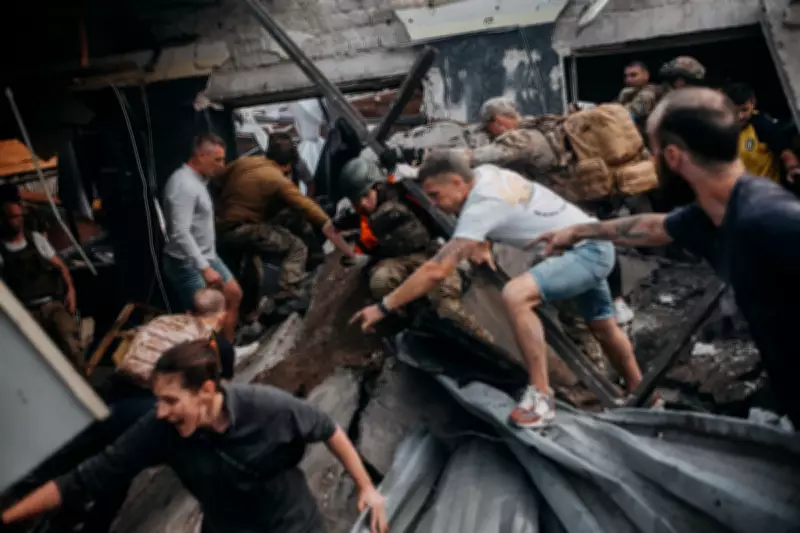
As the war entered its fourth year, new challenges arose. Russia captured Chasiv Yar in the Donetsk region after a long campaign, with ruins photographed at dawn on 24 July 2025. Rescue workers cleared rubble after a Russian strike in Kyiv on 28 August 2025, which killed at least 17 people.
Memorials continued to honor the fallen. People visited the memorial to Ukrainian defenders at Independence Square in Kyiv on 24 February 2025. The family of Andriy Zakhary grieved at his funeral in Novotroitske on 11 January 2025; the soldier was killed in November 2023 but his remains were identified later.
In a poignant moment, Ukrainian skeleton racer Vladyslav Heraskevych held his helmet with images of athletes killed since the invasion during a press conference in Kyiv on 19 February 2026. He was disqualified from the 2026 Winter Olympic Games for wearing the helmet.
Conclusion: A Continuing Struggle
The visual record of the Ukraine war serves as a stark reminder of the conflict's toll on human lives, infrastructure, and the environment. From the initial invasion to ongoing military actions and humanitarian efforts, these photographs document a nation's resilience in the face of adversity. As the war persists, the world continues to witness the unfolding tragedy through the lens of photojournalism.