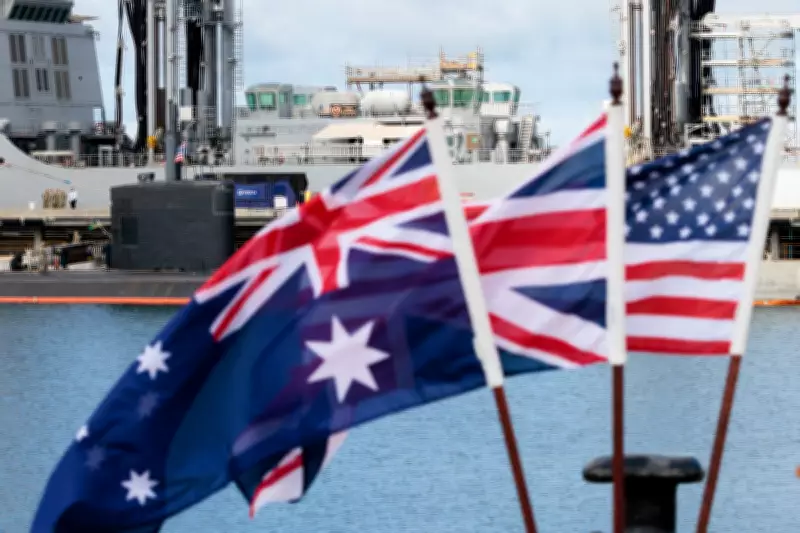
A British parliamentary inquiry has issued a stark warning that the ambitious Aukus nuclear submarine agreement could be derailed due to significant shortcomings and failures in its delivery. The House of Commons defence committee's report highlights that "cracks are already beginning to show" in the UK's funding for the trilateral pact, posing a serious threat to Australia's long-term security.
Critical Findings on UK Submarine Capabilities
The report reveals that UK shipbuilding has been under-funded for decades, resulting in "critically low" submarine availability. In February, the nuclear submarine HMS Anson became Britain's only attack-class submarine at sea during a visit to Australia. However, it was rapidly recalled to the northern hemisphere ahead of schedule when conflict erupted in the Gulf, undermining confidence in the UK's capacity and commitment to Aukus.
The inquiry found that "shortcomings and failings in the delivery of Aukus threaten to prevent that promise becoming a reality." It emphasized that political leadership, essential for a program of Aukus's length, cost, and complexity, has faded. The committee called on the prime minister to take a more visible role in promoting and driving forward Aukus to counter political drift that could see it derailed.
Australia's Dependence on UK Deliveries
Australia is heavily reliant on the UK's ability to design and build an entirely new class of nuclear submarine, the SSN-Aukus. Any delay or failure on the UK side could leave Australia exposed without any sovereign long-term submarine capability. Under pillar one of the agreement, Australia will initially buy between three and five Virginia-class submarines from the US to cover the capability gap, but US capacity to deliver these is also in serious jeopardy.
The report notes that Australia has promised the UK A$4.6 billion to uplift its submarine-building capacity and has already sent nearly half a billion dollars to the UK Ministry of Defence. Prime Minister Anthony Albanese stated that Aukus has overwhelming support from the British government and defence personnel, quoting President Trump as saying it is "full steam ahead."
Concerns Over UK's Industrial Capacity
The UK faces structural challenges, including having only one shipyard for building submarines, at Barrow-in-Furness. While £200 million has been committed to upgrade Barrow, the committee found that the timeline for improvements has "already slipped." The report warns that Aukus will fail if it is seen within the UK's defence bureaucracy as just another plan competing for scarce resources.
Committee chair Labour MP Tan Dhesi stated that "cracks are already beginning to show" in Aukus funding, adding that even seemingly minor shortfalls and delays snowball over time with potentially severe consequences. The committee also expressed disquiet over government secrecy regarding the reality of Aukus progress, noting that a review by former national security adviser Sir Stephen Lovegrove has not been made public more than a year after its completion.
Strain on UK Submarine Fleet
The report highlights that the UK's submarine fleet is the smallest in living memory and has been stretched to its limits. Dr. Sidharth Kaushal, a senior research fellow at the Royal United Services Institute, warned that fulfilling Aukus commitments means some functions and training for the UK's fleet would have to be abandoned, risking operating the fleet "to death."
Shadow defence minister James Paterson suggested that capability gaps caused by Aukus delays could be plugged if Australia acquired a fleet of B-21 stealth bomber jets. However, he acknowledged that increased defence spending and contingency planning are necessary.
The inquiry's findings underscore the fragility of the Aukus agreement and the urgent need for renewed political commitment and adequate funding to prevent the project from failing.