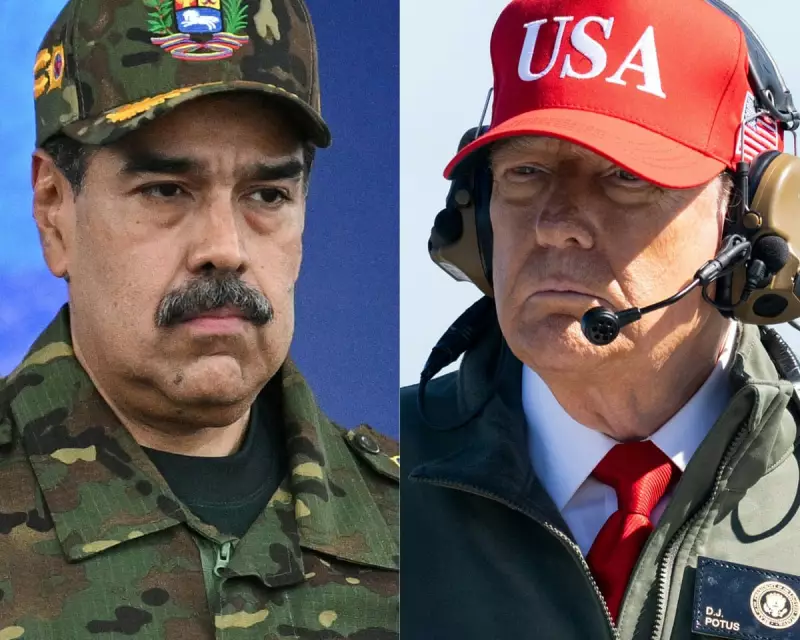
In a dramatic and unprecedented military operation, United States forces have captured the sitting president of Venezuela, Nicolás Maduro. The action followed overnight airstrikes on the South American nation's capital, Caracas, marking a serious escalation in a long-running geopolitical confrontation.
A Sudden Strike and a Presidential Capture
In the early hours of Saturday, explosions rocked Caracas as the US carried out airstrikes across Venezuela. Shortly after the bombardment, former US President Donald Trump announced that American forces had successfully apprehended President Nicolás Maduro and his wife, Cilia Flores, and had flown them out of the country.
This bold move follows months of intense military and economic pressure from the US. Since September, a substantial US naval fleet had gathered off the Venezuelan coast. During this campaign, American forces conducted strikes against vessels allegedly linked to drug trafficking in the Caribbean and Pacific, and seized Venezuelan oil tankers. Human rights groups state that at least 110 people were killed in these maritime strikes, actions they argue could constitute war crimes.
The Path to a Breaking Point
The relationship between the US and Venezuela has been strained for decades, deteriorating sharply after Hugo Chávez took power in 1999. The situation worsened under his successor, Maduro, whom the Trump administration deemed illegitimate. In 2019, the US recognised opposition figure Juan Guaidó as Venezuela's legitimate president.
After his re-election, Trump pursued a "maximum pressure" campaign against Maduro's regime. In July 2024, the US placed a $50 million bounty on Maduro's head, labelling him a major narcotics trafficker. The administration also designated Venezuelan gangs as terrorist organisations.
The pressure culminated in late November 2024, when Trump presented Maduro with an ultimatum: relinquish power in exchange for safe passage out of Venezuela. Maduro refused, telling supporters he would not accept "a slave's peace" and accusing the US of coveting Venezuela's vast oil reserves, the largest in the world.
Uncertain Aftermath and Global Repercussions
The immediate future of Venezuela is now shrouded in uncertainty. The country's defence minister has vowed to continue resisting, calling the US operation a foreign "invasion" and urging citizens to unite in a "fight for freedom". While Maduro is captured, Venezuela's state institutions and military remain largely intact, raising questions about potential prolonged instability.
Some opposition leaders, including Nobel Peace Prize laureate María Corina Machado, have called for US support to foster an uprising. However, experts warn of a chaotic power vacuum. Simulations of such a "decapitation" of Venezuela's leadership have predicted prolonged chaos, with mass refugee exodus and violent infighting among rival factions for control.
This operation also formalises a new, aggressive US doctrine for the region. In early December, the Trump administration published the "Trump corollary", asserting that the western hemisphere must be under US political, economic, and military control, and explicitly stating that the military could be used to secure access to energy and mineral resources.
The capture of a sitting head of state by American forces on foreign soil is a historic event with profound and unpredictable consequences for Latin America and international relations.