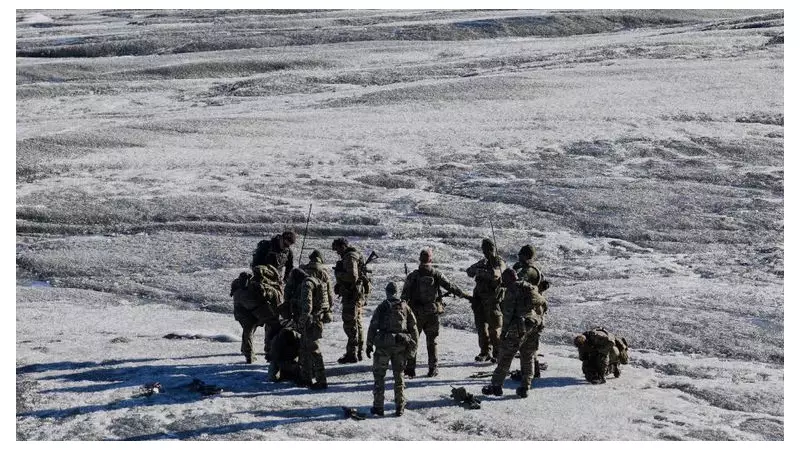
Security analysts are growing increasingly concerned that former US President Donald Trump is earnest in his ambition to acquire Greenland from Denmark, a move that would catastrophically fracture the NATO alliance. The calculation, experts suggest, hinges on a cold geopolitical reality: European nations lack the independent military capacity to oppose Washington by force.
The Uncomfortable Truth of NATO's Dependence
At the heart of this potential crisis lies decades of strategic dependency. Most NATO members have become perilously over-reliant on American fighting power, advanced weaponry, and cutting-edge technology. This has eroded the alliance's ability to defend itself autonomously, let alone counter a potential threat emanating from its own leading member, the United States.
The United Kingdom, often touted as Europe's foremost military power within NATO, finds itself in a uniquely vulnerable position. Its armed forces have been massively augmented by the so-called "special relationship" with the US. This is most evident in the realm of nuclear deterrence, where Britain's submarine-based Trident system is wholly dependent on American-made missiles and technical support.
On the conventional battlefield, the UK's reliance is equally critical. So-called "enabler" capabilities – the vital components that allow forces to operate effectively – are overwhelmingly provided by Washington. These include:
- Satellite intelligence for targeting.
- Advanced electronic warfare systems to protect assets.
- The vast logistical network needed to sustain operations.
A Wartime Assumption That May No Longer Hold
British and broader NATO defence planning has long operated on a fundamental assumption: in any major conflict, they will fight alongside the United States. This presumption has allowed successive governments in London and other European capitals to avoid investing in expensive, sovereign enabling capabilities, trusting that American support would always be forthcoming.
But the prospect of a US administration hostile to NATO, or actively seeking to annex allied territory, shatters that core assumption. The question now being urgently asked in defence circles is: what if America is not there?
This dependency extends to hardware. Key platforms operated by the UK and other allies, from F-35 fighter jets and P-8 patrol aircraft to Chinook helicopters, are American in origin, tying their operational readiness to US supply chains and support.
Greenland as the Ultimate Wake-Up Call
Following Mr Trump's military strikes against Venezuela and the capture of its president, Danish Prime Minister Mette Frederiksen issued a stark warning. She stated that an attack on a NATO ally – specifically referencing Greenland – would mean the end of the alliance and the post-Second World War security order.
However, as the greatest losers from such a collapse would be the European members and Canada, this threat is unlikely to deter a US president who perceives the alliance as a burden. Instead, analysts argue this should serve as the final, unequivocal wake-up call for the UK, Europe, and Canada. The imperative is to rebuild sovereign defence industrial capacity and military capability to never again be placed in such a position of profound strategic weakness.
While diplomatic efforts may still avert a crisis, the underlying vulnerability exposed by the Greenland speculation remains a defining challenge for transatlantic security, demanding immediate and sustained action from America's allies.