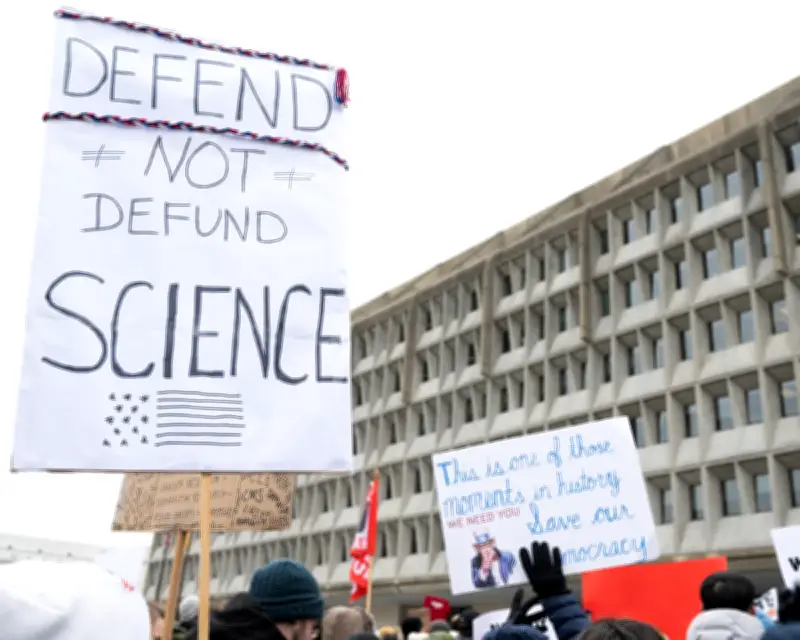
New Trump administration rules would undermine longstanding research practices, making federally funded scientific research increasingly onerous, according to Daniel Malinsky, an assistant professor of biostatistics at Columbia University. In an opinion piece, he argues the goal appears to be to make scientists give up on the endeavor, leading to a gradual privatization and destruction of the publicly funded science sector.
Proposed OMB rules target peer review and international collaboration
A set of proposed rules released in May by the Office of Management and Budget (OMB) outlines dozens of changes to the US Code of Federal Regulations governing grants and federal financial assistance. These rules undermine the scientific peer review process that has been in place for decades and codify oversight of award decisions by political appointees. Grants must be evaluated to determine whether they advance the president's policy priorities. The proposed rules also prohibit the use of funds to support bilateral or multilateral collaborations with covered foreign countries or entities, which could create formidable obstacles to collaborations between US and Chinese scientists on projects related to cancer, environmental health, or new technologies.
Professional associations voice strong opposition
Professional scientific associations, including the American Astronomical Society, state plainly that the proposed rule, if passed in its current form, would enact policies causing significant harm to the scientific community, research institutions, and professional societies. They urge scientists and the public to submit comments on the OMB proposal by the July 14 deadline.
Uncertainty undermines junior researchers
Reducing the number, size, or scope of available funding opportunities damages the scientific ecosystem. Creating uncertainty about the availability or timing of funding undermines the ability of junior researchers to develop careers in science. Without the ability to plan over long time horizons, junior researchers are nudged towards leaving science or leaving the US.
Redirecting funds to private tech companies
There are signs that private tech companies are envisioned as replacements for academic research labs. Science magazine reports that the National Science Foundation (NSF) is cutting budgets for basic science research programs and redirecting money to a new $1.5 billion initiative called X-Labs, meant to support the creation of new products and technologies by looking outside traditional institutions. The suggestive name and language point strongly toward the involvement of private companies and a move away from universities and basic science research organizations. Malinsky warns that private tech companies are motivated by profit, not by advancing knowledge or improving public health, and that redirecting scarce research resources to companies will lead to research divorced from the public good.
Call to action: oppose the gradual degeneration of science
Malinsky urges the public to contribute comments opposing the new OMB rules and to contact elected officials to fight these moves in Congress. He emphasizes that to prevent the death of US science by a thousand cuts, all must be vigilant to seemingly boring or bureaucratic changes that the Trump administration aims to impose on funding and oversight of science to advance its anti-science agenda.