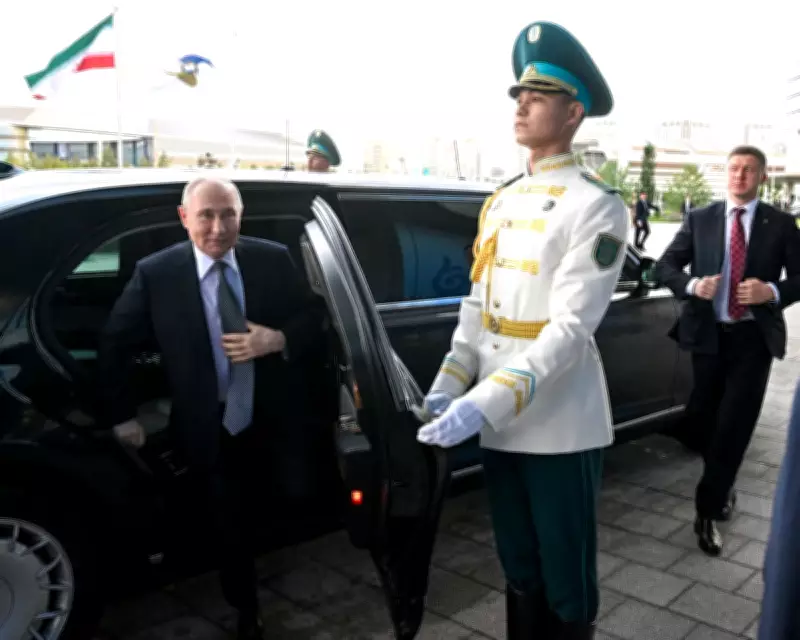
Vladimir Putin should be worried. Not since the trials of the Nazis at Nuremberg and the Japanese war criminals in Tokyo have so many world leaders made common cause to bring to justice the perpetrators of crimes that have brought terror, death and misery to defenceless millions.
Historic Agreement
The decision to prosecute Putin’s cabal for the crime of aggression, reached this month after an agreement between the Council of Europe and the European Union, is historic and offers hope in an age of chaos and fracture. This special tribunal is a mechanism of practical intent but, more than that, it is a statement: that there will never again be any hiding place for those guilty of war atrocities and the needless destruction of civilian life.
It will target those in the president’s inner circle – the generals, bureaucrats and functionaries – who have planned Russian aggression in Ukraine. Justice might have been delayed for the four years since Ukraine was invaded, but it is no longer being denied. And now the Russian war machine has to explain its culpability for the first war started by a major power in Europe since 1945, and its responsibility, as the Center for Strategic and International Studies (CSIS) has estimated, for the deaths of up to 100,000 Ukrainian soldiers. In April 2026 alone, more than 1,600 Ukrainian civilians were killed or maimed. Schools, hospitals and other civic amenities worth half a trillion dollars have been wilfully destroyed. The Putin circle has also to explain why politicians and generals have been prepared to sacrifice almost half a million of their own troops, according to some estimates. And, unlike Putin himself, the cabal can be tried while in office and in absentia.
Rules-Based Retribution
At the heart of this is rules-based retribution. While the crime of aggression applies to all those who plan, initiate, influence or shape a war, an extremely high evidentiary standard of proof must nevertheless demonstrate the culpability of the individual on trial. The special tribunal for the crime of aggression against Ukraine, being organised within the framework of the Council of Europe, is right now adopting rules of procedure and electing experienced judges and prosecutors, all of whom will scrutinise the bombing of civilian targets and the indiscriminate killing of the innocent.
It has been long coming, and is the culmination of years of pressure led initially by Philippe Sands and a group of prominent international lawyers, supported by Ukraine’s president, Volodymyr Zelenskyy, and now by many governments.
Progress and ICC Actions
Things are moving apace. Already the international criminal court (ICC) has issued arrest warrants for Putin and Maria Lvova-Belova, Russia’s commissioner for children’s rights, for their roles in the unlawful deportations of thousands of children from occupied areas of Ukraine into Russia. Judges have also issued arrest warrants for the former defence minister Sergei Shoigu and for Valery Gerasimov, the chief of the general staff of the Russian armed forces, who has masterminded the bombardment of Ukraine’s infrastructure, leaving cities devastated and millions without electricity.
But a Nuremberg-style tribunal is necessary because, despite having jurisdiction over possible war atrocities, crimes against humanity and genocide committed on Ukraine’s territory, the ICC cannot prosecute Russia’s political and military leaders for the crime of aggression. This is because Russia is not a party to the Rome statute, which established the ICC, and because Russia’s power of veto at the UN will always prevent the security council from referring the matter to the court.
Historical Precedent
That leaves only the mechanism of a special tribunal, the precedent for which goes back 85 years to the 1941 declaration of St James’s Palace, or the “London declaration”, in which a group of countries agreed that there would be no safe haven for those guilty of aggression. The same principle that was applied to the Nazis then now justifies the prosecution of Putin’s foundational crimes: namely, a conspiracy to plan, prepare and execute the invasion, occupation and the attempted annexation of Ukraine, starting with the invasion of Crimea in 2014. The parallel with Nuremberg exists because that tribunal had jurisdiction over crimes against peace or aggression, war crimes and crimes against humanity, and about 80 of the arguments during that process related to aggression.
Council of Europe's Role
Prosecuting the Kremlin cabal in this way falls squarely within the mission of the Council of Europe, which was founded in the aftermath of the second world war, when much of the continent lay in ruins. Its goal of upholding the rule of law and human rights makes it an ideal instigator of this criminal process. But more importantly, its endorsement of the process sends an unmistakeable message that a rules-based system is still the best way to create a more stable and peaceful world.
The level of determination is not in doubt. “Unpunished crimes only encourage future atrocities,” notes Kaja Kallas, the EU’s high representative for foreign affairs. Michael McGrath, the EU commissioner for democracy, justice and the rule of law, says this is a moment. “There can be no durable peace without justice, and no justice without accountability … we move one step closer to turning principles into action.”
Global Implications
The need for strong, principled, coordinated action is undeniable. Indeed, this tribunal’s very existence demonstrates that despite the many breaches of international rules, from Gaza, Iran and Sudan to the Democratic Republic of the Congo and Myanmar, we are not yet in a world without rules and without laws. Indeed, a record number of 23 cases are being brought before the international court of justice, and almost 100 countries are today supporting a new UN convention on the prevention and punishment of crimes against humanity.
The stakes are incredibly high. The rule of law has been and is being undermined on the one hand by rising authoritarianism that rejects traditional norms guaranteeing human rights, and on the other by the international institutions that have failed to address the transnational challenges no state can solve on its own.
And that’s why the fate of Putin, but more immediately, his murderous cabal, is crucial: for if the tribunal succeeds in holding them to account, we will once again be upholding the basic requirements of international law and the crucial understanding that to flout it has real and disastrous consequences. Let the tyrant and his acolytes know they will never again be able to commit such atrocities: that they will be pursued to the ends of the Earth.